TheJakartaPost
Please Update your browser
Your browser is out of date, and may not be compatible with our website. A list of the most popular web browsers can be found below.
Just click on the icons to get to the download page.


Popular Reads
Top Results
No results found. Please check your search term and try again
Can't find what you're looking for?
View all search results
Popular Reads
Top Results
No results found. Please check your search term and try again
Can't find what you're looking for?
View all search resultsFive centuries of Jakarta: Building a 'bleisure' bridge to global city status
The city could target high-value spenders who might attend a morning conference in Sudirman but demand a world-class culinary adventure in South Jakarta at night.
Change text size
Gift Premium Articles
to Anyone
Share the best of The Jakarta Post with friends, family, or colleagues. As a subscriber, you can gift 3 to 5 articles each month that anyone can read—no subscription needed!
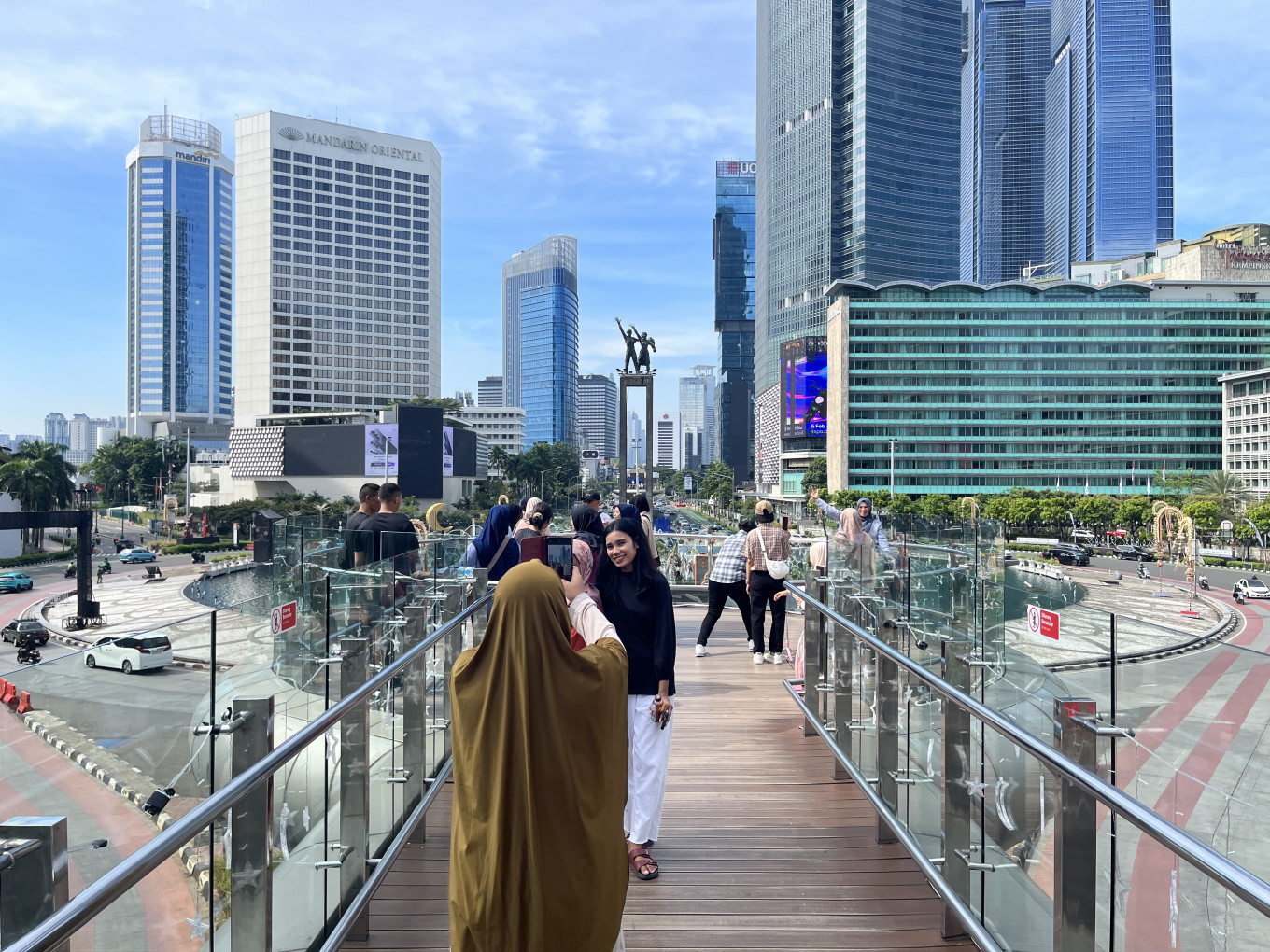 Visitors prepare to take selfies at the Transjakarta bus stop pavilion at the Hotel Indonesia traffic circle amid light traffic during the Idul Fitri holiday in Jakarta on March 23, 2026. (JP/Iqro Rinaldi)
J
akarta stands at an important crossroads as it approaches its 500th anniversary next year. The city’s identity is transitioning from an administrative center to a global commercial hub. Capturing a larger share of the US$15 trillion global leisure market as part of this transition is no longer optional, it is an economic imperative.
While recent economic headwinds present unwelcome financial pressures, a deeper look reveals a resilient appetite for travel. The business and leisure (bleisure) market acts as a critical economic stabilizer.
As noted in a recent Boston Consulting Group (BCG) study, “Unpacking the $15 Trillion Opportunity in Leisure Travel”, the global leisure market is increasingly driven by experience-led urban themes, areas that Jakarta is prioritizing through the strategy of its city administration. These trends are increasingly shaping how travelers make decisions, and how they choose to spend.
Resilience of the experience economy
Despite tighter household budgets, modern Indonesian consumers continue to spend. They are simply spending smarter, prioritizing experiences and memories over material goods.
The economic impact of this strategy is already evident. Targeted urban programming has proven effective at capturing domestic spend, evidenced by the Rp 15.25 trillion (US$890 million) generated during the “Jakarta Festive Wonders” event in March. The next strategic phase involves translating the success of these temporary events into sustained, year-round commercial ecosystems.

Jakarta is rolling out extensive urban initiatives to enhance this appeal. This includes transforming 153 traditional markets into modern, hybrid cultural spaces. The city has also developed a night-time economy with extended opening hours and after-dark activities, providing another avenue to capture spending while supporting the bleisure lifestyle.
The value of this market is clear. The BCG report reveals Indonesia leads the world in mixed travel. A significant 85 percent of Indonesian respondents plan to combine business trips with leisure time next year. This participation rate is double that of mature markets like the United States or the United Kingdom. For visitors, a work trip is not just about meetings. It is an opportunity to experience a city and its offerings within a single trip.
Reaping the demographic dividend
The archetype of “uncompromising traveler” drives this important trend, a group that makes up 30 percent of the market. These travelers, largely millennials and Gen Z, refuse to sacrifice comfort. They are willing to pay for quality.
As Jakarta prepares for its 500th year, the city could target these high-value spenders. They might attend a morning conference in Sudirman, but demand a world-class culinary adventure in South Jakarta by night. The strategic goal should be to capture this spending locally, preventing it from leaking to regional competitors like Singapore or Thailand.
Providing seamless experiences that appeal to these high-spend groups requires coordinated planning across multiple stakeholders. The city administration plays a critical role as the orchestrator, alongside a wide group of public and private stakeholders.
The reality is these travelers seek well-curated and meaningful experiences without sacrificing convenience.
Against this backdrop, Jakarta’s current urban layout presents a structural barrier to capturing high-yield bleisure spend. The fragmentation between commercial districts and heritage sites, compounded by inconsistent last-mile mobility, creates friction for the uncompromising traveler. Overcoming this requires shifting from isolated tourist attractions to integrated urban corridors.
Placemaking as a strategic enabler
Jakarta has made important steps to address this need, with the city heavily investing in placemaking. The strategy involves a shift toward integrated, multi-use urban environments that move beyond traditional tourist zones. Jakarta is transforming as it embraces its global city role.
This approach goes beyond beautification. It focuses on designing human-scale, walkable environments. It activates ground floors and programs regular cultural events to keep spaces dynamic.
Placemaking is now increasingly integrated with public transportation. The city is connecting transit nodes with public plazas to form transit-oriented developments. Examples such as Blok M and Dukuh Atas illustrate progress in designing destinations that blend mobility with public engagement and support local creative communities.
Jakarta’s competitive advantage lies in its contrast. World-class retail destinations such as Grand Indonesia and Plaza Indonesia coexist with traditional street markets. Shopping and dining drive nearly 30 percent of visitor spending in these modern centers. Meanwhile, historic neighborhoods provide a distinctive experience that can attract travelers globally.
The Blok M renaissance exemplifies this shift. Once just a bus terminal, it has transformed into a cultural hub with vinyl shops and artisan coffee. Markets like Pasar Baru and Tanah Abang offer similar propositions, acting as cultural windows into Southeast Asian trade history.
Jakarta’s appeal also lies in its cultural landscape. For instance, Istiqlal Mosque stands directly across from the neo-Gothic Jakarta Cathedral, connected by the fittingly named Tunnel of Friendship. Along with the historic temples of Glodok, these sites reinforce the city’s identity as an urban destination where multiculturalism is prevalent.
Projects such as the Kota Tua Jakarta revitalization plan echo this narrative. Propelled by the development of MRT Phase 2A, the plan focuses on the adaptive reuse of heritage buildings. By connecting Kota Tua and Glodok into a seamless heritage-cultural district, Jakarta can transform historical preservation into an immersive experience.
Momentum for next five centuries
Next year’s 500th anniversary provides a timely opportunity to build on this momentum. Under the new status of the Special Region of Jakarta, the city can focus on its economic competitiveness.
But positioning Jakarta as a gateway to Indonesia, rather than merely a transit point to competing destinations, will require strengthening the integration between business infrastructure and leisure offerings.
Key to realizing this vision is collaboration across government, business and communities. The partnership between InJourney and Telkom Indonesia exemplifies this, where tourism information is digitized to support travelers who use digital planning tools. This is an example of a collaboration that ensures the city builds connected destinations, not just hotels.
Converting the bleisure opportunity into value
Current financial pressures highlight the need to diversify revenue streams. Tourism, specifically the high-yield bleisure sector, offers a strategic answer.
As Jakarta looks toward its 500th anniversary, its economic proposition is evolving beyond its traditional role as simply a business hub toward a more integrated commercial and cultural destination. However, addressing current disconnects and fragmented experiences is critical.
While infrastructure continues to improve, and the city’s reputation grows on the global stage, the challenge to overcome is curating the city’s various attractions into a seamless, high-value experience for the uncompromising traveler.
Fulfilling Jakarta's potential as a premier bleisure destination requires a coordinated approach across three strategic pillars: Expanding transit-oriented placemaking, accelerating the adaptive reuse of heritage assets and fostering public-private data integration to streamline the end-to-end visitor journey.
Ultimately, Jakarta’s 500th anniversary can serve as a catalyst for a new economic era. By transforming isolated attractions into integrated urban ecosystems that fuse business with cultural heritage, the city can secure its position as a leading global bleisure hub.
*****
Lenita Tobing is managing director and senior partner at Boston Consulting Group, while Atika Nur Rahmania is the head of Jakarta’s Development Planning Board (Bappeda). Special thanks to Suharini Eliawati, the undersecretary for economic and financial affairs at the Jakarta city administration, who also heads the “5 Centuries of Jakarta” committee.