The Jakarta Post
Please Update your browser
Your browser is out of date, and may not be compatible with our website. A list of the most popular web browsers can be found below.
Just click on the icons to get to the download page.


Popular Reads
Top Results
No results found. Please check your search term and try again
Can't find what you're looking for?
View all search results
Popular Reads
Top Results
No results found. Please check your search term and try again
Can't find what you're looking for?
View all search resultsRupiah, BI rate and the illusion of stability
Defending the rupiah with high interest rates and short-term "hot money" buys immediate stability, but it leaves the real economy resting on a fragile foundation.
Change text size
Gift Premium Articles
to Anyone
Share the best of The Jakarta Post with friends, family, or colleagues. As a subscriber, you can gift 3 to 5 articles each month that anyone can read—no subscription needed!
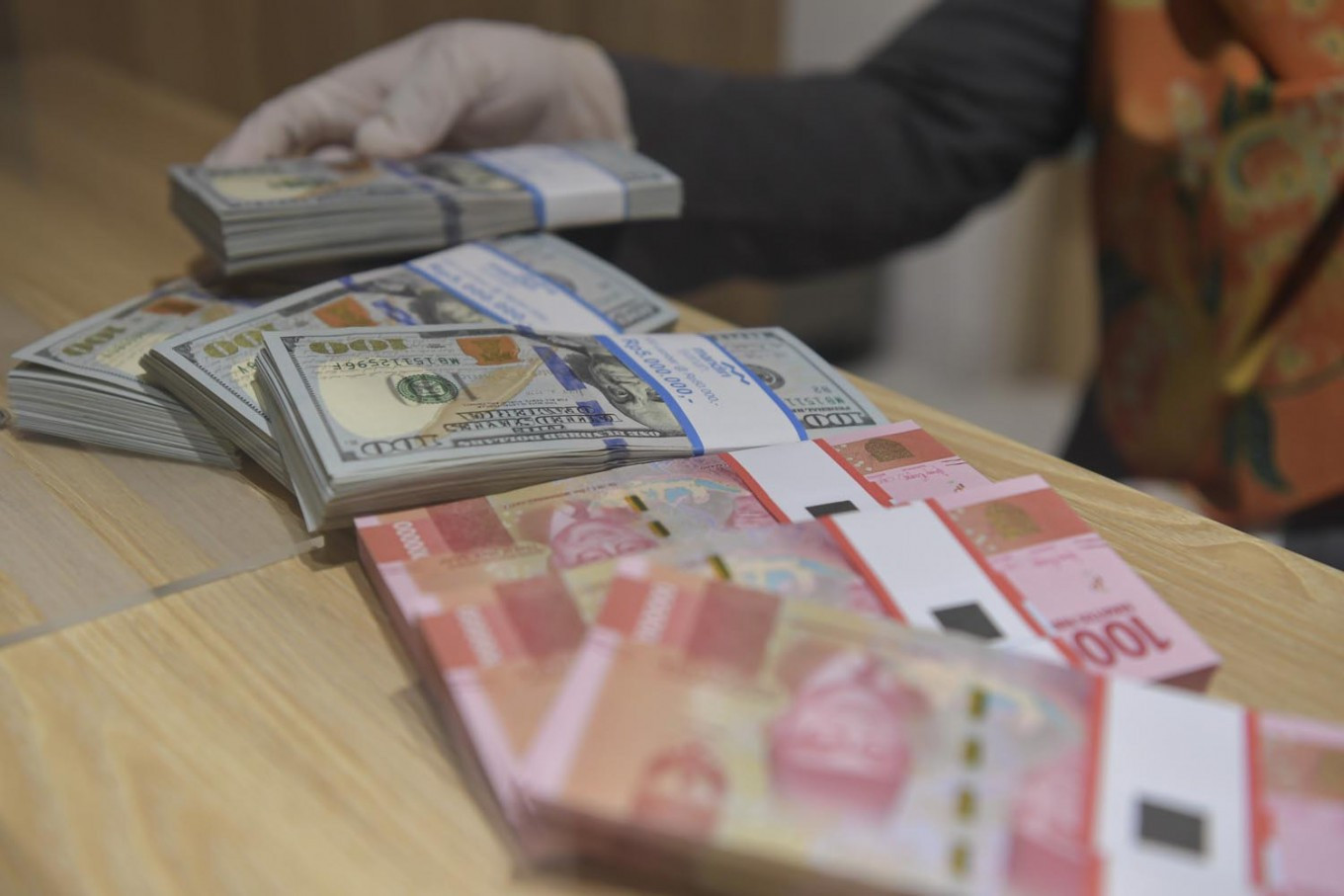 An employee shows rupiah and United States dollar bank notes at Bank Mandiri Syariah, Jakarta, in this file photo. (Antara/Nova Wahyudi)
O
n May 20, Bank Indonesia (BI) announced something few people expected: the BI rate was raised by 50 basis points (bps) to 5.25 percent, double the market consensus, which had projected a modest 25 bps increase.
The market responded immediately: the Indonesia Stock Exchange (IDX) Composite index closed down 0.82 percent, slumping to 6,318. Interest rates rose more aggressively than anticipated, yet the stock market remained sluggish. There is an important message hidden within this small contradiction.
The policy decision was not a routine move; it was an emergency signal delivered in polite language. When the central bank must act twice as fast as market expectations to defend a rupiah that has already breached the 17,500 to the United States dollar mark, it means the pressure can no longer be managed with standard measures.
The defensive mechanism is clear. BI’s liquidity instruments (SRBI) now yield between 6.21 and 6.45 percent across various tenors. Attracted by these rates, net foreign portfolio inflows for the second quarter surpassed Rp 93.5 trillion (US$5.5 billion) as of May 18. While that figure sounds encouraging, we must ask an honest question: What kind of capital is actually coming in?
Because the SRBI are short-term instruments, capital flowing through this channel can exit just as quickly as it arrived the moment returns elsewhere become more attractive or geopolitical tensions flare. Economists call this "hot money", capital that warms the balance of payments today but builds no structural foundation for tomorrow. Our foreign exchange reserves stood at $146.2 billion as of April, enough to cover 5.8 months of imports and well above international safety standards. However, their steady downward trend over recent months serves as a blunt reminder that our ammunition is not unlimited.
This is where the deeper dilemma lies. A high-interest-rate policy operates on a single logic, attracting foreign capital to stabilize the currency. But that stability comes at a steep domestic cost. Bank lending rates, already hovering around 8.76 percent, will not drop anytime soon.

The business sector, especially small and medium enterprises borrowing working capital, must now bear a heavier interest burden. Combined with corporate layoffs that have surpassed 15,000 people in recent months, the central bank is forced to choose between two distinct kinds of pain: allowing the rupiah to weaken further, or maintaining high interest rates that squeeze the real economy.