TheJakartaPost
Please Update your browser
Your browser is out of date, and may not be compatible with our website. A list of the most popular web browsers can be found below.
Just click on the icons to get to the download page.


Popular Reads
Top Results
No results found. Please check your search term and try again
Can't find what you're looking for?
View all search results
Popular Reads
Top Results
No results found. Please check your search term and try again
Can't find what you're looking for?
View all search resultsEnergizing Indonesia’s rise as an AI contender
Agentic AI are execution models involving autonomous agents that coordinate across workflows, tools and systems with minimal human input.
Change text size
Gift Premium Articles
to Anyone
Share the best of The Jakarta Post with friends, family, or colleagues. As a subscriber, you can gift 3 to 5 articles each month that anyone can read—no subscription needed!
 A message reading “AI artificial intelligence,“ a keyboard and robot hands are seen in this illustration created on Jan. 27, 2025. (Reuters/Dado Ruvic)
I
ndonesia is poised at an era of growth in the global artificial intelligence race. After the surge of generative AI, a new wave is emerging in the form of agentic AI.
Agentic AI are execution models involving autonomous agents that coordinate across workflows, tools and systems with minimal human input. While it stops short of true autonomous decision-making, agentic AI’s ability to make decisions within predefined parameters is a game changer.
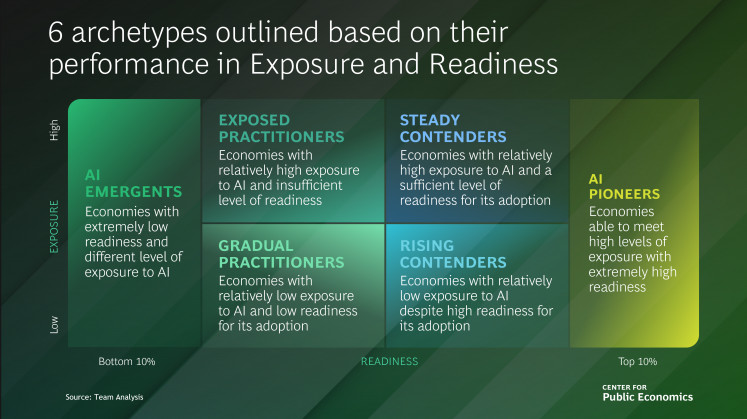
According to BCG’s AI Maturity Matrix, which benchmarks 73 economies globally on AI exposure and readiness, Indonesia is classified as a ‘rising contender’. This reflects the nation’s position as an economy with relatively low exposure to AI currently, but high readiness for adoption.
Historically, Indonesia has demonstrated its ability to leapfrog digitally, for example, advancing from wireline to wireless and fostering an ecosystem that produced numerous homegrown unicorns. That proven capacity for innovation speaks to the nation’s potential in leaping forward again with AI.
Geopolitical reality of an evolving AI landscape

As AI becomes critical national infrastructure, geopolitical shifts, compute access and sovereign capability increasingly determine economic outcomes and geopolitical influence.
The US and China lead the global AI race. Tech companies from these two superpowers created 59 percent and 26 percent, respectively, of top-performing large language models (LLMs).
This presents a conundrum for competing nations. Relying solely on external technology providers poses challenges for corporate leaders and governments, especially since local regulations, data requirements and model availability are subject to shifting policies.
Against this backdrop, a small group of ‘GenAI middle powers’ is emerging across Europe, Asia and the Middle East. Each has distinct strengths to compete as a regional or global technology supplier. This race now expands beyond software to encompass hardware, infrastructure and technology adoption.
Indonesia will need to build its domestic AI capabilities to mitigate technology sovereignty risks as agentic AI evolves. Execution speed and scale will dictate whether Indonesia rises to a leading position in ASEAN, or falls behind.
To provide a strategic outline for Indonesia’s AI future, the Communications and Digital Ministry developed its White Paper on the National Artificial Intelligence Roadmap and the Concept for Artificial Intelligence Ethics Guidelines, which were released for public consultation in August 2025, and currently pending final sign off. The roadmap draft has identified seven key elements to address, which are ethics, policy and governance, infrastructure and data, research and industrial innovation, talent development, investment and funding, as well as use cases.
With regards to use cases, ten priority sectors will be targeted, spanning food security; healthcare; education; economy and finance; bureaucratic reform; politics, law and security; energy; natural resources and environment; housing, transportation, logistics and infrastructure; as well as arts, culture and creative economy. These align with the nation’s development goals and digital transformation priorities, as set out in Indonesia’s RPJPN 2025-2045, RPJMN 2025-2029 and the Asta Cita.
With the delivery of momentum being critical, eight ‘Quick Win’ use cases have been determined to drive innovation across several priority sectors over the next few years.
Achieving these AI aspirations, however, may require a few key challenges to be addressed first, such as the nation’s uneven digital infrastructure. Also essential would be a robust data ecosystem, and a sharper focus on talent development through education, training and upskilling.
Agentic AI: A powerful productivity multiplier
Globally, early signs indicate the rise of agentic AI will be rapid. BCG’s Build for the Future 2025 study shows that agentic AI’s share of AI-driven value is expected to nearly double from 17 percent in 2025 to 29 percent by 2028.
Leading companies are moving beyond experimentation, one-third of ‘AI future-built’ firms have deployed agentic solutions and are demonstrating measurable value.
BCG’s study shows that while companies are exploring agentic AI across operations, support functions and innovation, customer experience is emerging as their top priority.
Leading use cases include deploying intelligent agents to autonomously handle Level 1 and Level 2 customer support, as well as optimizing digital marketing campaigns, continuously adjusting bids to maximize returns, reallocating spend to high-performing channels and testing creatives in real time.
AI represents a powerful productivity multiplier for Indonesia. It can strengthen key economic sectors such as manufacturing, digital services and other industries. For small and medium-sized enterprises (SMEs), agentic AI can lower the cost of sophistication, providing access to capabilities once reserved for large enterprises.
Beyond the private sector, agentic AI can modernize public services and improve policymaking decisions in healthcare, education and justice. It can help bridge urban-rural divides by expanding access to digital services and decision support.
In a nation balancing growth ambitions with socioeconomic constraints, agentic AI is not merely a technology upgrade. It is a lever for sustainable and inclusive growth.
Four strategic priorities for Indonesia
To compete effectively in this next phase of AI, Indonesia will have to act with clarity and intent across four priorities.
Build sovereign AI capabilities. Indonesia could expand reliable access to compute, building on nascent data center foundations to serve Indonesia’s major tech-focused companies. A pragmatic and technology-neutral approach that combines global technology partnerships with targeted domestic capability-building will be more effective than pursuing full-stack independence.
Technology partnerships could focus on leveraging leading AI innovations from both Western and Eastern ecosystems in a neutral manner. Open-source AI models offer a practical pathway to reduce dependency risks and support local customization. Efforts could also focus on enabling responsible use of high-quality local datasets.
Invest in talent. Indonesia will need to pair global talent attraction with sustained local capability development to build its AI workforce. It could attract top global AI talent through competitive incentives, strong research ecosystems and vibrant innovation hubs, while simultaneously building a deep domestic pipeline of AI talent.
Scale national platforms. Indonesia will need to move from fragmented pilots to scaled national platforms, anchored on high-impact use cases. These platforms can offer a common foundation to embed AI agents that deliver personalized public services. Doing so could catalyze greater private-sector participation and ensure sustainable adoption of agentic AI.
The launch of INA Digital provided an early step to unify Indonesia’s fragmented government services. Championing this approach to unified digital infrastructure offers a path for Indonesia to replicate the success of regional peers, such as the integrated nature of Singapore’s digital ID platform Singpass.
Encouragingly, we’re already seeing examples of AI at scale, with organizations like Telkom embedding AI solutions into their digital transformation efforts and Pertamina’s Digital Factory deploying AI to optimize operations.
Implement pro-innovation regulation. To protect users while preserving competition, policymakers could favor a flexible model over rigid frameworks, particularly in a fast-evolving landscape.
Indonesia could maintain a balanced approach, combining principle-based guidelines, regulatory sandboxes and sector-specific standards that can evolve alongside the technology.
Priming Indonesia for growth is critical, and the nation could differentiate itself by championing ethical, inclusive AI. This is a core foundation and should align with national values, ensuring that trust and confidence underpin the adoption of agentic AI.
Defining the future
The stakes are clear. AI investment compounds rapidly. Early movers attract capital, talent and vibrant ecosystems.
The choice is not whether AI will reshape the Indonesian economy, but whether Indonesia can shape that transformation with speed, clarity, and ambition to accelerate adoption and catalyze growth.
*****
Ching-Fong (CF) Ong and Davids Tjhin are managing directors and senior partners at Boston Consulting Group (BCG).