TheJakartaPost
Please Update your browser
Your browser is out of date, and may not be compatible with our website. A list of the most popular web browsers can be found below.
Just click on the icons to get to the download page.


Popular Reads
Top Results
No results found. Please check your search term and try again
Can't find what you're looking for?
View all search results
Popular Reads
Top Results
No results found. Please check your search term and try again
Can't find what you're looking for?
View all search resultsBeyond tropical: How Indonesian design is evolving today
Today’s practitioners are responding to a shifting design discourse, shaped by a fast-moving industry, environmental urgency and new ways audiences encounter design and space.
Change text size
Gift Premium Articles
to Anyone
Share the best of The Jakarta Post with friends, family, or colleagues. As a subscriber, you can gift 3 to 5 articles each month that anyone can read—no subscription needed!
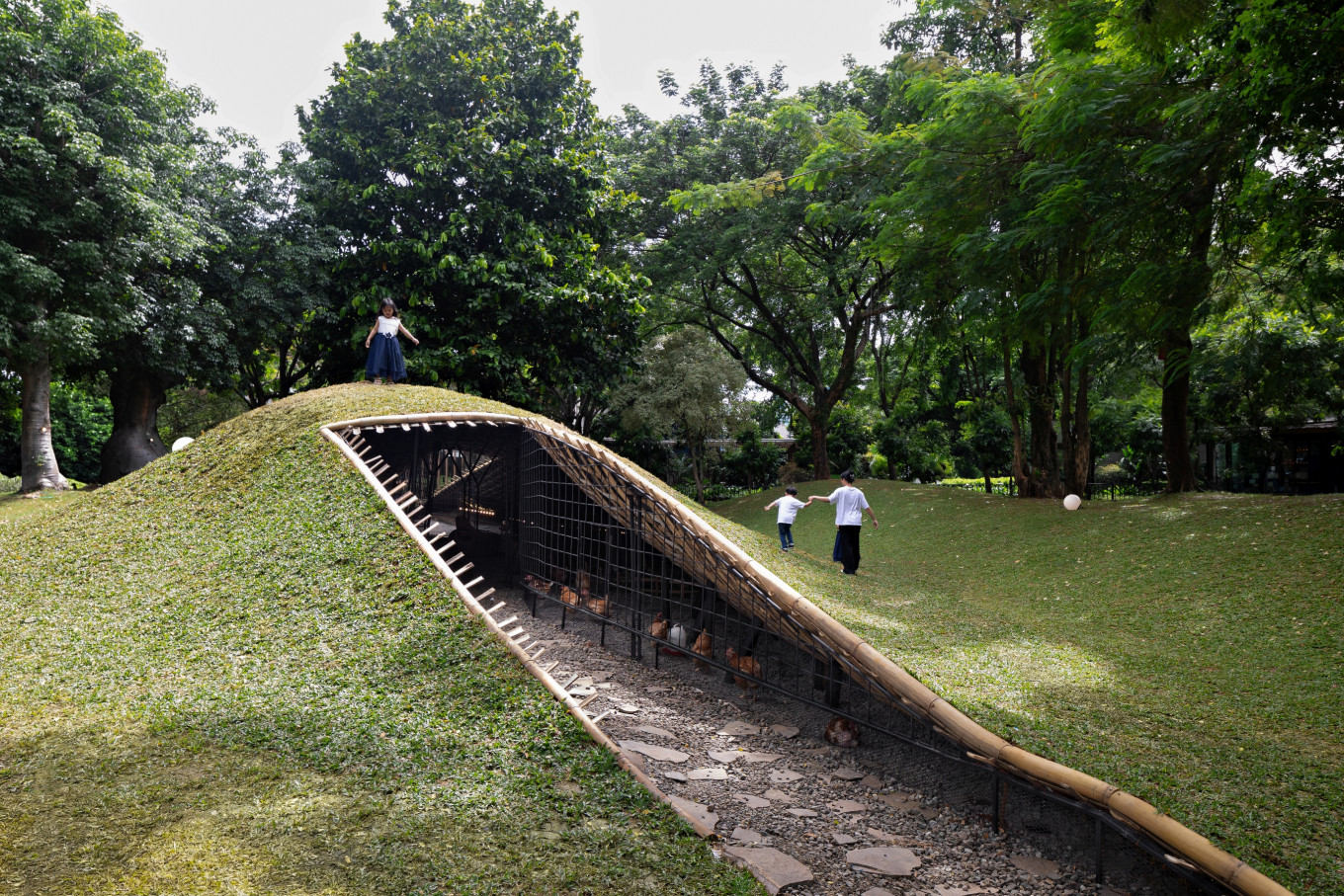 Urban farming reimagined: Chicken Hero Pavilion, a self-initiated project by RAD+ar, rises as a hilly structure in Urban Forest, South Jakarta, exploring backyard poultry farming as a design response to food waste and urban resilience. (Mario Wibowo/-)
C
lients often approach Antonius Richard, founder of Jakarta-based architecture studio RAD+ar, to design “sustainable” establishments. He would respond back with a simple question: “What do you think about sustainability?” More often than not, the exchange reveals a gap between the ambition and a clear understanding of what that entails.
Established in 2017, RAD+ar (Research Artistic Design + architecture) is a firm known for its climate-responsive design approach in urban settings. The award-winning studio builds prototypes in real conditions, treating climate, shade, wind, solar orientation and humidity as fundamental design tools, and shares its work as part of a broader creative and research practice.
“We are actively shifting the narrative that sustainability must be expensive because it’s not true,” says Antonius. “When we talk about sustainability, it’s often less about design and more about enforcement; how to be more inclusive, how to be more generous to society.”

One of the studio’s talked-about projects is the Chicken Hero Pavilion. Installed as a temporary installation at Urban Forest in South Jakarta, the hilly structure, built using reclaimed bamboo for its green roof, aimed to address Indonesia’s waste problem through the idea of backyard poultry farming.
“The project went viral,” Antonius recalls. “It wasn’t about a chicken coop. It was about showing developers and policymakers that change can happen in small ways and doesn’t have to look ‘sexy.’ At the same time, visual appeal matters, which is why we presented it aesthetically, to prove a point.”
RAD+ar is part of a new generation of practitioners in Indonesia that are expanding the country’s design identity and narrative beyond established frameworks.
Today, sustainability is no longer treated as an afterthought but as a conscious process embedded from the outset. Material exploration is increasingly tested rather than proposed, while collaborations across disciplines are actively pursued.

More from The Weekender

Show up, show off and call it self-care: Strong is the new flex
With toned arms as the new status symbol, maybe it’s time we rethink why we come to the gym and pick up those dumbbells.

When a friend becomes a stranger: Healing after a platonic breakup
We expect heartbreak in romance, but no one warns us how much it hurts when a friendship falls apart.

The power of small acts: Glimmers of hope from 2025
In a year marked by despair, it was small, human acts that broke through the noise, reminding us that hope doesn’t vanish. It’s passed hand to hand, one person to another.