The Jakarta Post
Please Update your browser
Your browser is out of date, and may not be compatible with our website. A list of the most popular web browsers can be found below.
Just click on the icons to get to the download page.


Popular Reads
Top Results
No results found. Please check your search term and try again
Can't find what you're looking for?
View all search results
Popular Reads
Top Results
No results found. Please check your search term and try again
Can't find what you're looking for?
View all search resultsHome at last: ‘Java Man’ fossils anchor new National Museum exhibit
The return of the Dubois Collection from the Netherlands places Indonesia at the heart of human evolution studies, opening new ground for research and public education.
Change text size
Gift Premium Articles
to Anyone
Share the best of The Jakarta Post with friends, family, or colleagues. As a subscriber, you can gift 3 to 5 articles each month that anyone can read—no subscription needed!
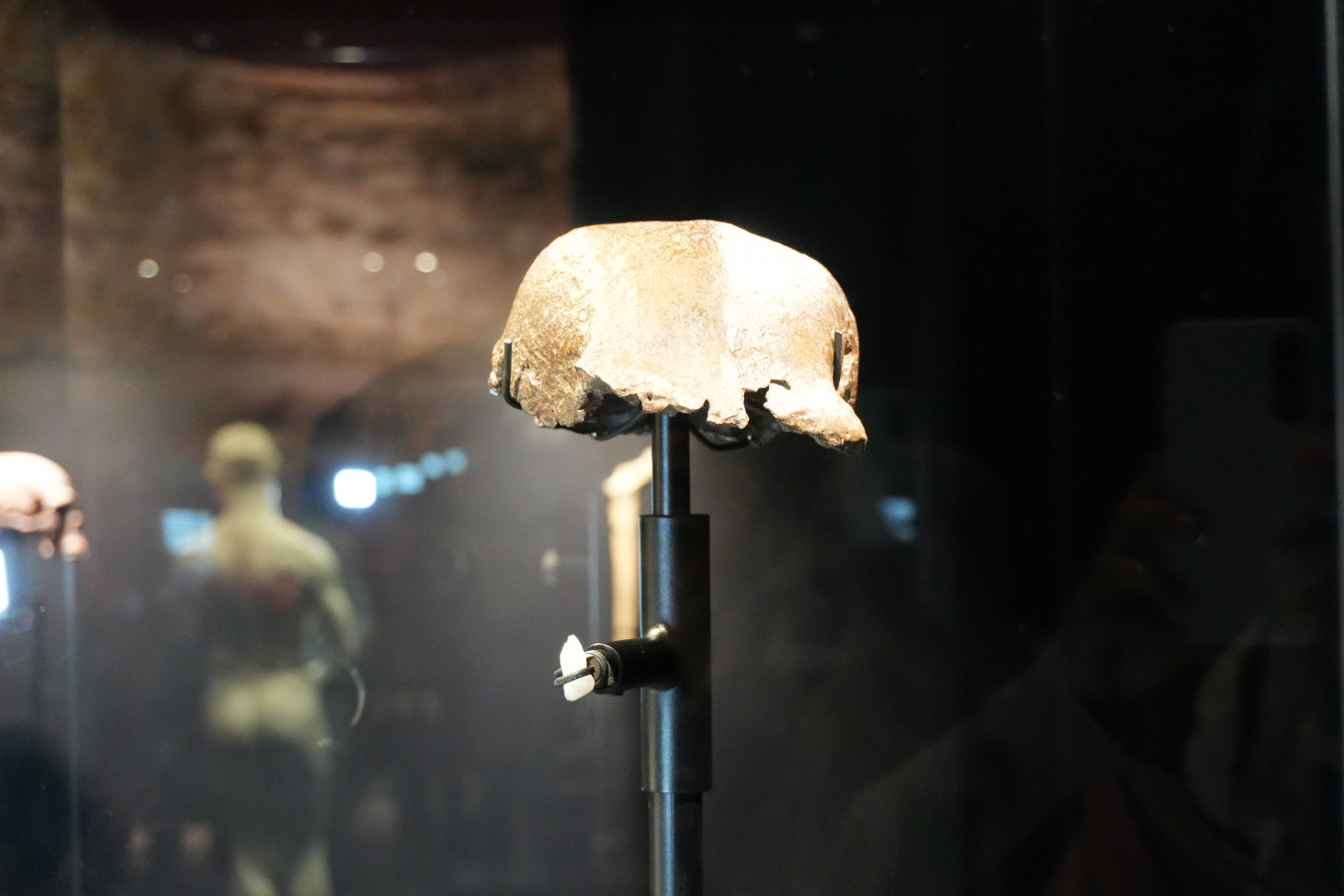 Unearthing origins: An ape-like skullcap discovered by Dutch geologist Eugène Dubois at Trinil in 1891 is displayed on Dec. 17, 2025, at the National Museum of Indonesia in Jakarta. The fossil is part of the permanent Early History exhibition introducing early human discoveries in Indonesia. (Indonesian Heritage Agency/-)
A
skullcap, molar and femur believed to be remains of Homo erectus, or “Java Man,” unearthed by Dutch geologist Eugene Dubois in Java in the 19th century, are on display at the National Museum of Indonesia in Jakarta, introducing the public to one of the most influential discoveries in human evolution studies.
After the first phase of more than 28,000 fossils from the Dubois Collection arrived from the Netherlands last October, the Culture Ministry launched a permanent exhibition, titled Early History, on Dec. 17, 2025.
Presented in chronological order and accompanied by contextual explanations as well as replicas of ancient life, the exhibition highlights Indonesia’s role as a key region in the study of early human origins and migration.

Drawing on estimates that Homo erectus lived between 1.9 million and 150,000 years ago, the exhibition challenges prevailing evolutionary theories suggesting that ancient human civilization emerged only in Africa and Europe.
Culture Minister Fadli Zon said more than 50 percent of the world’s Homo erectus fossil discoveries originate from Indonesia, including finds from Sangiran, Ngandong, Semedo, Bumiayu in Central Java, Trinil in East Java and Rancah in West Java.
“We have contributed one of the richest records of early human discoveries,” Fadli said during the exhibition opening. “[The discoveries] establish Nusantara as a cornerstone of paleoanthropology and a vital reference in the narrative of human evolution.”
The exhibition expands the National Museum’s holdings, which already include more than 195,000 cultural heritage items.



More from The Weekender

A passport to the kingdom of the sick
A breast cancer diagnosis, a journey to the kingdom of the sick and a determination to describe what lies there without metaphor, euphemism or the word “fight.”

The weight of time
Richard Mille’s newest ultralight timepiece pares down haute horlogerie to its mechanical necessities, proving that sophistication often comes from knowing what to leave out.

At this wellness retreat, your poo is everybody’s business
Ayurvedagram promises balance through ancient Ayurvedic practices. For four days, I surrendered my schedule, my modesty and, almost, my digestive tract.