Enjoy This Gifted Article!
You're reading this thanks to a The Jakarta Post subscriber.
Access is available for 30 days. For unlimited access, consider subscribing.
Can't find what you're looking for?
View all search resultsCan't find what you're looking for?

View all search resultsThe return of the Dubois Collection from the Netherlands places Indonesia at the heart of human evolution studies, opening new ground for research and public education.
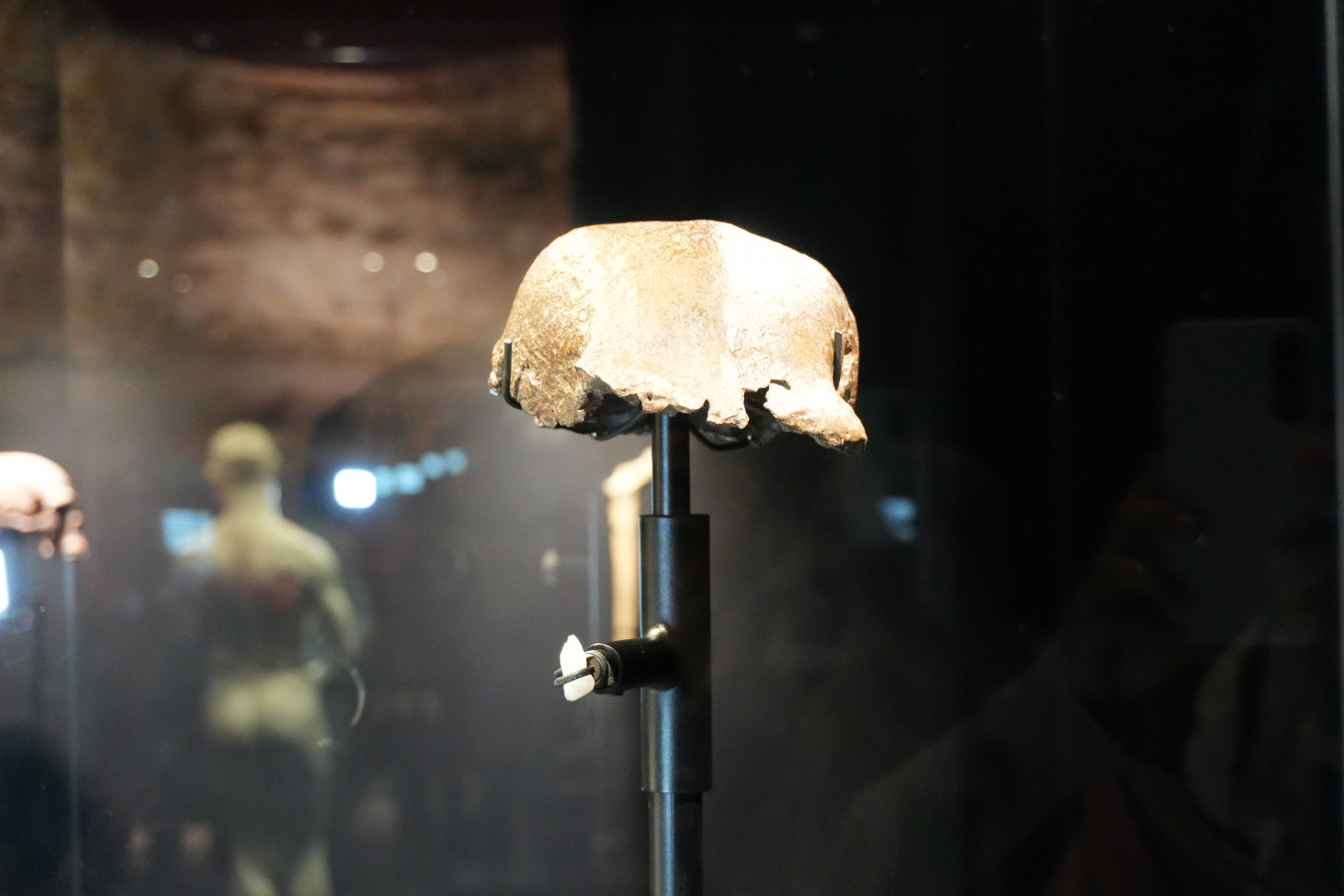
Unearthing origins: An ape-like skullcap discovered by Dutch geologist Eugène Dubois at Trinil in 1891 is displayed on Dec. 17, 2025, at the National Museum of Indonesia in Jakarta. The fossil is part of the permanent Early History exhibition introducing early human discoveries in Indonesia. (Indonesian Heritage Agency/-)
skullcap, molar and femur believed to be remains of Homo erectus, or “Java Man,” unearthed by Dutch geologist Eugene Dubois in Java in the 19th century, are on display at the National Museum of Indonesia in Jakarta, introducing the public to one of the most influential discoveries in human evolution studies.
After the first phase of more than 28,000 fossils from the Dubois Collection arrived from the Netherlands last October, the Culture Ministry launched a permanent exhibition, titled Early History, on Dec. 17, 2025.
Presented in chronological order and accompanied by contextual explanations as well as replicas of ancient life, the exhibition highlights Indonesia’s role as a key region in the study of early human origins and migration.
Drawing on estimates that Homo erectus lived between 1.9 million and 150,000 years ago, the exhibition challenges prevailing evolutionary theories suggesting that ancient human civilization emerged only in Africa and Europe.
Culture Minister Fadli Zon said more than 50 percent of the world’s Homo erectus fossil discoveries originate from Indonesia, including finds from Sangiran, Ngandong, Semedo, Bumiayu in Central Java, Trinil in East Java and Rancah in West Java.
“We have contributed one of the richest records of early human discoveries,” Fadli said during the exhibition opening. “[The discoveries] establish Nusantara as a cornerstone of paleoanthropology and a vital reference in the narrative of human evolution.”
The exhibition expands the National Museum’s holdings, which already include more than 195,000 cultural heritage items.
Marks of early life: Replicas of prehistoric rock wall art are shown as part of the Early History exhibition on Dec. 17, 2025, at the National Museum of Indonesia in Jakarta, providing context for the development of early human life. (Indonesian Heritage Agency/-)Exhibiting global legacy
So far, only four items from the Dubois collection, including Homo erectus remains and an engraved shell, have been publicly displayed in a small, black-walled room in Building A of the museum, according to Ismunandar, chairman of the Expert Panel on the Repatriation of Indonesian Cultural Heritage and a former Indonesian ambassador to the United Nations Educational, Scientific and Cultural Organization (UNESCO).
“The shell is particularly important because it shows that cultural expression already existed in ancient times,” Ismunandar said.
He added that other collections, including fossils from both Java and Sumatra, have yet to be exhibited, as they still require further study to provide context for the general public, while the second wave of the repatriation process will take place this year.
“An exhibition must tell a story. Without context, objects lose their meaning,” he said.
Naturalis Biodiversity Center director general Marcel Beukenboom said the collection, long housed in Leiden and admired by millions of visitors for illustrating the theory of evolution, is now on display in its home country.
“The collection bears witness to an important link in human evolution. It also represents part of Indonesian history and constitutes a cultural heritage,” he said.
History reclaimed: Visitors view the Early History exhibition on Dec. 17, 2025, at the National Museum of Indonesia in Jakarta. The exhibition opened following the return of the Dubois Collection, specimens gathered by Eugène Dubois in the 19th century. (Indonesian Heritage Agency/-)From colonial excavation to repatriation
The return of the collection has closed a long-standing gap that had constrained the development of paleontological research in the country.
The collection was excavated between 1888 and 1900, during Dutch colonial rule. Dubois arrived in Sumatra in December 1887 as a medical officer with the Royal Netherlands East Indies Army (KNIL), but his main intention was to explore the colony in search of the “missing link” between apes and modern humans to support Charles Darwin’s theory of evolution.
After conducting research in Sumatra, Dubois shifted his focus to Java, particularly the Kendeng Mountains in Central Java, following earlier excavations by the Javanese artist and researcher Raden Saleh, and along the banks of the Solo River. He eventually uncovered many important fossils at the Trinil site in 1891 and 1892.
Dubois returned to the Netherlands in 1895 with the fossils, but the research remained unfinished when he died in 1940.
Indonesia has sought the repatriation of the collection excavated from its land since 1951, but the effort only came to fruition following a renewed request in 2022, after an investigation found that Dubois had looted the specimens.
A member of the Netherlands’ Colonial Collections Committee, Remco Raben, said the panel found the collection should never have been in the Netherlands in the first place.
“[The specimens] were taken without permission and involved violence, as forced laborers were used. Indonesian people died in the work,” Raben said.
The repatriation, he added, corrects the injustices of colonialism and restores knowledge, as the long-term absence of the collection from its country of origin had hampered scientific research in Indonesia.
“The inequality of knowledge is also being restored,” he said.
Bonnie Triyana, a member of House of Representatives Commission X overseeing culture and research, and a former member of Indonesia’s repatriation team, said the return of the artifacts should mark the beginning of more serious scientific research into the human past in the archipelago.
“The collection has arrived, so don’t let these historical objects just end up stored in a warehouse, untouched and not generating knowledge,” he said.
Share your experiences, suggestions, and any issues you've encountered on The Jakarta Post. We're here to listen.
Thank you for sharing your thoughts. We appreciate your feedback.
Quickly share this news with your network—keep everyone informed with just a single click!
Share the best of The Jakarta Post with friends, family, or colleagues. As a subscriber, you can gift 3 to 5 articles each month that anyone can read—no subscription needed!
Get the best experience—faster access, exclusive features, and a seamless way to stay updated.