The Jakarta Post
Please Update your browser
Your browser is out of date, and may not be compatible with our website. A list of the most popular web browsers can be found below.
Just click on the icons to get to the download page.


Popular Reads
Top Results
No results found. Please check your search term and try again
Can't find what you're looking for?
View all search results
Popular Reads
Top Results
No results found. Please check your search term and try again
Can't find what you're looking for?
View all search resultsIndonesia and the board of peace: Another unnecessary misstep
It is difficult to understand why Indonesia, which has persistently supported Palestinian independence, is willing to engage in a peace initiative led by an administration whose approach to Gaza and the broader Palestinian question raises serious normative and political concerns.
Change text size
Gift Premium Articles
to Anyone
Share the best of The Jakarta Post with friends, family, or colleagues. As a subscriber, you can gift 3 to 5 articles each month that anyone can read—no subscription needed!
 Set as preferred source
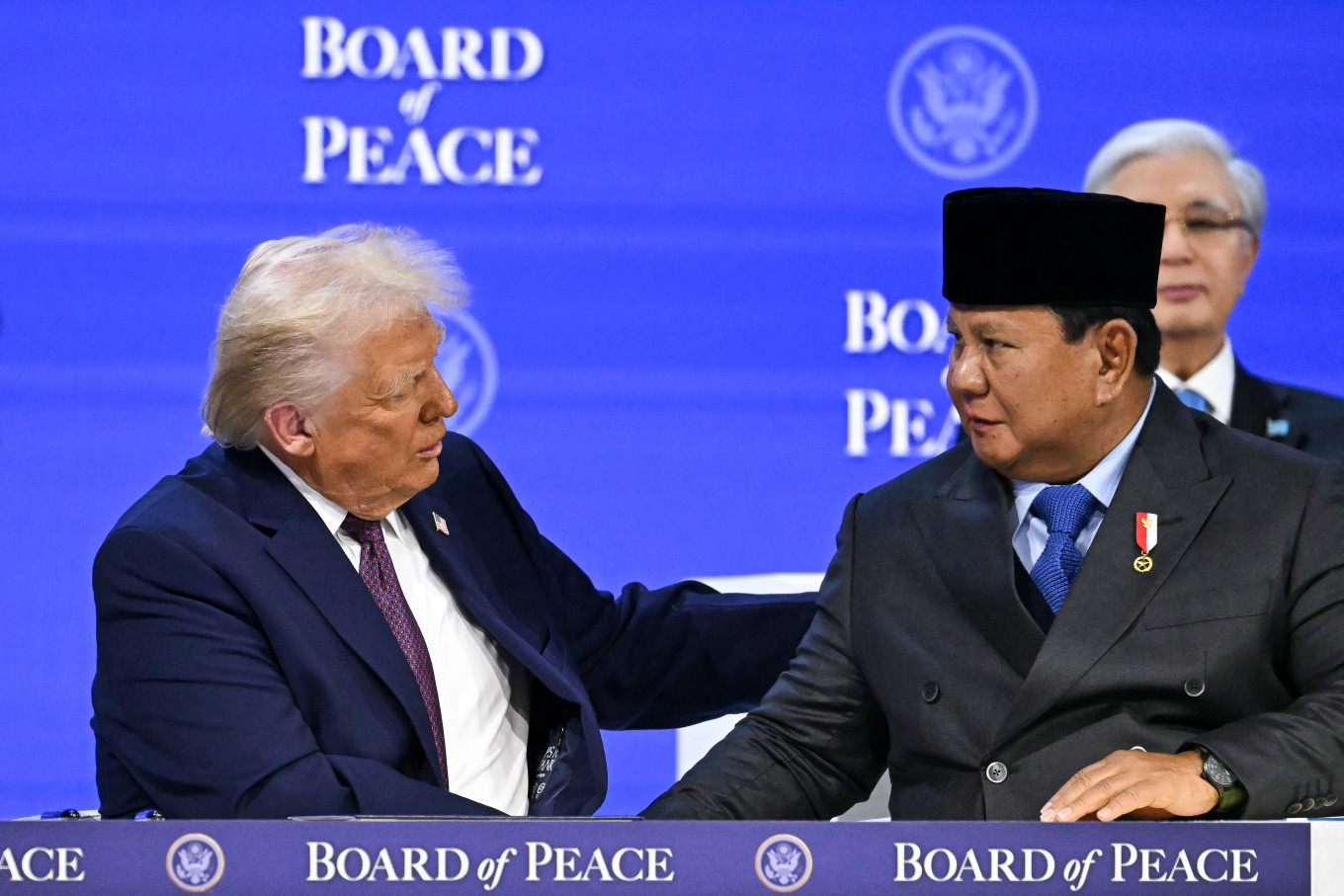 Peace gambit: President Prabowo Subianto (right) shakes hands with United States President Donald Trump on Jan. 22, 2026, at the Board of Peace launch event during the World Economic Forum (WEF) annual meeting in Davos, Switzerland. (AFP/Fabrice Coffrini)
S
hortly after the proposal to deploy 20,000 peacekeepers to Gaza under an International Stabilization Force (ISF), Indonesia has once again taken a surprising step by joining the United States-led Board of Peace.
For a country that has long positioned itself as a staunch supporter of multilateralism, a contributor to international order and security and a consistent champion of Palestinian independence and a two-state solution, this decision carries serious risks. It threatens to place Indonesia at odds with its own ideals and foreign-policy objectives, while raising fundamental questions about the coherence of foreign-policy decision-making in Jakarta.
There are three key points to consider.
First, the Foreign Ministry has argued that Indonesia’s decision is legitimate because it aligns with Jakarta’s commitment to resolving the Israeli-Palestinian conflict, and because the board is presented as part of the Comprehensive Plan to End the Gaza Conflict endorsed by United Nations Security Council Resolution 2803 (2025).
However, a close reading of the Board of Peace Charter reveals a striking omission: nowhere are Gaza or Palestine explicitly mentioned. This raises an obvious question - whether the initiative is genuinely about addressing the situation in Gaza, or whether it reflects Donald Trump’s broader ambition to establish a “mini–UN Security Council” that sidelines and delegitimizes the existing UN system.
Indonesia has consistently framed its support for Palestinian independence not merely as a matter of diplomatic preference, but as a constitutional obligation rooted in international law, anti-colonial solidarity, and the defense of basic human rights. Crucially, this commitment has been advanced through the multilateral UN system.

It is, therefore, difficult to reconcile this long-standing position with Indonesia’s willingness to engage in a peace initiative led by an administration whose approach to Gaza and the broader Palestinian question raises serious normative and political concerns.