The Jakarta Post
Please Update your browser
Your browser is out of date, and may not be compatible with our website. A list of the most popular web browsers can be found below.
Just click on the icons to get to the download page.


Popular Reads
Top Results
No results found. Please check your search term and try again
Can't find what you're looking for?
View all search results
Popular Reads
Top Results
No results found. Please check your search term and try again
Can't find what you're looking for?
View all search resultsMore jobs, less value: Indonesia’s labor efficiency gap
When unemployment declines and employment rises, labor market conditions are commonly perceived as improving. This interpretation is not incorrect, but it remains incomplete.
Change text size
Gift Premium Articles
to Anyone
Share the best of The Jakarta Post with friends, family, or colleagues. As a subscriber, you can gift 3 to 5 articles each month that anyone can read—no subscription needed!
 Set as preferred source
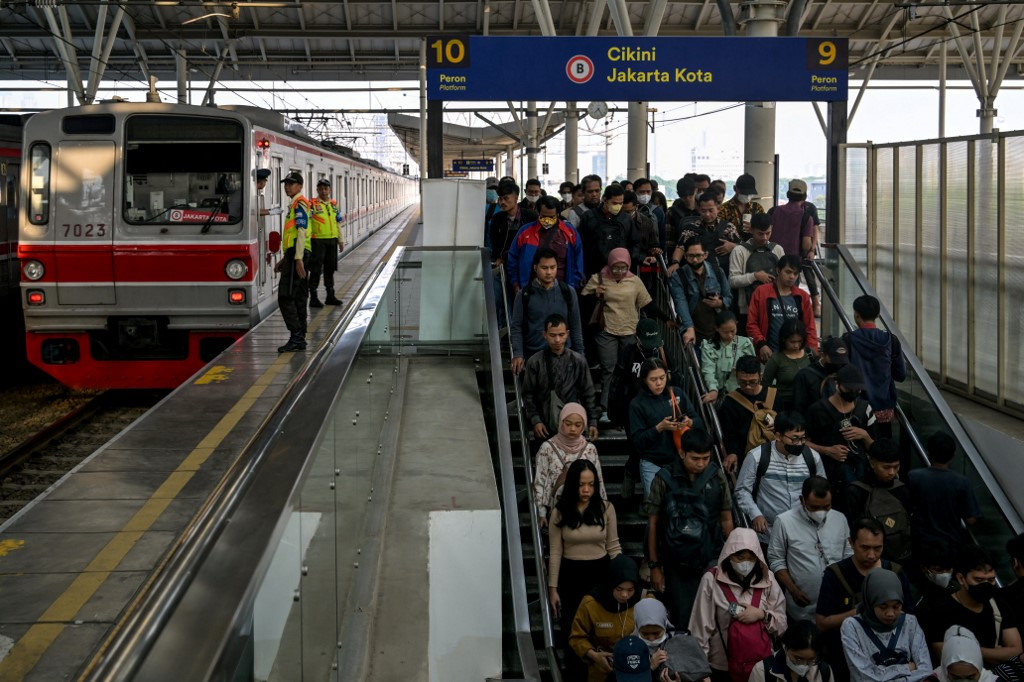 Commuters arriving from the suburbs on a commuter train are seen leaving the Manggarai Station on Nov. 8, 2024, during the morning rush hour in Jakarta. (AFP/Bay Ismoyo)
T
he labor market is often assessed through its most visible indicator: the unemployment rate. When unemployment declines and employment rises, labor market conditions are commonly perceived as improving. This interpretation is not incorrect, but it remains incomplete. Beneath these dynamics lies a more fundamental and frequently overlooked question: how efficiently is labor being utilized within the economy?
Statistics Indonesia (BPS) data indicates that Indonesia’s labor market is relatively active in aggregate terms. In August 2025, the open unemployment rate stood at 4.85 percent, while the number of employed persons continued to increase alongside a growing labor force, which has now reached 154 million people. These figures point to a degree of stability in the labor market.
However, such stability does not automatically reflect the quality or efficiency of labor utilization.
The employment-to-population ratio was recorded at 67.17 percent, while the labor force participation rate stood at 70.59 percent. This suggests that a portion of the working-age population remains either unabsorbed or not fully engaged in productive economic activities.
This condition warrants closer attention, as it signals the presence of labor potential that has yet to be optimally utilized.
Concerns over labor market efficiency become more apparent when examining working-hour patterns. The August 2025 National Labor Force Survey (Sakernas) reveals the coexistence of two extremes. Approximately 25.47 percent of employed individuals worked 49 hours or more per week. At the same time, 24.77 percent worked fewer than 35 hours per week. Both conditions point to imbalances in labor utilization.

Long working hours are often perceived as evidence of strong economic activity. In many cases, however, excessive working hours instead reflect low productivity per hour worked. When hourly earnings are relatively low, workers tend to extend their working hours simply to meet basic living needs. The resulting busyness stems not from efficiency, but from the necessity of compensating for limited income.