TheJakartaPost
Please Update your browser
Your browser is out of date, and may not be compatible with our website. A list of the most popular web browsers can be found below.
Just click on the icons to get to the download page.


Popular Reads
Top Results
No results found. Please check your search term and try again
Can't find what you're looking for?
View all search results
Popular Reads
Top Results
No results found. Please check your search term and try again
Can't find what you're looking for?
View all search resultsNASA's Artemis astronauts enter final preparations for Moon mission
While it will not attempt a Moon landing, the Artemis II mission will send astronauts farther from Earth than any previous human spaceflight, testing the Orion spacecraft's life-support systems, navigation, communications and heat shield performance.
Change text size
Gift Premium Articles
to Anyone
Share the best of The Jakarta Post with friends, family, or colleagues. As a subscriber, you can gift 3 to 5 articles each month that anyone can read—no subscription needed!
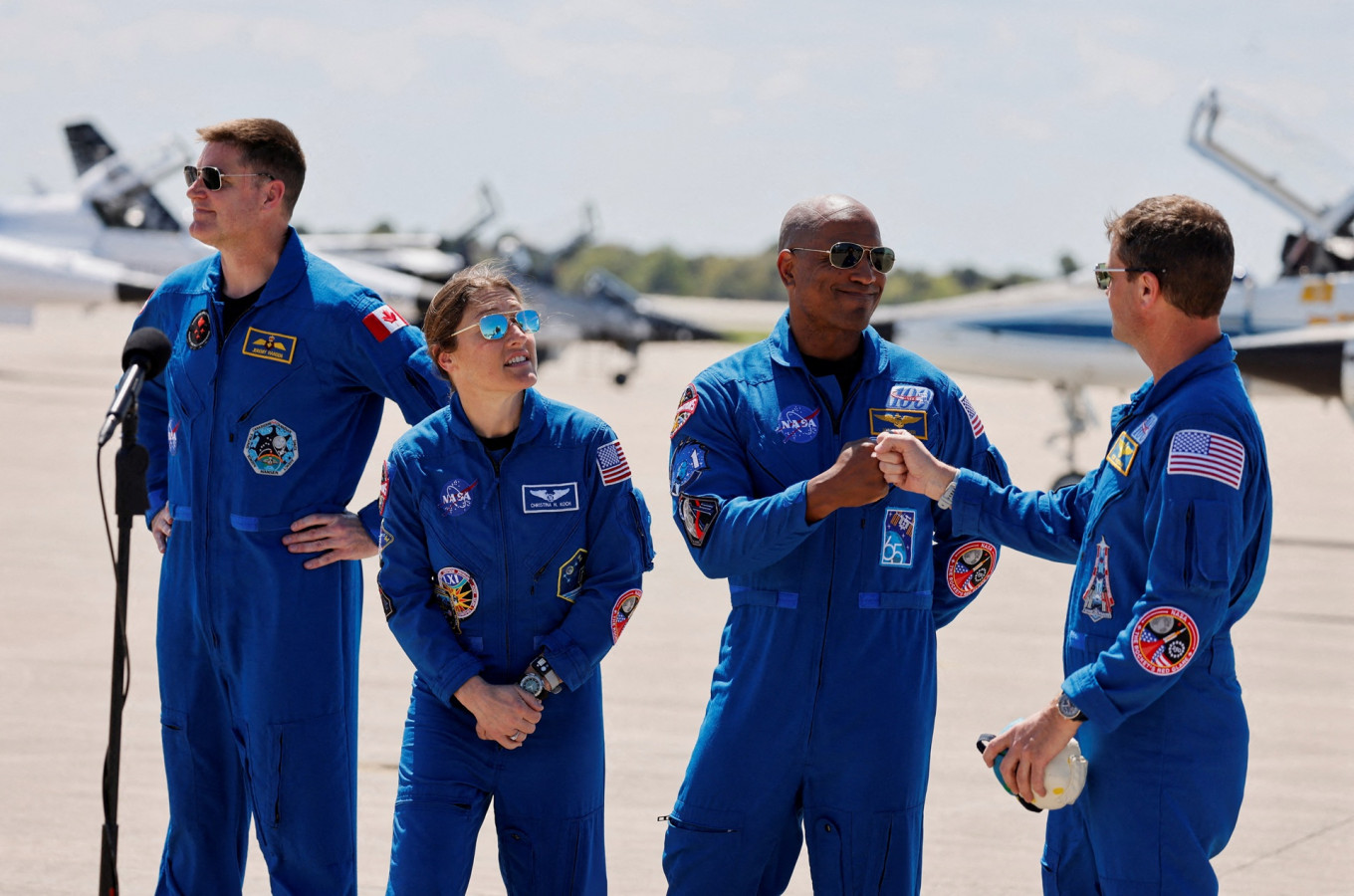 NASA astronauts Reid Wiseman (right) and Victor Glover (second right) greet each other next to NASA astronaut Christina Koch (second left) and Canadian Space Agency (CSA) astronaut Jeremy Hansen (left) at Kennedy Space Centre in Cape Canaveral, Florida, the United States on March 27, 2026, ahead of the Artemis II launch. (Reuters/Joe Skipper)
T
he four astronauts selected for NASA's Artemis II mission arrived in Florida on Friday, entering the final phase of preparations for the first crewed journey toward the Moon in more than five decades.
NASA astronauts Reid Wiseman, Victor Glover and Christina Koch as well as Canadian Space Agency astronaut Jeremy Hansen hopped out of Northrop T-38 jets that they flew from Houston, Texas, to NASA's Kennedy Space Center, where they could launch to space as soon as April 1 aboard NASA's towering Space Launch System (SLS) rocket.
They will ride inside an Orion crew capsule built to carry humans into deep space. The roughly 10-day mission will send the crew on a high-speed loop around the Moon and back.

"The nation and the world has been waiting a long time to do this again," Wiseman, the mission commander, told reporters after landing at Kennedy Space Center, adding that he and his crewmates "are really pumped to go do this."
"It has been a lot of work. It's been a great journey, it's great to be down here in the Florida warm air," he added.
Artemis II will be the first crewed mission of NASA's multi-billion-dollar Artemis program. While it will not attempt a Moon landing, it will send astronauts farther from Earth than any previous human spaceflight, testing the Orion spacecraft's life-support systems, navigation, communications and heat shield performance.
Boeing is the prime contractor for the SLS core stage, Northrop Grumman builds the rocket's solid-fuel boosters and Lockheed Martin produces the Orion spacecraft.
The crew has spent more than two years training for the mission since being named in 2023. They have been in standard preflight quarantine at NASA's Johnson Space Center in Houston since March 18 and are scheduled to move into NASA's Astronaut Crew Quarters in Florida ahead of launch.
Glover, the mission's pilot, will become the first Black astronaut to travel to the Moon's vicinity. Koch will be the first woman to do so, while Hansen will be the first non-American astronaut to go beyond low Earth orbit.
All of the crew members except Hansen have previously been in space. Wiseman, the mission commander, told reporters last year that the crew were prepared for all eventualities.
"When we get off the planet, we might come right back home, we might spend three or four days around Earth, we might go to the Moon; that's where we want to go," Wiseman said. "But it is a test mission, and we're ready for every scenario."
Wiseman, 50, logged 165 days aboard the International Space Station (ISS) during a 2014 mission launched aboard a Russian Soyuz spacecraft. A former US Navy test pilot, he later served as NASA's chief astronaut before being selected to command Artemis II.
Glover, 49, spent 168 days in space beginning in 2020 as pilot of NASA's Crew-1 mission, the first operational ISS mission using SpaceX's Crew Dragon capsule. Before joining NASA, he flew more than 40 aircraft during a US Navy career that included combat deployments and test-pilot duties.

Koch, 47, set a record in 2019 for the longest continuous spaceflight by a woman, spending 328 days aboard the ISS. Trained as an electrical engineer and physicist, she previously worked as a NASA engineer and carried out extended research expeditions in Antarctica.
The mission will mark the first spaceflight for Hansen, 50, who was selected as a Canadian astronaut in 2009. His seat reflects a long-standing US–Canadian partnership in human spaceflight, including Canada's contributions to robotics used aboard the ISS.
NASA plans additional Artemis missions in the years ahead as it works toward a sustained human presence on the Moon and future crewed missions to Mars.



More from The Weekender

Success isn’t at the top of the corporate ladder anymore
My generation watched our parents give everything to a company. We decided to give it to ourselves instead. But it's more complicated than that.

Our second Instagram account is the real one
In an act of rebellion against overexposure and performative social media, Gen Z are turning to smaller, controlled spaces on social media where they can be their authentic selves.

What women want, and the gap men are still trying to close
While millennial and Gen Z women were raised to chase careers, the same generation of men were not taught to do chores or be vulnerable. How can men step up?