The Jakarta Post
Please Update your browser
Your browser is out of date, and may not be compatible with our website. A list of the most popular web browsers can be found below.
Just click on the icons to get to the download page.


Popular Reads
Top Results
No results found. Please check your search term and try again
Can't find what you're looking for?
View all search results
Popular Reads
Top Results
No results found. Please check your search term and try again
Can't find what you're looking for?
View all search resultsNowhere is safe: Women remain vulnerable to violence across all spaces
One in four women in Indonesia has experienced sexual violence in their lifetime, with at least 30 percent of reported cases committed by intimate partners according to a 2024 survey conducted by the Women’s Empowerment and Child Protection Ministry.
Change text size
Gift Premium Articles
to Anyone
Share the best of The Jakarta Post with friends, family, or colleagues. As a subscriber, you can gift 3 to 5 articles each month that anyone can read—no subscription needed!
 Set as preferred source
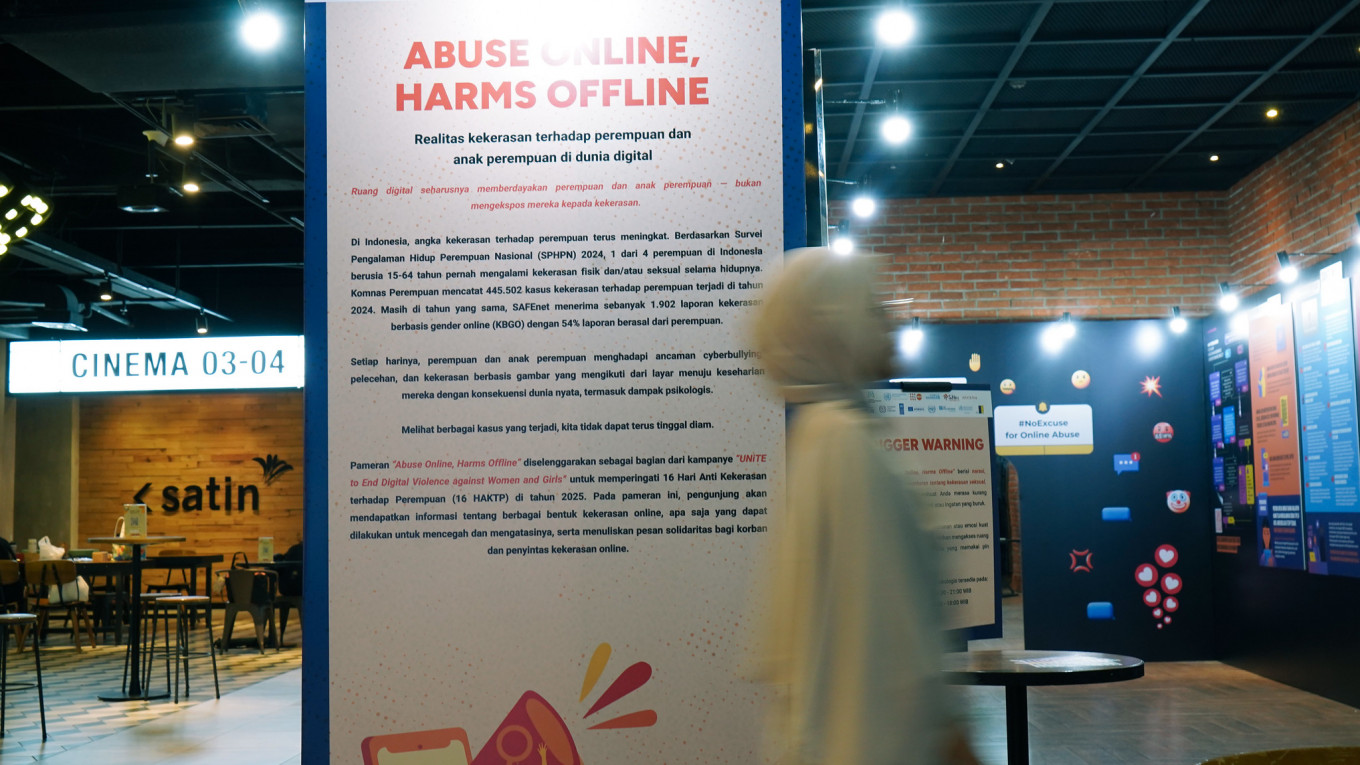 A woman walks in front of a poster on gender-based violence on Friday at CGV FX Sudirman in Jakarta. United Nations Women, UN Population Fund (UNFPA) and the Women's Empowerment and Child Protection Ministry held the UNiTE 2025 Film Screening and Discussion on Friday as part of the 16 Days of Activism against Gender-Based Violence campaign aimed to strengthen collective action to end violence against women and girls. (Handout/UN Information Centre/Dedy Maryanto)
A photo that might seem harmless can turn a woman into a target of sexual harassment overnight.
This is a reality portrayed in short film FOTOME that follows Kila, a young woman who is photographed without consent while jogging and her photo is then met with body-shaming, objectification and sexualized comments after it is uploaded and reposted online.
As the inappropriate reactions multiply, so does the harm, leaving Kila with little power to reclaim her dignity in a digital realm where traces rarely disappear.
Director and scriptwriter Vera Isnaini drew from her own experience and those of other female runners in Pontianak, West Kalimantan, who were photographed in public without their consent. Their images were later shared online without permission.
“Many of the photos are misused, especially on Instagram, which attracts people who fetishize women wearing hijabs and leggings,” Vera said during the film’s premiere in Jakarta on Friday.
Vera was one of five directors whose films explore the realities faced by women and girls of how they continue to face the risk of violence in all settings and relationships. Such concerns became the focus of this year’s 16 Days of Activism against Gender-Based Violence campaign, which renews calls for the urgent need for safe spaces in both public and private spheres.

The directors, supported by United Nations agencies in Indonesia, made films about how women and girls still face violence in private, public and digital spaces ranging from forced marriages to the exploitation of female models in creative industries.