The Jakarta Post
Please Update your browser
Your browser is out of date, and may not be compatible with our website. A list of the most popular web browsers can be found below.
Just click on the icons to get to the download page.


Popular Reads
Top Results
No results found. Please check your search term and try again
Can't find what you're looking for?
View all search results
Popular Reads
Top Results
No results found. Please check your search term and try again
Can't find what you're looking for?
View all search resultsPolice defy court order on double jobs
A recently-signed National Police chief internal decree paves the way for active officers to sit in civilian positions in 17 ministries and state institutions without resigning or retiring from the force, despite a recent Constitutional Court ruling banning them from doing so.
Change text size
Gift Premium Articles
to Anyone
Share the best of The Jakarta Post with friends, family, or colleagues. As a subscriber, you can gift 3 to 5 articles each month that anyone can read—no subscription needed!
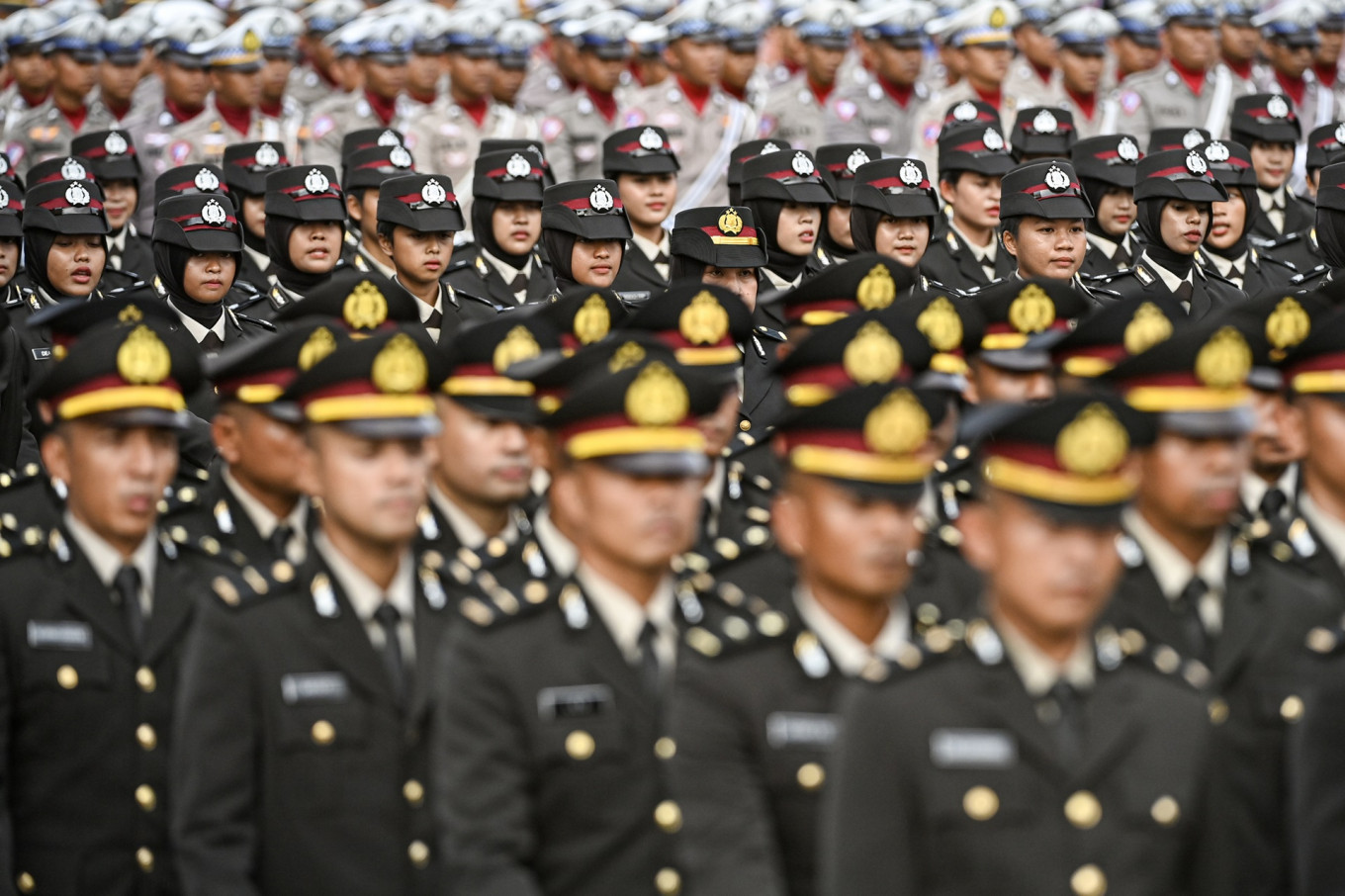 Police officers march during a ceremony on July 1, 2024, to commemorate the 78th anniversary of the National Police at the National Monument (Monas) Square in Central Jakarta. (Antara/Muhammad Adimaja)
A
new internal National Police regulation permitting active officers to hold positions in government ministries and state bodies has drawn criticism as a blatant act of constitutional disobedience for going against a recent Constitutional Court ruling prohibiting such appointments.
The regulation was stipulated in a decree (Perpol) signed by National Police chief Gen. Listyo Sigit Prabowo on Tuesday and promulgated by the Law Ministry the following day. It outlines the deployment of police personnel outside the force’s organizational structure, both for domestic and international postings.
Under the decree, officers may take up posts in ministries, government bodies, commissions, international organizations or foreign representative offices in Indonesia, provided the positions are relevant to policing functions and formally requested by the respective institutions.
Among the eligible institutions are the Office of the Coordinating Political and Security Affairs, Law Ministry, Energy and Mineral Resources Ministry, Forestry Ministry, Transportation Ministry, Financial Services Authority (OJK), Financial Transaction Reports and Analysis Center (PPATK), National Cyber and Encryption Agency (BSSN) and Corruption Eradication Commission (KPK).
The new decree came only several weeks after the Constitutional Court struck down an ambiguous provision in the 2002 National Police Law.
Through the ruling, the court made clear that police officers are barred from holding additional positions in the government. Should they want to take on civilian roles, the officers must resign or retire from the service.

The court was praised for the ruling, which was called by pro-democracy activists a significant step toward long-awaited reform of the National Police to help ensure the police force remains professional on its core duty of law enforcement.