Enjoy This Gifted Article!
You're reading this thanks to a The Jakarta Post subscriber.
Access is available for 30 days. For unlimited access, consider subscribing.
Can't find what you're looking for?
View all search resultsCan't find what you're looking for?

View all search resultsDuring his fifth visit to the disaster-hit northern Sumatra provinces, President Prabowo Subianto reasserted his administration’s commitment to “return normalcy” to the region within three months, focusing on rebuilding bridges, houses and other public facilities.
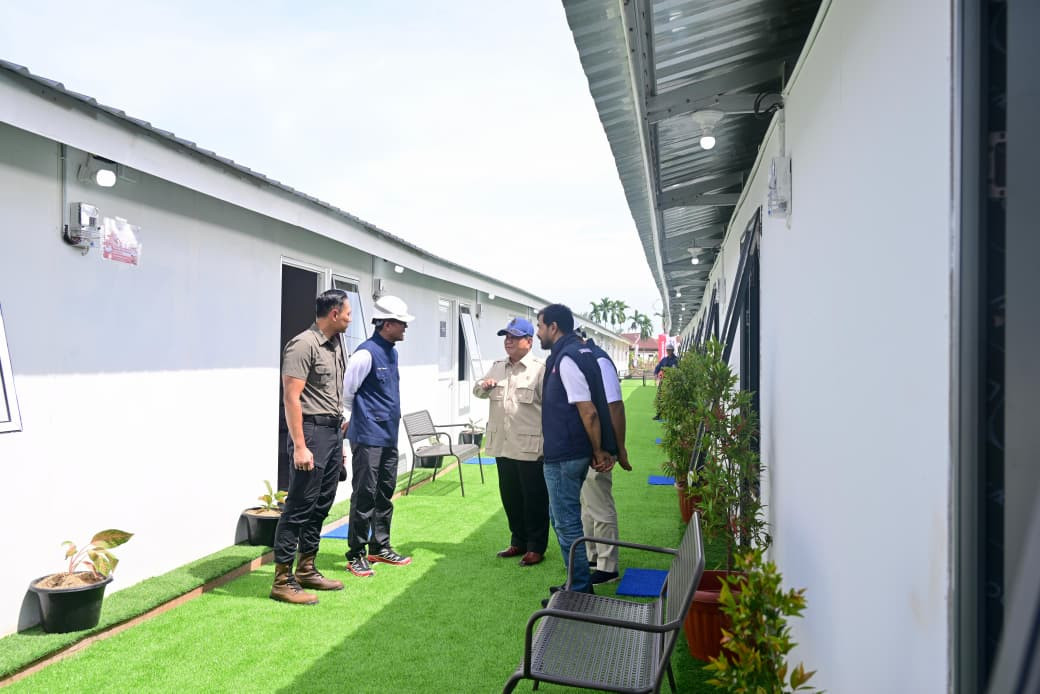
President Prabowo Subianto (center) speaks to Coordinating Infrastructure and Regional Development Minister Agus Harimurti Yudhoyono (left), State-Owned Enterprises (SOEs) Regulatory Agency head Dony Oskaria (second left) and state asset fund Danantara CEO Rosan Roeslani (second right) and Aceh Governor Muzakir Manaf during an inspection on Jan. 1 of a temporary housing site for residents affected by floods and landslides in Aceh Tamiang regency, Aceh. (Courtesy of Presidential Secretariat/Rusman)
President Prabowo Subianto welcomed the new year by visiting disaster-hit northern Sumatra for the fifth time since the floods and landslides hit the region, a move met with questions on whether his promise to rehabilitate the region within three months can be delivered.
The President joined on Wednesday evacuees in a muted celebration at a temporary shelter in South Tapanuli regency, North Sumatra, where they watched films, sang national songs and watched traditional dances to await the midnight.
In his new year message to the people in the shelter, Prabowo said the government was coordinating to speed up rebuilding in disaster-stricken areas, including installing Bailey bridges to reconnect isolated areas and repairing damaged houses.
He added he felt optimistic the new year would bring meaningful recovery, as the number of isolated regions have decreased from more than 10 during the first week of the disasters to only five.
“We are committed to immediately rebuild houses, replace lost homes and assist those damaged,” Prabowo said as the night turned to Thursday. “Trust that your government, your leader and your state will never abandon you.”
As of Friday afternoon, the National Disaster Mitigation Agency (BNPB) recorded 178,479 houses damaged across the three provinces. More than 381,000 people were displaced in Aceh, North Sumatra and West Sumatra.
Read also: Extreme weather, fresh floodings haunt survivors of Sumatra disaster
The President continued his trip by visiting Aceh Tamiang regency in Aceh on Thursday, one of the worst-affected regions with at least 101 deaths recorded and was cut off for several days after the cyclone-induced floods and landslides.
In Aceh Tamiang, Prabowo reasserted that restoring basic services for evacuees, such as health posts and schools, was among his top priorities. At least 215 health facilities and 3,188 schools were damaged, according to BNPB’s record.
Prabowo previously pledged in mid-December that life would “return to normal” in affected regions within three months.
Since then, the government has deployed thousands of personnel from various institutions to remove debris and mud. State asset fund Danantara and private institutions also pledged and started working to build more than 17,000 temporary houses by April.
Storm ahead
But works to recover the disaster-affected areas might face challenges as dozens of key access routes are still cut off, hindering the delivery of humanitarian aid to impacted villages.
The regions are also facing a risk of moderate to heavy rain that may trigger new floods which may impact the newly-built roads and bridges, said BNPB spokesperson Abdul Muhari in a statement on Friday.
With the country expected to see the peak of the rainy season in January, doubt lingers that the goal to recover affected regions by April would be achieved, while evacuees are facing risks of new disasters every day.
A woman gathers utensils from a house on Jan. 1, buried by mud and wooden logs carried by a flood and landslide in Mendale village, Central Aceh regency, Aceh. At least 295 villages in the regency were impacted by cyclone-induced floods and landslides in late November, with nearly 15,000 residents in 30 villages still cut off by Dec. 31, 2025, according to data from the Central Aceh administration. (Antara/Irwansyah Putra)On Dec. 24, heavy rainfall triggered new flash floods and landslides in several regencies in Aceh and North Sumatra, killing at least one person while 60 others were missing. The flood brought back mud and large wooden logs to areas previously had been cleaned.
“The floodwaters have receded, but left new problems behind,” said Murthalamuddin, the spokesperson for Aceh Hydrometeorological Disaster Emergency Response Post in Banda Aceh.
“Mud and flood debris have piled up again, covering up the roads and people’s houses. This is slowing down the disaster-response efforts that had already been carried out, because everything now has to be cleaned up again,” he continued.
Ramping up works
In a press briefing on Dec. 29, Coordinating Human Development Minister Pratikno said the government had been preparing to ramp up the disaster mitigation efforts, including by speeding up the clearing of debris such as large logs from river channels.
Authorities had also mapped areas at high risk of landslides and would continue to launch cloud seeding to reduce the rainfall intensity and frequency.
Pratikno also acknowledged challenges faced by authorities, including delays in relocating residents along riverbanks and the limited capacity of existing emergency infrastructure.
At the same briefing, Army chief of staff Gen. Maruli Simanjuntak said Prabowo had ordered to import 100 Bailey bridges to accelerate the reconstruction of all destroyed bridges, with an aim to finish constructing all by February.
But the import was met with opposition by the local industry, with the Indonesian Society of Steel Construction (ISSC) pledging 22 domestic manufacturers would be ready to supply 151 Bailey bridges within the next month.
Read also: Muted NYE celebrations reflect solidarity with Sumatra disaster victims
With the government still struggling to manage post-disaster recovery and prepare for potential disasters, analysts have begun doubting whether Prabowo’s April deadline can be realistically met.
Yanuar Nugroho, public policy expert and a senior advisor at the Center for Innovation Policy and Governance (CIPG), highlighted some of the issues that have yet been handled, such as the number of people to be relocated to new locations. He cited construction experts who estimated that full recovery would take up to 30 years.
“The three-month deadline for a return to normalcy is impossible,” Yanuar said. “The situation is extremely concerning.”
– Apriadi Gunawan contributed to the story from Medan
Share your experiences, suggestions, and any issues you've encountered on The Jakarta Post. We're here to listen.
Thank you for sharing your thoughts. We appreciate your feedback.
Quickly share this news with your network—keep everyone informed with just a single click!
Share the best of The Jakarta Post with friends, family, or colleagues. As a subscriber, you can gift 3 to 5 articles each month that anyone can read—no subscription needed!
Get the best experience—faster access, exclusive features, and a seamless way to stay updated.