TheJakartaPost
Please Update your browser
Your browser is out of date, and may not be compatible with our website. A list of the most popular web browsers can be found below.
Just click on the icons to get to the download page.


Popular Reads
Top Results
No results found. Please check your search term and try again
Can't find what you're looking for?
View all search results
Popular Reads
Top Results
No results found. Please check your search term and try again
Can't find what you're looking for?
View all search results10 out of 12 soil orders can be found in Bogor museum
Located in a Dutch colonial-style building, the Indonesian Soil Museum in Bogor, West Java, hosts a micro-monolith collection of soils from across Indonesia.
Change text size
Gift Premium Articles
to Anyone
Share the best of The Jakarta Post with friends, family, or colleagues. As a subscriber, you can gift 3 to 5 articles each month that anyone can read—no subscription needed!
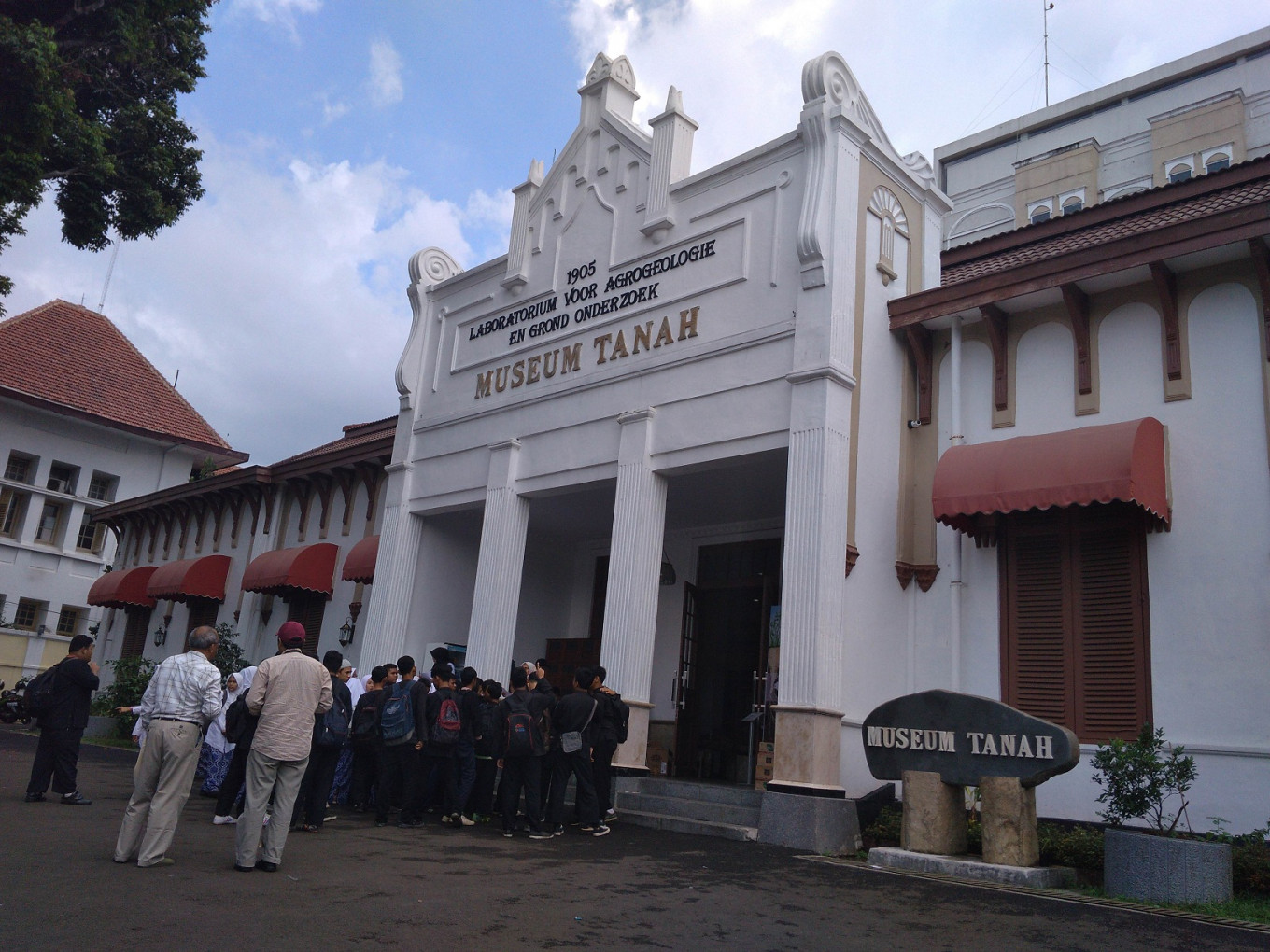 A group of students from a vocational school in Bogor enter the Indonesian Soil Museum. (JP/Theresia Sufa)
S
oils are classified into orders based on their physical, chemical and biological properties, as explained by Soil Science Society of America’s David Lindbo. Of the existing 12 soil orders in the world, 10 of them can be found in Indonesia.
The 10 soil orders are Ultisols (red clay), Alfisols (Mediterranean), Oxisols (laterite), Vertisols (grumusol), Spodosols (coniferous), Histosols (peat), Mollisols (Black Forest), Inceptisols (forest bed), Entisols (tsunami alluvial) and Andisols (volcanic ash).
The samples can be found at the Indonesian Soil Museum in Bogor, West Java.

The museum was established in 1988 by the Agriculture Ministry and International Soil Reference and Information Center (ISRIC). Located in a Dutch colonial-style building, it hosts a micro-monolith collection of soils from across Indonesia.
Although the museum has been open to the public for free since December last year, it has a relatively low monthly visitor count of 700. Thus, the Indonesian Soil Museum’s management is actively promoting the museum through social media.
Read also: Four-tusked ‘elephant’ on display at Bandung museum – in fossils
Soil studies in Indonesia began in the Dutch colonial era, with the establishment of the Voor Agrogeologie en Grond Onderzoek Laboratory (Laboratory for Agrogeology Expansion) in 1905. The institution merged with the Agricultural Research and Development Agency (Balitbangtan) in 1974.
However, intensive Indonesian soil sample collecting by the Center for Agricultural Soil Resources (BBSDLP) only started in 1988. The effort aims to study Indonesian soils, which are more diverse and richer in microbes than those of other tropical countries. (iru/kes)