TheJakartaPost
Please Update your browser
Your browser is out of date, and may not be compatible with our website. A list of the most popular web browsers can be found below.
Just click on the icons to get to the download page.


Popular Reads
Top Results
No results found. Please check your search term and try again
Can't find what you're looking for?
View all search results
Popular Reads
Top Results
No results found. Please check your search term and try again
Can't find what you're looking for?
View all search resultsA trip down memory lane
From babies: Poultry is widely available at Pasar Gawok traditional market in Surakarta, Central Java
Change text size
Gift Premium Articles
to Anyone
Share the best of The Jakarta Post with friends, family, or colleagues. As a subscriber, you can gift 3 to 5 articles each month that anyone can read—no subscription needed!

F
span class="caption" style="width: 398px;">From babies: Poultry is widely available at Pasar Gawok traditional market in Surakarta, Central Java. The market makes available almost everything needed by rural people.“I’ve been a barber here for 46 years. It has always been a bustling market, even though modern shops are already around,” said Hardjo Soewito, 78, about Pasar Gawok, a traditional market on the outskirts of Surakarta, traditionally called Solo, in Central Java.
This elderly man works in a makeshift booth — with pieces of cloth hanging from plastic strings — under a large tree in a corner of the market amid stalls offering household utensils, remedies and children’s clothes.
Pasar Gawok is one of the city’s last remaining genuine traditional markets. It only opens on Pon, the third day of the five-day week of the Javanese calendar, from 8:00 a.m. until 1:00 in the afternoon. There are no market activities the rest of the week.
“It’s an old market and its original structures are quite different from present-day buildings. It’s always cool, even without AC,” added Hardjo.
This market has few permanent buildings, with traders selling their merchandise and other daily needs on rows of low counters instead of kiosks. Outside, vendors put up their stalls and other shelters, for example the barber’s. Some even display their goods on the ground, creating a typical Javanese atmosphere of bygone times.
Unlike other traditional markets, Pasar Gawok provides almost everything needed by rural people, from bamboo kitchen utensils, antiques, songbirds, cattle and poultry to remedies, therapists and tinsmiths.
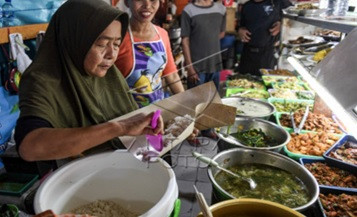
Food counters offer soto (a soup-like dish), sate (skewered and grilled meat), getuk lenjongan (sweet potato and cassava cake with brown sugar syrup and grated coconut), tiwul (sweet cassava snack), onde-onde (sticky rice-flour balls filled with beans) and pecel kembang turi (turi flower salad with peanut dressing).
On roofless counters, dozens of blacksmiths make hoes, crowbars, sickles and daggers based on customer orders and also repair damaged farm implements. The stronger, the worthier: Gawok traders and shoppers watch a cockfight to determine the prices of roosters.The market also boasts a unique tradition of cockfighting, with crowds of people, including gamblers, forming large circles to watch the battling roosters. This area has become a place of high-quality gamecock transactions. 
The winner usually determines the price of the relevant breed of roosters. In this way, a cock offered at Rp 500,000 (US$58) is frequently given up for just Rp 100,000 if it belongs to the losing stock.
On another corner under bamboo trees, lines of old bicycles are lined up for sale. Interestingly, their sellers are elderly people clad in long-sleeved batik shirts and felt hats. The bikes come in various brands such as Humber, Simplex and Phoenix and are sold at relatively low prices, ranging from Rp 300,000 to Rp 900,000. In other markets they can cost over Rp 1 million.
“Actually, they’re not full-time traders. Many of them sell their bikes for want of money to buy paddy seedlings or fertilizer so they offer prices far lower than those at Pasar Triwindu [Solo’s antique market],” said Gawok village resident Saptono. Antiques: : Old bicycle sellers offer rare products.An array of genuine parts and components of old bicycles can also be found in this area, including headlights, pedals, saddles and rims, making it a destination for vintage bike buffs. 
Not far from the cycle grounds, several people are busily finishing their daily sewing amid hectic business deals taking place around them. “I’ve been here since childhood. I used to help my father and have carried on his job since he died. It’s been about 40 years now,” said Samingun, 74.
Samingun and three of his peers, however, are mostly patching up and altering clothes. They very rarely receive customer orders for jackets or pants. “We’re very busy when Pon falls on Sunday and take home Rp 40,000 to Rp 70,000. On other days we earn Rp 25,000 at most,” said the grandfather of eight.
The market, steeped in rural harmony, is about 10 kilometers southwest of Surakarta, surrounded by stretches of paddy fields with the Gawok River flowing right behind the market. The precise location is in Geneng village, Gatak district, Sukoharjo regency. Local residents say that Pasar Gawok, named after the hamlet, was built by the Dutch to meet the labor demand of the colonial government’s garment factory near the location. Job equality: A woman waits for shoppers to buy her household earthenware for daily use.Pariman, a soto seller for over 10 years, said the market formerly opened daily, but closed with the closure of the factory. “My grandfather said the local community later reopened this market on every Pon. Since January, it also began to open on Legi,” added Pariman. 
Unlike modern supermarkets, Pasar Gawok, with traders mostly comprising local residents, is known for its hospitality. Sellers treat customers as old friends so transactions take place like easy chats without much haggling.
“We will heartily welcome old friends or relatives, asking what they want and serving their needs. That’s how Gawok traders receive their guests,” Pariman said.
Perhaps this typical style and its other traditional features have helped Pasar Gawok survive. Visiting Pasar Gawok is like taking a trip down memory lane, while enjoying an air of friendliness rarely found in modern markets.