TheJakartaPost
Please Update your browser
Your browser is out of date, and may not be compatible with our website. A list of the most popular web browsers can be found below.
Just click on the icons to get to the download page.


Popular Reads
Top Results
No results found. Please check your search term and try again
Can't find what you're looking for?
View all search results
Popular Reads
Top Results
No results found. Please check your search term and try again
Can't find what you're looking for?
View all search resultsLocal F&B franchises explore questions of taste to lure customers
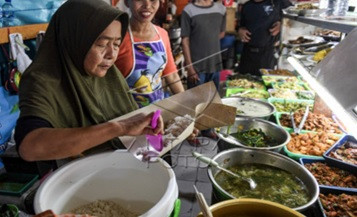
Champion's row: A branch of Es Teler 77, a franchise selling traditional food, in Jakarta
Change text size
Gift Premium Articles
to Anyone
Share the best of The Jakarta Post with friends, family, or colleagues. As a subscriber, you can gift 3 to 5 articles each month that anyone can read—no subscription needed!
 Championâs row: A branch of Es Teler 77, a franchise selling traditional food, in Jakarta. The brand has successfully expanded to foreign markets, with its owner saying the key is high standards and professionalism. (JP/Jerry Adiguna) (JP/Jerry Adiguna)
C
span class="caption" style="width: 508px;">Champion's row: A branch of Es Teler 77, a franchise selling traditional food, in Jakarta. The brand has successfully expanded to foreign markets, with its owner saying the key is high standards and professionalism. (JP/Jerry Adiguna)
Food lover Mochamad Jajang Raharjo does not care about the venue where he chooses to dine, whether it's a bar, café, restaurant or dimly lit sidewalk food stall.
For him, it's the taste that matters.
'I frequently find that food served at sidewalk stalls is tastier even though this doesn't necessarily mean that restaurant food isn't good,' said the 33-year-old bank executive who enjoys sampling food on his travels.
'The price at a sidewalk is affordable but the food is very delicious, like that served at a five-star hotel,' he said, laughing.
'Even though soto sapi (a traditional seasoned broth with chunks of beef and vegetables) is served at both mid-range restaurants and sidewalk stalls, the food at the latter is more mouthwatering because it is mixed with more ingredients, especially garlic.'
His family dines out on most weekends.
'Dining out is part of our lifestyle. It serves as a way for us to become closer to each other. It's good for a change after work.'
Many Indonesians choose food based on taste and affordability. It may explain why local franchising businesses that target the middle-to-low market segment are flourishing. The F&B franchises are categorized into small-and-medium-scale enterprises (SMEs) with initial capital of less than Rp 50 million.
According to data at the Indonesian Franchise Association, of the total of 700 franchises in 2009, 400 were local franchises. Many of them focused on food and beverage products.
Bone to pick
'Indonesian consumers see taste as the most important thing, but they don't make the country of origin an issue,' said Satrio Purwito, owner of Kebab Alibaba outlets.
The basic kebab is meat cooked over a fire. Countries in the Middle East, India and Eastern Europe have their own distinct kebab, with diverse tastes and flavors.
Satrio's version has won the hearts of Indonesian consumers through adjustment to the Indonesian palate. The meat is first grilled and frozen before being blended with spices to make it tastier.
First established in 2007, it now has 35 outlets, of which 17 are franchises.
He said location was a determining factor in terms of attracting customers. Given that targeted consumers were in the middle-to-low income brackets, the outlets are located on sidewalks, close to small and busy supermarkets at t-junctions or at crossroads instead of in malls.
'Around 85-90 percent of our consumers are 'take away' consumers, meaning they buy food and eat it somewhere else,' he said, adding that the products were mostly enjoyed by teenagers.
Many consumers buy and they sit on their motorcycles while the cooking is in progress. 'Many also buy from inside their car as they park it close to the outlet,' he said.
Kebabs seem a big hit among Indonesians; the world's largest kebab franchise, Kebab Turki Baba Rafi, hails from Surabaya.
Other local franchises are taking advantage of Indonesians' insatiable love of noodles.
'Noodles have become an alternative staple food to replace rice for Indonesians. That's why I use noodles as my basic material for my food franchise,' said Ubaidilah who runs a food stall focusing on noodles under the brand Pangsito and Mie Ayam Jago.
He said besides taste, his venture prioritized quality in terms of the material and service.
'Our noodles are free of preservatives. And we clean the bowl the noodles are served in with fresh running water to make sure it is really clean,' he said.
Due to increasing requests for franchises from business partners, he plans to open 10 outlets in Depok, West Jakarta, under a franchise agreement after Idul Fitri.
Several other local food and beverage franchises have expanded to overseas markets. Es Teler 77, a franchise serving Indonesian authentic food and beverages, has outlets in several countries, including Australia, Singapore, Malaysia and India.
Es Teler 77 prepares its own ingredients to make its food tasty and promises warm comfort for foreign consumers.
The products served constitute a blend of fast food brands and restaurants.
Several menus are especially created to make it more familiar with foreign consumers' tongues. However, the menus still consist of Indonesian food and beverages.
For example, even though their standard menus consist of Indonesian food and beverages, they serve chicken curry at their Singapore outlet and balado fried fish at their outlet in Australia.
'Especially for Indian consumers, we've created vegetarian gulai [a curried soup] and gulai mutton. While, for Malaysian consumers, we serve a menu similar to Indonesia given that the market in both countries has the same character,' said Anton Wijaya, the vice president of PT Top Food Indonesia, owner of the Es Teler 77 brand.
'With more young people enjoying Indonesian food and beverages, Es Teler 77 always endeavors to keep up with current trends in terms of its marketing concept, which include making the appearance of its outlets attractive to young people.'
According to him, building an adequate business infrastructure was especially important in competing with foreign franchises that were superior in terms of having a clear concept, training center and standard operating procedures.
'Local franchises should also have competent and professional teams to be able to franchise their ventures,' he said.