TheJakartaPost
Please Update your browser
Your browser is out of date, and may not be compatible with our website. A list of the most popular web browsers can be found below.
Just click on the icons to get to the download page.


Popular Reads
Top Results
No results found. Please check your search term and try again
Can't find what you're looking for?
View all search results
Popular Reads
Top Results
No results found. Please check your search term and try again
Can't find what you're looking for?
View all search resultsThe unmet needs of heaven's flowers
Hoping for the best: Romadhan (left) poses with his second son Ihsan Faiz (second left), wife Aning Nurul and first son Ardiansyah
Change text size
Gift Premium Articles
to Anyone
Share the best of The Jakarta Post with friends, family, or colleagues. As a subscriber, you can gift 3 to 5 articles each month that anyone can read—no subscription needed!

Hoping for the best: Romadhan (left) poses with his second son Ihsan Faiz (second left), wife Aning Nurul and first son Ardiansyah.
The World Down Syndrome Day is observed Friday to recognize 'the value, acceptance and inclusion' of people with the genetic disorder. But out there, there's little to cheer about in Indonesia other than the resilience of brave families.
Let's celebrate heroes without uniforms, people like Aning Nurul, 39, and her husband Romadhan, 41. Eleven years ago the East Java couple's comfortable world was suddenly grabbed, roughly shaken and tossed back, never to be the same again.
Ihsan Faiz, their darling second son, had been diagnosed as one in 1,000 ' a Down Syndrome (DS) child.
'When he was born all seemed OK,' said Aning. 'There were no signs of anything unusual. Our first son Ardiansyah had been born two years earlier and he was quite normal.
'Slowly we noticed Ihsan wasn't developing as fast as his brother. We saw four doctors who weren't interested. The fifth understood.'
Down Syndrome, named after a 19th century British doctor who first identified the incurable condition, develops when the body has an extra chromosome. The causes are complex and still little understood. Only 1 percent is linked to the child's hereditary aspects.
Precise figures are elusive, but using World Health Organization statistics estimated 4,500 DS children are born every year in Indonesia, the majority boys. Although official figures aren't kept, a parents' support group believes around 300,000 Indonesians have DS.
Typically DS kids have stunted growth, flattened facial features and speech problems. Given proper health care they can often live into their 50s, though in the past many died young. In the West, a few DS people have graduated from university and achieved in the arts.
They are prone to other health problems, particularly heart disease, and usually have low intelligence, though Ihsan is in the less severe group. He can speak a little, play computer games and use the toilet. He radiates joy.
After hearing the news the family unblinkingly confronted their new reality. Lesser folk and those genuinely unable to cope because Indonesia is not a welfare state would have dumped the boy in a home for the disabled. Aning and Romadhan chose to give love, unqualified and abundant.
'This is part of God's plan, and whatever He gives us is the best,' said Romadhan. 'Who are we to understand why? There is a reason.'
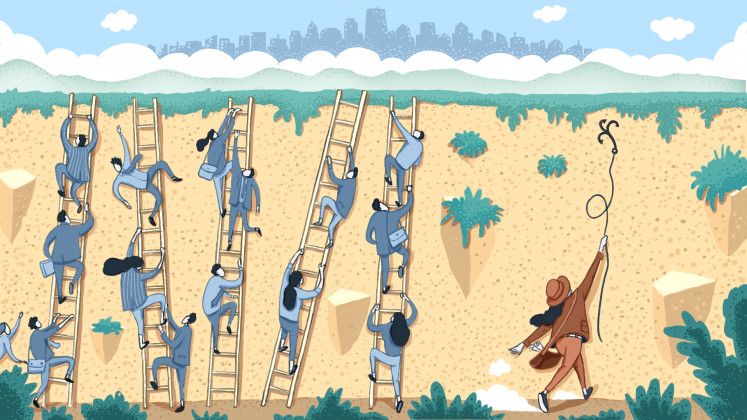
Romadhan and Ihsan Faiz.
Many couples split under the pressure of caring for a handicapped child. Blaming is hard to resist. Others move closer. 'We no longer quarrel over silly things,' laughed Aning. 'We've grown to be more patient with each other.'
Though not with the way they've been treated by the medical profession, teachers and the community of Sidoarjo, near Surabaya, where they once lived.
To have a disabled child was proof of parental sin to cruel neighbors, whose mutterings, stares and snubs scratched the couple's pain, particularly as Romadhan was often away in Jakarta working as an airline aviation inspector.
'We tried to ignore the gossip but it was everywhere,' he said. 'We were judged through ignorance. The situation became worse when we tried to enrol Ihsan at school. No-one would accept him.
'The education and welfare of children is part of our Constitution. But the law is not being upheld and no one seems to care. We want Ihsan to grow into an independent man, to reach his full potential.
'We're an educated professional couple and I have a good job. We know how to get things done and where to protest, yet we still get little more than embarrassed nods. So imagine how difficult it must be for poor villagers.'
Four years ago the family moved to Lawang, Aning's hometown. Here the smaller community was more accepting. The couple got to know others with handicapped kids, to share experiences and provide mutual support.
As a bonus a local school was happy to take on the responsibility. (See sidebar)
Pre-natal screening can diagnose genetic defects and offer the mother termination, a choice frequently taken in the West. 'I would never have had an abortion,' said Aning. 'Whatever God has given me is the best.'
Ihsan is close to his father and occasionally accompanies him on aircraft inspections to crew members' amazement and the boy's delight.
'So many families try to shut away their handicapped kids for shame,' Romadhan said. 'Don't hide your children. They are the stars of every family, the flowers of heaven.
Father and son rubbed noses and cuddled, the tough engineer whose signature can ground an Airbus, and the chuckling, vulnerable boy who gently strokes the family cat.
'This is Ihsan,' said Romadhan facing his visitors with pride. 'This is my special son.'
- Photos by Duncan Graham