TheJakartaPost
Please Update your browser
Your browser is out of date, and may not be compatible with our website. A list of the most popular web browsers can be found below.
Just click on the icons to get to the download page.


Popular Reads
Top Results
No results found. Please check your search term and try again
Can't find what you're looking for?
View all search results
Popular Reads
Top Results
No results found. Please check your search term and try again
Can't find what you're looking for?
View all search resultsINSIGHT; The selfies after the party: Bringing back beauty to our cities
With all the hype over the Asian-African Conference Commemoration this week, what is most telling is the influx of selfies about it in social media lately
Change text size
Gift Premium Articles
to Anyone
Share the best of The Jakarta Post with friends, family, or colleagues. As a subscriber, you can gift 3 to 5 articles each month that anyone can read—no subscription needed!

W
ith all the hype over the Asian-African Conference Commemoration this week, what is most telling is the influx of selfies about it in social media lately.
Yes, there is a genuine increase of interest in this historic international gathering involving a rare display of country leaders from two global regions.
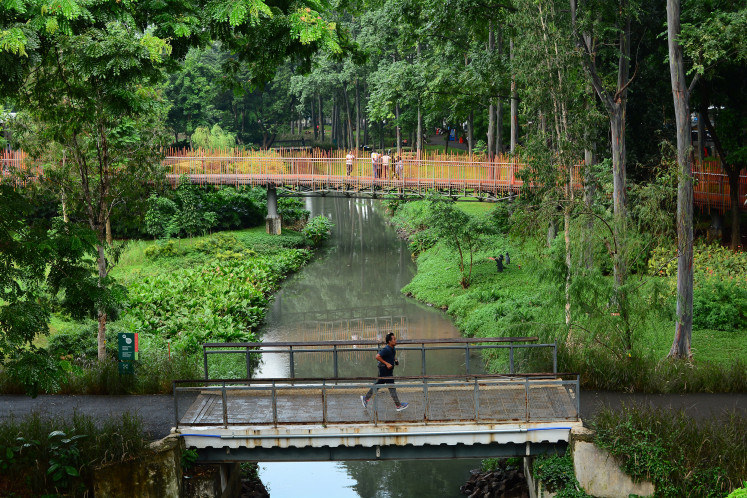
Yet the better proof of public interest is in their candid eyes ' individuals and families posing in front of new benches, water fountains, landscaped tapestries, redone city parks, historic buildings and streets adorned with decorative lights next to attractive public spaces around the conference's building in downtown Bandung.
Could this self-declared 'selfies capital of the world' achieve one extra point: the return of its urban life?
Indonesian cities are still growing as from a teenager's body and state of mind, often trampling over their own feet in pursuit of progress. These cities are indeed making noticeable strides to revamp their branding among peers.
With mounting needs, from delivering basic infrastructure to a capacity for tackling the maintenance
of public amenities, the logical priorities can be so upside-down that public programs are not only
delivered in bits and pieces, but they also lose coherence and conviction in their main goal of increasing public welfare.
Reiterating what Marco Kusumawijaya of the Rujak Center of Urban Studies has pointed out, the three aspects of city priorities in people's mind ' kampung, the markets and shared spaces ' are the true faces of a city with not much room to hide. The degradation of their openness, quality and functioning has most affected our ability to congregate outdoors as social and democratic beings.
The dark reality of such slow and degrading shifts in our urban places is what Bandung seems determined to tackle through a series of priority changes. In an obvious benefit of having an architect as its mayor, Bandung has performed shock treatments on itself with several thematic upgrades and interventions on what used to be forgotten public places. Public arts and diverse programming give further signs of the rethinking of the city's face.
Also, the historic event does the job, too.
It's much like what Chicago went through when preparing for the 1996 Democratic National Convention. It launched a citywide streetscape program delivering many kilometers of tree-lined boulevards and attractive public rights-of-way that effectively became a reference model for urban revitalization programs around the world. The more than 300,000 street trees the mayor had planted since 1989 also made commercial sense ' the business community poured in to form project partnerships. The benefits filled neighborhoods with pride and confidence that attracted private investors to do their part along and around those beautiful streets.
Bandung has its challenges and opportunities. As a leading second-tier city, it is able to overcome the 'little brother syndrome' of the capital. While it generously provides a steady supply of qualified professionals to other economic nodes, Bandung digs in its heels to keep balancing between presenting progress and managing the system's protocols to keep ahead of the course.
While the headaches of delivering public goods expeditiously justify Mayor Ridwan Kamil and team taking extra sleep time after the conference is over, the rest of us should think and act on how these initiatives can be created elsewhere in context to varying conditions and potentials and without a trigger as large as this week's event.
Before we see exact copies of what we see in those selfies, clear action manuals for people-scale urban priorities should provide keys for contemporary urban discussions, such as for smart cities, livable cities and the like. We don't need what the cookie-cutter shophouses or ruko have done to the face of our economic arteries from west to east. We need careful packaging in the name of substance, not over it.
With fierce competition in the age of multilateral partnership with regions and countries around us, cities like where we now live are never immune from the need to revamp and rebrand their living environments. It's for our welfare, our access to fair chance and our ability to propel ourselves forward when opportunity comes.
If the father of Chicago's city planning, Daniel Burham, advocated to 'make no little plans, that they have no magic to stir men's blood and probably will not themselves be realized', a series of micro urban moments is actually the grand gesture that makes Bandung truthfully seem a people-driven creative city.
Do we need the smiling faces in renewed urban places to be reminded to get together in the urban outdoors? Do we need effective urban financing to make this kind of excitement happen more around the country? Apparently we do.
It is in those smiling faces that we find confirmation that that is what we meant by bringing back beauty to our cities. But please don't just copy them. Adapt them to your own.
_______________
The writer is an award-winning architect and CEO of Terra Lumen Indonesia, formerly assistant for green initiatives under the mayor of Chicago, director of greening under the mayor of San Francisco and a former special staff member in the previous Indonesian Cabinet.