The Jakarta Post
Please Update your browser
Your browser is out of date, and may not be compatible with our website. A list of the most popular web browsers can be found below.
Just click on the icons to get to the download page.


Popular Reads
Top Results
No results found. Please check your search term and try again
Can't find what you're looking for?
View all search results
Popular Reads
Top Results
No results found. Please check your search term and try again
Can't find what you're looking for?
View all search resultsForeign Ministry looks to A. Soebardjo for inspiration
Change text size
Gift Premium Articles
to Anyone
Share the best of The Jakarta Post with friends, family, or colleagues. As a subscriber, you can gift 3 to 5 articles each month that anyone can read—no subscription needed!
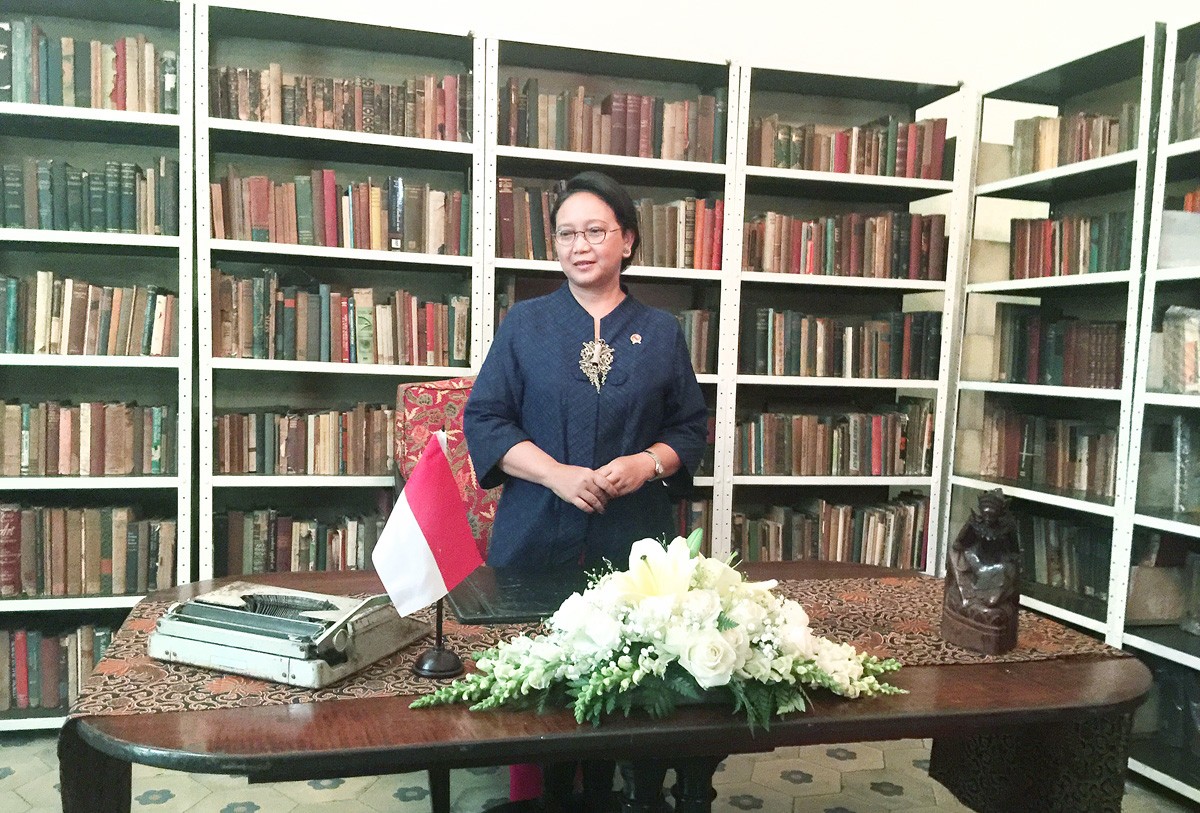 Happy anniversary: Foreign Minister Retno LP Marsudi speaks at a press conference at the residence of Indonesia’s first foreign minister Achmad Soebardjo, which was also his office, in Jakarta on Friday. The historic building was the first office of the Foreign Ministry. The meeting was organized to celebrate both the 71st anniversary of Indonesia’s independence and the Foreign Ministry’s anniversary, which fell on Friday. (JP/Tama Salim)
“I feel like I might weep,” said a teary-eyed Foreign Minister Retno LP Marsudi as she looked around the high-ceilinged study of one of Indonesia’s founding fathers, Achmad Soebardjo.
In a quiet nook of an old colonial-era house on a buzzing street in the heart of Central Jakarta, the minister counted her blessings as she stood up from the very same chair that Achmad, Indonesia’s first foreign minister, sat in to set the foundations of Indonesia’s foreign policy for years to come.
It was there, the first office of the fledgling Foreign Ministry in the garage of Achmad’s home on Jl. Cikini 80–82, that he set out to gain acknowledgement from other countries on Indonesia’s proclamation of independence.
“This is where Indonesian diplomacy took its first step, where the first Indonesian foreign minister started his work for Indonesia — a new journey as a sovereign country,” Retno said during the ministry’s 71st anniversary celebrations on Friday.
Achmad was credited with assembling Indonesia’s first batch of diplomats, six people who would come to inspire generations of young diplomats to serve their country.
Among the first few were Herawati Diah, R. Soedjono, Suyono Hadiasmoro and TM Hadi Thayeb. The latter compiled the ministry’s history in his book in Indonesian, titled The Period of Service to the Republic of Indonesia, Particularly the Department of Foreign Affairs.
Thayeb recorded two particular activities with which minister Achmad occupied himself in the country’s early days.
First, he was expected to maintain communications with the leaders of the military and the civilian government of Japan “in accordance with international law” until the Allied Forces arrived.
Second, he was to convene meetings with the first Cabinet and ensure the success of the Repatriation of Allied Prisoners of War and Internees operation.
“Bapak Achmad Soebardjo’s contributions serve as a great inspiration, [...] teaching us how important it was to lay solid foundations for this republic,” Retno said.
Achmad was among those who chartered the path of foreign policy from the independence proclamation until the present day, which has now shifted its focus to the better protection of Indonesians abroad and President Joko “Jokowi” Widodo’s economic diplomacy.
Achmad’s eldest daughter, Pujiwati Soebardjo Effendi, revealed how the ministry’s first staff members, foreign diplomats, as well as local and international journalists used to frequent the family’s Cikini residence during the early days of independence.
“My family and I witnessed firsthand how our father quickly [...] transformed this house into the first office of the Foreign Ministry, which is why there were youths guarding the place with bamboo runcing,” she said, referring to sharpened bamboo sticks, a common weapon during Indonesia’s freedom struggle.
“It was in this very house that the struggles of Indonesian diplomacy started.”
“If these walls can reveal to you the journey of Indonesian diplomacy and how its history was closely intertwined with independence, then it is our hope that our father’s struggles and those of other national figures were not in vain,”
she said.
Achmad held the role for four months after he was assigned to the post by then president Sukarno. He served another brief stint as foreign minister in 1951. He was also ambassador to Switzerland in 1957.
The ministry’s anniversary was attended by diplomats spanning the generations, including former foreign minister Marty Natalegawa, Deputy Foreign Minister AM Fachir and members of the Ambassador’s Forum.