The Jakarta Post
Please Update your browser
Your browser is out of date, and may not be compatible with our website. A list of the most popular web browsers can be found below.
Just click on the icons to get to the download page.


Popular Reads
Top Results
No results found. Please check your search term and try again
Can't find what you're looking for?
View all search results
Popular Reads
Top Results
No results found. Please check your search term and try again
Can't find what you're looking for?
View all search resultsIndonesia’s chairmanship and ASEAN’s challenges in 2023
As the chair, Indonesia must continuously emphasize ASEAN’s strategic interests that the grouping does not want either pax-Americana nor a pax-Sinica in the region.
Change text size
Gift Premium Articles
to Anyone
Share the best of The Jakarta Post with friends, family, or colleagues. As a subscriber, you can gift 3 to 5 articles each month that anyone can read—no subscription needed!
 Set as preferred source
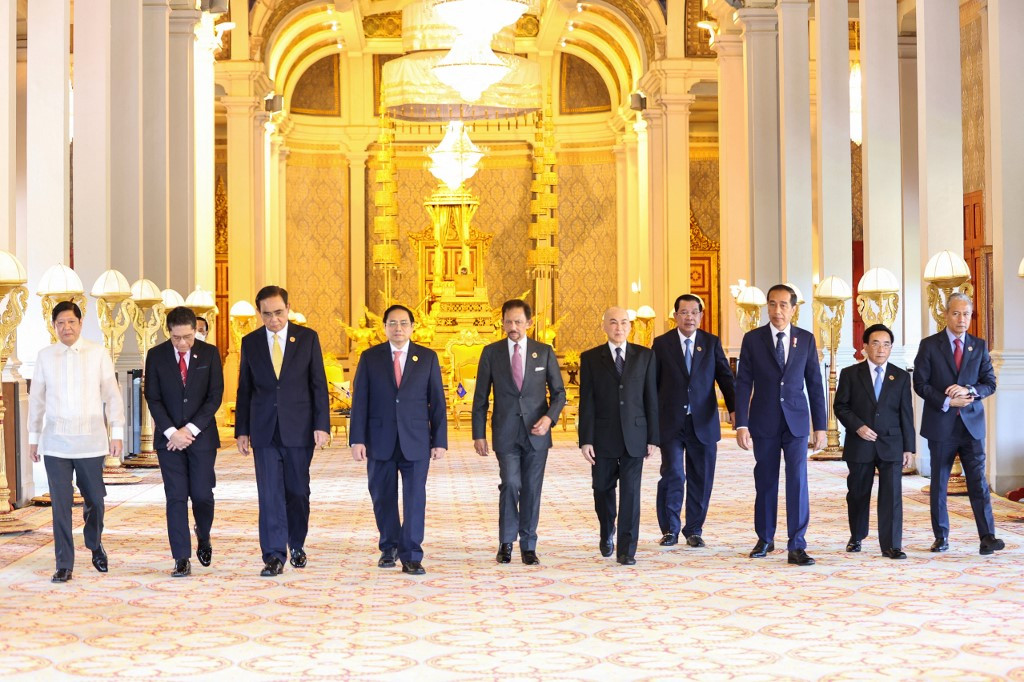 Philippines' President Ferdinand Marcos Jr (left), Thailand’s Prayut Chan-O-Cha (third left), Vietnam’s Prime Minister Pham Minh Chinh (fourth left), Sultan of Brunei Hassanal Bolkiah (fifth left), Cambodia’s King Norodom Sihamoni (5th right), Prime Minister Hun Sen (fourth right), President Joko Widodo (third right), Laos' Prime Minister Phankham Viphavanh (second right) and Malaysia's lower house speaker Azhar Azizan Harun walk during a courtesy call to Cambodia's king before the ASEAN summit in Phnom Penh on Nov. 10, 2022.
(AFP/Kenn Sovanarra)
Philippines' President Ferdinand Marcos Jr (left), Thailand’s Prayut Chan-O-Cha (third left), Vietnam’s Prime Minister Pham Minh Chinh (fourth left), Sultan of Brunei Hassanal Bolkiah (fifth left), Cambodia’s King Norodom Sihamoni (5th right), Prime Minister Hun Sen (fourth right), President Joko Widodo (third right), Laos' Prime Minister Phankham Viphavanh (second right) and Malaysia's lower house speaker Azhar Azizan Harun walk during a courtesy call to Cambodia's king before the ASEAN summit in Phnom Penh on Nov. 10, 2022.
(AFP/Kenn Sovanarra)
O
n Jan. 1, Indonesia officially began its chairmanship of ASEAN for 2023. The last time Indonesia held that position was in 2011, in a swap with Brunei Darussalam, which then chaired ASEAN in 2013.
Back in 2011, Indonesia chaired ASEAN with the agenda of moving the grouping’s agenda one step further: From regional community-building into building a confident and coherent ASEAN that plays a greater role in the community of nations.
Moreover, 2011 was a year when ASEAN was poised to make progress after the adoption of the ASEAN Charter in 2008. Despite the border dispute between Thailand and Cambodia, which was successfully managed, Indonesia’s chairmanship in 2011 concluded with the adoption of the Bali Concord III. ASEAN was on its way to playing a role as a global actor that not only provides regional security, but also contributes to global stability.
The situation in 2023, however, is very different from 2011. ASEAN is now presented with several great challenges and problems that risk undermining the regional bloc’s most fundamental qualities: Relevance, unity and centrality. Those challenges will require ASEAN as an institution, regardless of who the chair is, to work closely to address them in a collective manner.
The first challenge is how to navigate the strategic rivalry between the United States and China. ASEAN will continue to grapple with the necessity to maintain its strategic autonomy while not getting drawn into taking sides in great-power politics.
As the chair, Indonesia must continuously emphasize ASEAN’s strategic interests, which are that the grouping wants neither a pax-Americana nor a pax-Sinica in the region. While extra-regional powers might want to advance their own visions of a regional order, ASEAN should continue advocating that it prefers a regional order based on the ASEAN Outlook on Indo-Pacific (AOIP). The key task for Indonesia’s chairmanship on this challenge is to ensure the operationalization of the AOIP.

The second challenge is the imperative of accelerating post-pandemic economic recovery amid the deterioration of global politics. The economic impacts of the COVID-19 pandemic have been devastating to many countries. The road to recovery will be long and even difficult for many. Yet, that road is now obstructed by Russia’s invasion of Ukraine, inflicting more severe damage on the global economy.