TheJakartaPost
Please Update your browser
Your browser is out of date, and may not be compatible with our website. A list of the most popular web browsers can be found below.
Just click on the icons to get to the download page.


Popular Reads
Top Results
No results found. Please check your search term and try again
Can't find what you're looking for?
View all search results
Popular Reads
Top Results
No results found. Please check your search term and try again
Can't find what you're looking for?
View all search resultsRethinking value-added taxes for developing economies
In resource-rich developing countries, value-added tax (VAT) has not delivered the expected benefits, failing to make up for lost tariff revenues and leaving governments with significant fiscal shortfalls.
Change text size
Gift Premium Articles
to Anyone
Share the best of The Jakarta Post with friends, family, or colleagues. As a subscriber, you can gift 3 to 5 articles each month that anyone can read—no subscription needed!
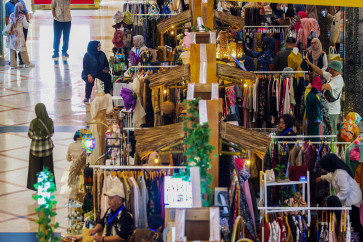
 Visitors view creative industry products at the Sunda Karsa Fest event at the Trans Studio Mall, Bandung, West Java, on July 17, 2025. (Antara Foto/Novrian Arbi)
T
he value-added tax (VAT) is one of the most widely implemented tax innovations of the past 70 years. First piloted in the early 1950s in the Ivory Coast, then a French colony, and gradually introduced across France from 1954 until its formal adoption in 1966, it has since been embraced by 175 countries, with the notable exception of the United States. In many developed and developing economies, it is the leading source of tax revenue, surpassing both corporate and personal income taxes.
The VAT’s global appeal lies in its intrinsic features. As a tax on final household consumption, it provides governments with a stable revenue base. Its debit-credit mechanism, applied throughout the value chain, prevents the cumulative tax burden that was once common with turnover and sales taxes. This method not only ensures neutrality but also strengthens compliance: by cross-checking transactions between suppliers and customers, the VAT generates a more reliable revenue stream even in cases of business failure or fraud.
The spread of the VAT has been closely tied to trade liberalization, as developing countries reduced tariffs and became integrated into the global economy. With tariff revenues shrinking, the VAT, anchored in domestic consumption and collected at the border, offered a powerful substitute capable of offsetting and even surpassing lost customs revenue.
But after decades of widespread use, the VAT warrants reassessment. As our recent study shows, its results have been mixed. In developed economies, it has been effective at boosting tax revenue, supporting industrialization and promoting diversification. In resource-rich developing countries, by contrast, it has not delivered the expected benefits, failing to make up for lost tariff revenues and leaving governments with significant fiscal shortfalls.
With donor governments slashing foreign-aid budgets, the need to mobilize domestic resources, primarily through taxation, has become increasingly critical. This urgency was reaffirmed at the Third International Conference on Financing for Development in Addis Ababa in 2015 and July’s Fourth Conference in Seville, Spain. Both gatherings highlighted domestic revenue as crucial for achieving the United Nations’ 2030 Sustainable Development Agenda.
Beyond its impact on tax revenues, the VAT has had unintended structural consequences for resource-rich developing countries. By design, the VAT applies only to domestic consumption; exports are exempt. Under the destination principle, exporters are even entitled to full refunds on VAT paid for equipment and intermediate goods.

Combined with tariff reductions, this framework has lowered the cost of resource extraction and deepened these countries’ reliance on unprocessed raw material exports such as oil and minerals rather than fostering industries that could add value. The result has been the “resource curse”: a self-reinforcing cycle of limited diversification and economic underdevelopment.