TheJakartaPost
Please Update your browser
Your browser is out of date, and may not be compatible with our website. A list of the most popular web browsers can be found below.
Just click on the icons to get to the download page.


Popular Reads
Top Results
No results found. Please check your search term and try again
Can't find what you're looking for?
View all search results
Popular Reads
Top Results
No results found. Please check your search term and try again
Can't find what you're looking for?
View all search resultsLet’s not give up on trade
While EU authorities would deny that protectionism is the main motive and would point instead to what they deem to be unfair trade practices on Indonesia’s part, the duties in effect protect EU-based steelmakers and rapeseed biodiesel producers.
Change text size
Gift Premium Articles
to Anyone
Share the best of The Jakarta Post with friends, family, or colleagues. As a subscriber, you can gift 3 to 5 articles each month that anyone can read—no subscription needed!
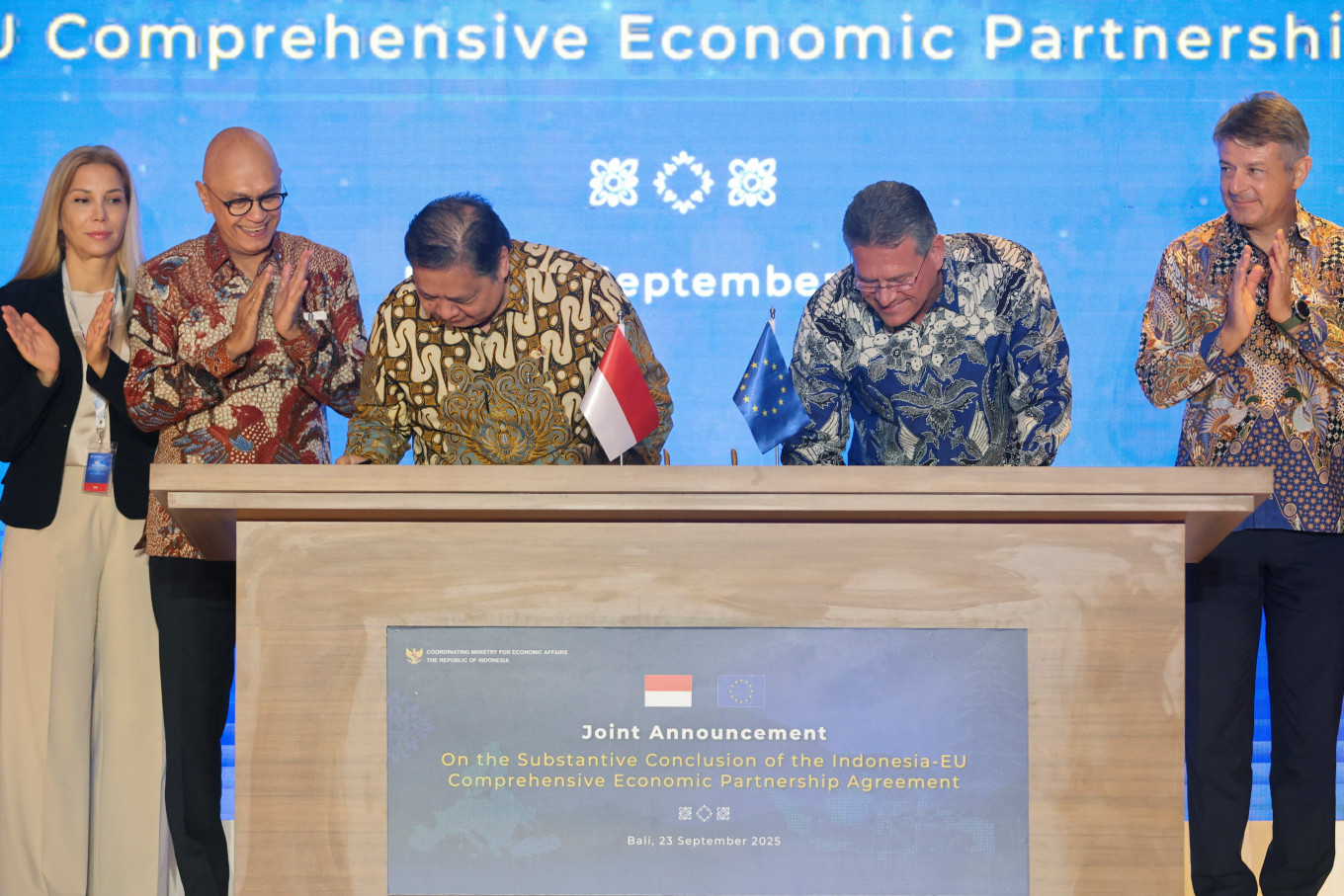 Airlangga Hartarto, Indonesia's Coordinating Minister for Economic Affairs, and Maros Sefcovic, European Commissioner for Trade and Economic Security, sign documents during a ceremony on Sept. 23 on the substantive conclusion of the Indonesia-European Union Comprehensive Economic Partnership Agreement (IEU-CEPA) in Nusa Dua, Bali. (REUTERS/Johannes P. Christo)
E
uropean Union appeals against recent World Trade Organization rulings in Indonesia’s favor fly in the face of the hard-won Indonesia-EU Comprehensive Economic Partnership Agreement (IEU-CEPA).
Since EU representatives came to Bali in September for a signing ceremony on the landmark free trade agreement, the same trade bloc has appealed two WTO rulings meant to support Indonesian exports of biodiesel and stainless steel.
Because the WTO’s appeals process has been dysfunctional for years due to obstruction from the United States, the EU can maintain its punishing import duties imposed on those goods shipped from Indonesia, even though the WTO ruled against the duties.
The EU has been charging countervailing duties of 8 to 18 percent on Indonesian biodiesel since 2019 and antidumping duties of 9.3 to 20.2 percent on stainless steel since 2021, later adding countervailing duties of up to 21.4 percent.
Jakarta has expressed its dissatisfaction in both cases, admitting, however, that it was within Brussels’ legal right to lodge the appeals.
The CEPA deal is slated for ratification by the end of next year, but it requires extensive legal scrubbing in both jurisdictions. Even once implemented, the trade agreement would have no direct bearing on trade-remedy measures like countervailing or antidumping duties, which are aimed, for instance, at offsetting alleged subsidies or dumping.

While EU authorities would deny that protectionism is the main motive and would point instead to what they deem to be unfair trade practices on Indonesia’s part, the duties in effect protect EU-based steelmakers and rapeseed biodiesel producers.