TheJakartaPost
Please Update your browser
Your browser is out of date, and may not be compatible with our website. A list of the most popular web browsers can be found below.
Just click on the icons to get to the download page.


Popular Reads
Top Results
No results found. Please check your search term and try again
Can't find what you're looking for?
View all search results
Popular Reads
Top Results
No results found. Please check your search term and try again
Can't find what you're looking for?
View all search resultsSumatra’s floods are not just nature’s fury, Indonesia must act together
To prevent similar disasters in the future, regular audits of plantation, mining, and logging permits, especially in upstream watersheds, are needed to ensure that land-use decisions support ecological protection.
Change text size
Gift Premium Articles
to Anyone
Share the best of The Jakarta Post with friends, family, or colleagues. As a subscriber, you can gift 3 to 5 articles each month that anyone can read—no subscription needed!
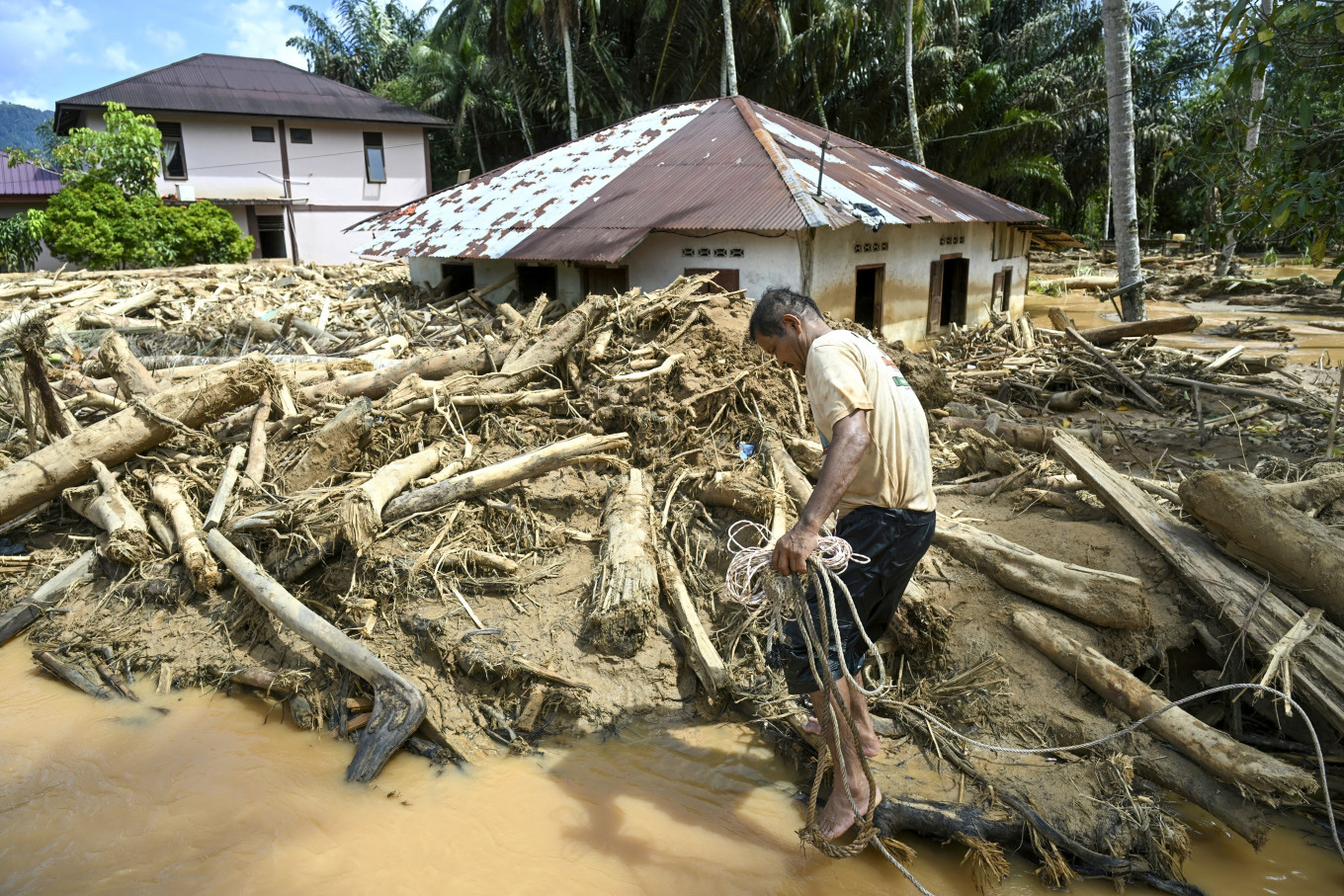 A villager affected by flash floods walks amongst a pile of log debris on Dec. 2, 2025, in Tukka village, Central Tapanuli regency, North Sumatra. The death toll from floods and landslides that have struck Indonesia's Sumatra island since late November has risen to 712, the National Disaster Management Agency said on Dec. 2. (AFP/YT Hariono)
T
he final week of November brought devastating floods and landslides across Aceh, North Sumatra and West Sumatra. More than 700 lives were lost, over 500 people remain missing, and more than 1 million residents have been displaced.
Some districts recorded an astonishing 411 millimeters of rainfall in a single day. Similar extreme weather struck Thailand, Malaysia and Sri Lanka, a reminder that Southeast Asia faces increasingly volatile climate risks.
Heavy rains were the immediate trigger, but the scale of destruction reflects deeper environmental and governance challenges that have accumulated over decades. Understanding these structural conditions, and how institutions can work together to address them, is essential if Indonesia is to build resilience to future climate hazards.
Sumatra’s landscape has undergone profound transformation. Large-scale deforestation for palm oil, timber and mining has stripped the island of its natural defenses. Forests once acted as buffers, stabilizing slopes, absorbing rainfall and protecting watersheds. Their loss has left hillsides exposed, river systems clogged with sediment and peatlands drained and fragile.
Climate change intensifies these hazards, but it does not create them. Long-term land-use change has eroded ecological protections that once softened the impact of heavy rain.
Research shows that plantation expansion, fire-driven land conversion and smallholder agriculture are major drivers of forest loss. When forests recede, the landscape becomes less resilient, not because rainfall is unprecedented, but because natural defenses have weakened.

Indonesia’s forest moratorium and peatland restoration programs are important steps forward. Strengthening and expanding these efforts is essential to reduce risk.