TheJakartaPost
Please Update your browser
Your browser is out of date, and may not be compatible with our website. A list of the most popular web browsers can be found below.
Just click on the icons to get to the download page.


Popular Reads
Top Results
No results found. Please check your search term and try again
Can't find what you're looking for?
View all search results
Popular Reads
Top Results
No results found. Please check your search term and try again
Can't find what you're looking for?
View all search resultsCoordinated response key to govt’s disaster handling
Technically, Indonesia doesn’t need to ask for international aid, but it should not reject foreign assistance either in times of emergency.
Change text size
Gift Premium Articles
to Anyone
Share the best of The Jakarta Post with friends, family, or colleagues. As a subscriber, you can gift 3 to 5 articles each month that anyone can read—no subscription needed!
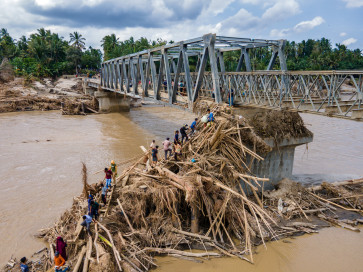
 This aerial photo shows people climbing debris, on Dec. 9, 2025, to cross the river on a newly built bridge, connecting Aceh and North Sumatra province, after being destroyed by flash floods along Peusangan river in Bireuen district, Aceh. (AFP/Chaideer Mahyuddin)
F
loods and landslides have continued to paralyze large parts of Aceh, North Sumatra and West Sumatra, with the death toll nearing 1,000. Aceh is seeing widespread destruction reminiscent of the earthquake and tsunami in 2004.
Among prominent figures with firsthand knowledge and experience of the Aceh disaster response more than 20 years ago is former vice president Jusuf Kalla, who now chairs the Indonesian Red Cross (PMI). On Wednesday, Kalla spoke with The Jakarta Post’s M. Taufiqurrahman, Radhiyya Indra and Kharishar Kahfi about the ongoing handling of the Sumatra disaster and lessons learned from the 2004 tsunami response. Below are excerpts from the conversation.
Question: As someone who was on the ground in Aceh in the early days of the 2004 tsunami and was deeply involved in the response, how critical is the government’s emergency action in the first few days of a disaster?
Answer: Today’s disaster and the 2004 disaster have different characteristics. In 2004, it was a tsunami. The devastation came from the earthquake, which destroyed buildings, and then the tsunami which followed and overwhelmed the region, causing huge numbers of deaths.
On the other hand, floods mostly cause damage to houses, though not total destruction. What destroyed infrastructure this time was not just floodwater, but the logs carried by the flood. If you look at the collapsed bridges, they didn’t fall apart because of the water alone, but because of the wooden logs. So the bigger “sin” lies with people cutting trees or damaging forests. Floods naturally have risks, but not to this extent.
The solution always includes three phases: emergency response, rehabilitation and reconstruction. Back in 2004, the emergency response lasted six months. Today’s disaster might differ. Despite differences in disasters, every casualty matters. Even one death is too many.

We’ve heard a lot of debate about whether the government should declare this tragedy a national disaster. In your view, is that a substantive discussion or are there more important issues that remain less talked about?