TheJakartaPost
Please Update your browser
Your browser is out of date, and may not be compatible with our website. A list of the most popular web browsers can be found below.
Just click on the icons to get to the download page.


Popular Reads
Top Results
No results found. Please check your search term and try again
Can't find what you're looking for?
View all search results
Popular Reads
Top Results
No results found. Please check your search term and try again
Can't find what you're looking for?
View all search resultsIndia’s strategic autonomy: A case for moral leadership
The warm recent reception given by Indian Prime Minister Narendra Modi to Russian President Vladimir Putin shows the double standards of India, which is trying to build stronger relationships with the West while maintaining its historical ties with Russia.
Change text size
Gift Premium Articles
to Anyone
Share the best of The Jakarta Post with friends, family, or colleagues. As a subscriber, you can gift 3 to 5 articles each month that anyone can read—no subscription needed!
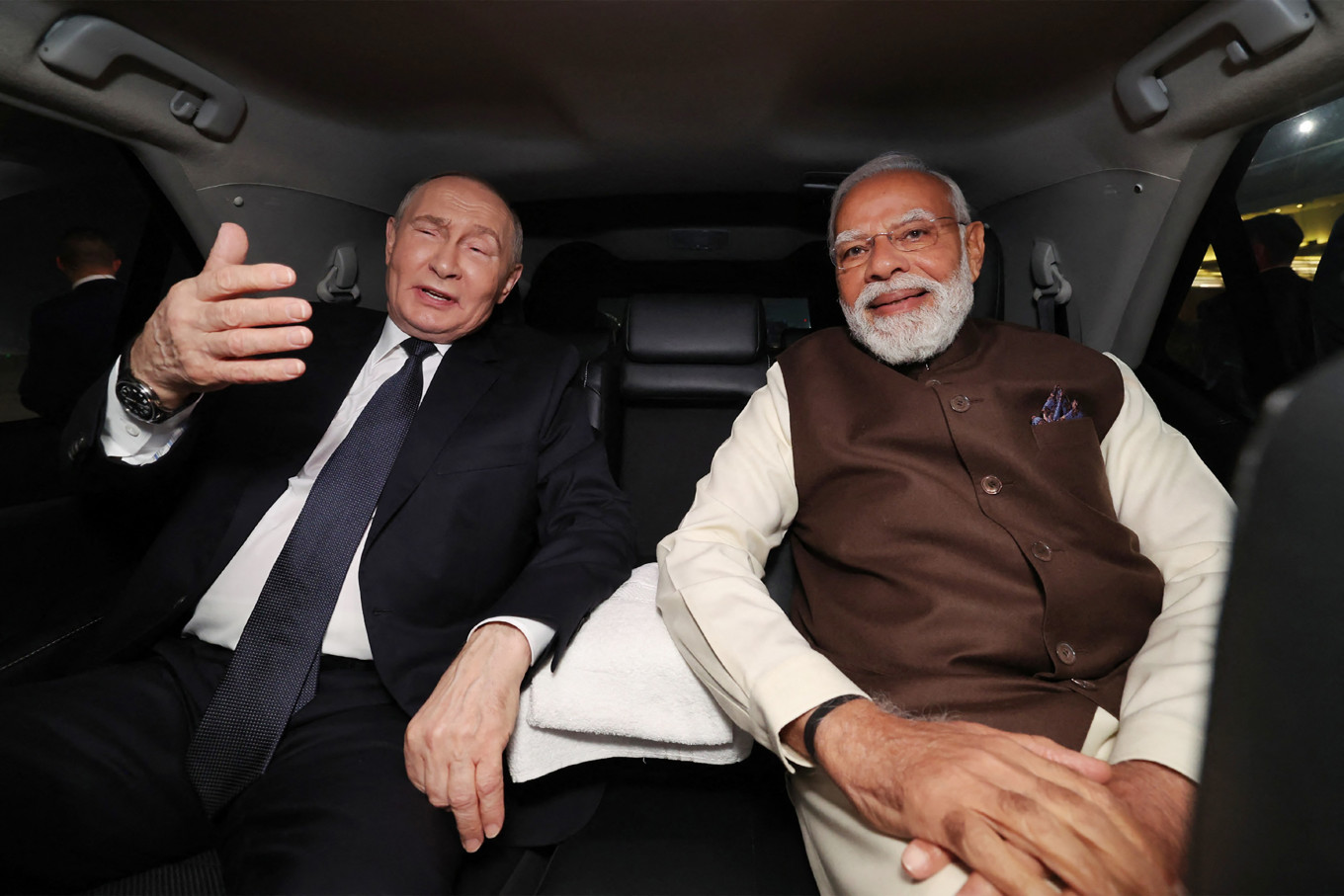 India's Prime Minister Narendra Modi (right) and Russia's President Vladimir Putin sit in a car, on Dec. 4, 2025, departing from Palam Air Force Base, India. Putin arrived in India on Dec. 4 for a two-day visit aimed at deepening defense ties, as New Delhi faces heavy United States pressure to stop buying oil from Moscow. (PIB/AFP/PIB/AFP)
I
n the conduct of international affairs, countries set boundaries and red lines. Establishing these key thresholds is a complex, multifaceted endeavor; the final outlook necessarily depends on an interplay of issues related to a government’s strategic priorities.
Some factors that determine these red lines often conflict with one another, forcing nations into difficult trade-offs. Economic ties and core issues of national sovereignty dictate the terms of these fundamental positions, marking how governments react to international dynamics in the realm of geopolitics.
Yet, a moral angle should remain central in this decision-making process, even though principles and values are too often forgotten when positions are solidified.
If a country is run by a one-party regime, or if the political system is rigged in favor of those in power, it is easy to brush off concerns related to morality. But if a nation claims to be democratic and pluralist, then things should be different.
Those who defend freedom and liberty should always remember the United Nations General Assembly voted March 2, 2022, against Russia’s invasion of Ukraine.
Observing the warm reception given by Indian Prime Minister Narendra Modi to Russian President Vladimir Putin inevitably brought me to think about geopolitical redlines. There has been much talk about the perceived double standards of India, which is trying to build stronger relationships with the West while maintaining its historical ties with Russia.

Over the last three years, India has been effective in pushing back against criticisms, reaffirming an independent and sovereign stance that balances its strategic interests with various partners. New Delhi, thanks to Indian Minister of External Affairs, S. Jaishankar, has been able to assert its strategic autonomy with extreme deftness.