TheJakartaPost
Please Update your browser
Your browser is out of date, and may not be compatible with our website. A list of the most popular web browsers can be found below.
Just click on the icons to get to the download page.


Popular Reads
Top Results
No results found. Please check your search term and try again
Can't find what you're looking for?
View all search results
Popular Reads
Top Results
No results found. Please check your search term and try again
Can't find what you're looking for?
View all search resultsA test of wisdom: NU grapples with conflict, politics
NU is not simply a religious organization, but a moral force and a social movement with enormous political weight.
Change text size
Gift Premium Articles
to Anyone
Share the best of The Jakarta Post with friends, family, or colleagues. As a subscriber, you can gift 3 to 5 articles each month that anyone can read—no subscription needed!
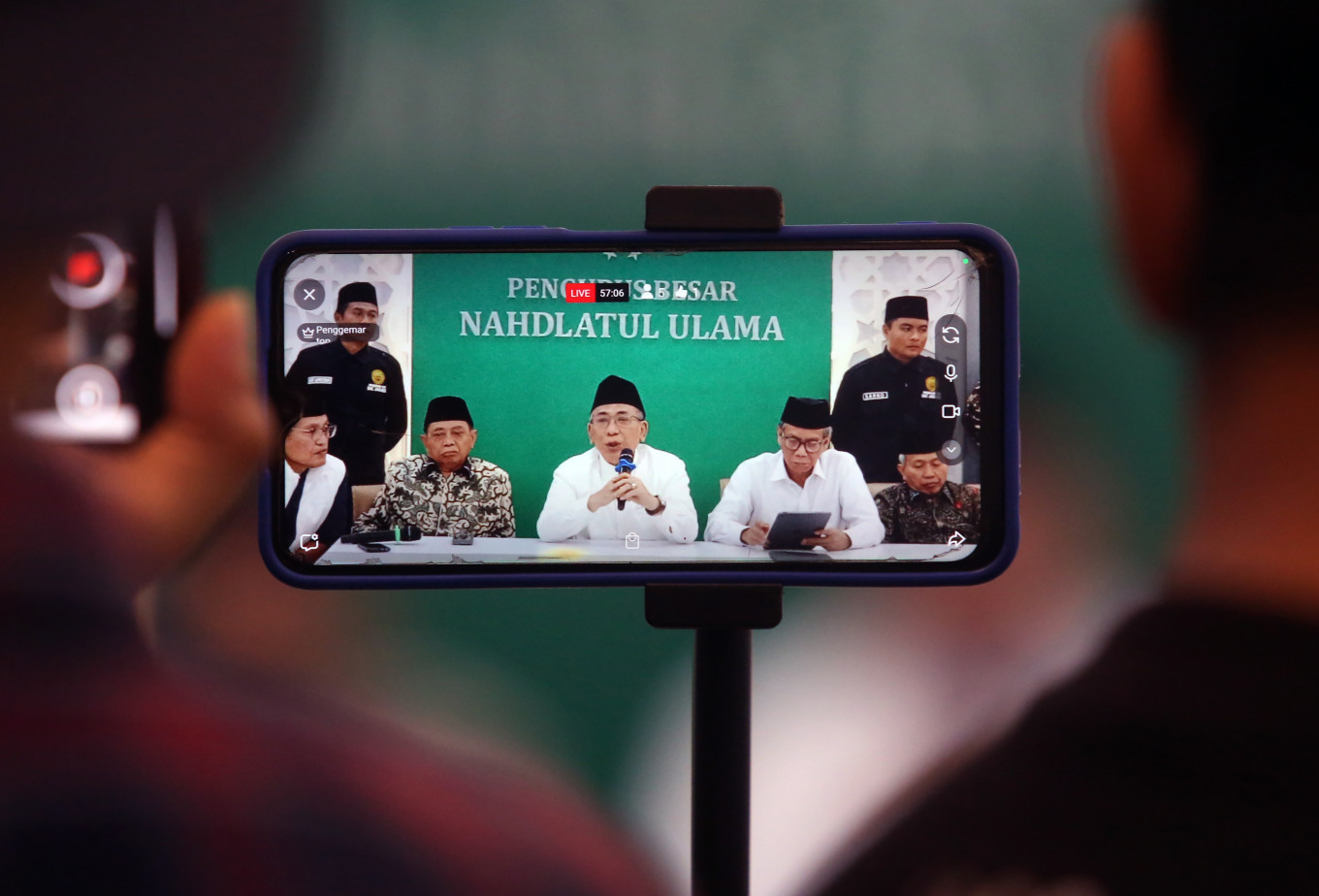 Indonesia’s largest Islamic organization Nahdlatul Ulama (NU) chairman Yahya Cholil Staquf (center), accompanied by the organization’s deputy chairman Masyhuri Malik (second left) and secretary-general Amin Said Husni (second right), gives a press statement on Dec. 3, 2025, regarding the refusal to step down as chairman in Jakarta. (Antara/Muhammad Iqbal)
N
ahdlatul Ulama (NU) today stands at one of the most critical junctures in its long history. For someone who has spent decades within NU, as a cadre, an organizer and a witness to its internal dynamics, like me, what is unfolding now is not merely an organizational dispute. It is a profound test of NU’s moral authority, political maturity and historical responsibility.
Internal conflict is not new to NU. Since its founding, NU has lived with differences of opinion and internal contestation. Yet the current crisis is unprecedented in its openness and intensity.
For the first time in recent history, two rival groups simultaneously claim to be the legitimate Executive Board of Nahdlatul Ulama (PBNU). This dualism is no longer a latent tension; it is a public rupture that risks undermining NU’s credibility as a moral anchor of Indonesian Islam.
Some have framed this crisis as a technical dispute over statutes and procedures. Such explanations are insufficient. What NU faces today goes far deeper: It concerns the legitimacy of ulema leadership, the ethics of power and NU’s direction combined as it enters its second century.
Scholars such as Greg Barton have long emphasized that NU is not simply a religious organization, but a moral force and a social movement with enormous political weight. With an estimated 110 million followers, nearly half of Indonesia’s electorate, NU is inevitably entangled in national politics.
The 2029 presidential election is four years away, but the political undertones of this conflict have become increasingly difficult to ignore. NU is seen not only as a religious authority, but also as a potential kingmaker, as happened in the past.

Yet NU’s greatness lies precisely in its ability to rise above short-term political calculations. When internal conflicts are driven, or perceived to be driven, by political ambition, NU risks losing the moral distance that has long been the source of its authority.