TheJakartaPost
Please Update your browser
Your browser is out of date, and may not be compatible with our website. A list of the most popular web browsers can be found below.
Just click on the icons to get to the download page.


Popular Reads
Top Results
No results found. Please check your search term and try again
Can't find what you're looking for?
View all search results
Popular Reads
Top Results
No results found. Please check your search term and try again
Can't find what you're looking for?
View all search resultsWhy the usual approach to corruption keeps failing
The real task of eradicating corruption is narrowing the space where wrongdoing still feels normal, necessary or excusable.
Change text size
Gift Premium Articles
to Anyone
Share the best of The Jakarta Post with friends, family, or colleagues. As a subscriber, you can gift 3 to 5 articles each month that anyone can read—no subscription needed!
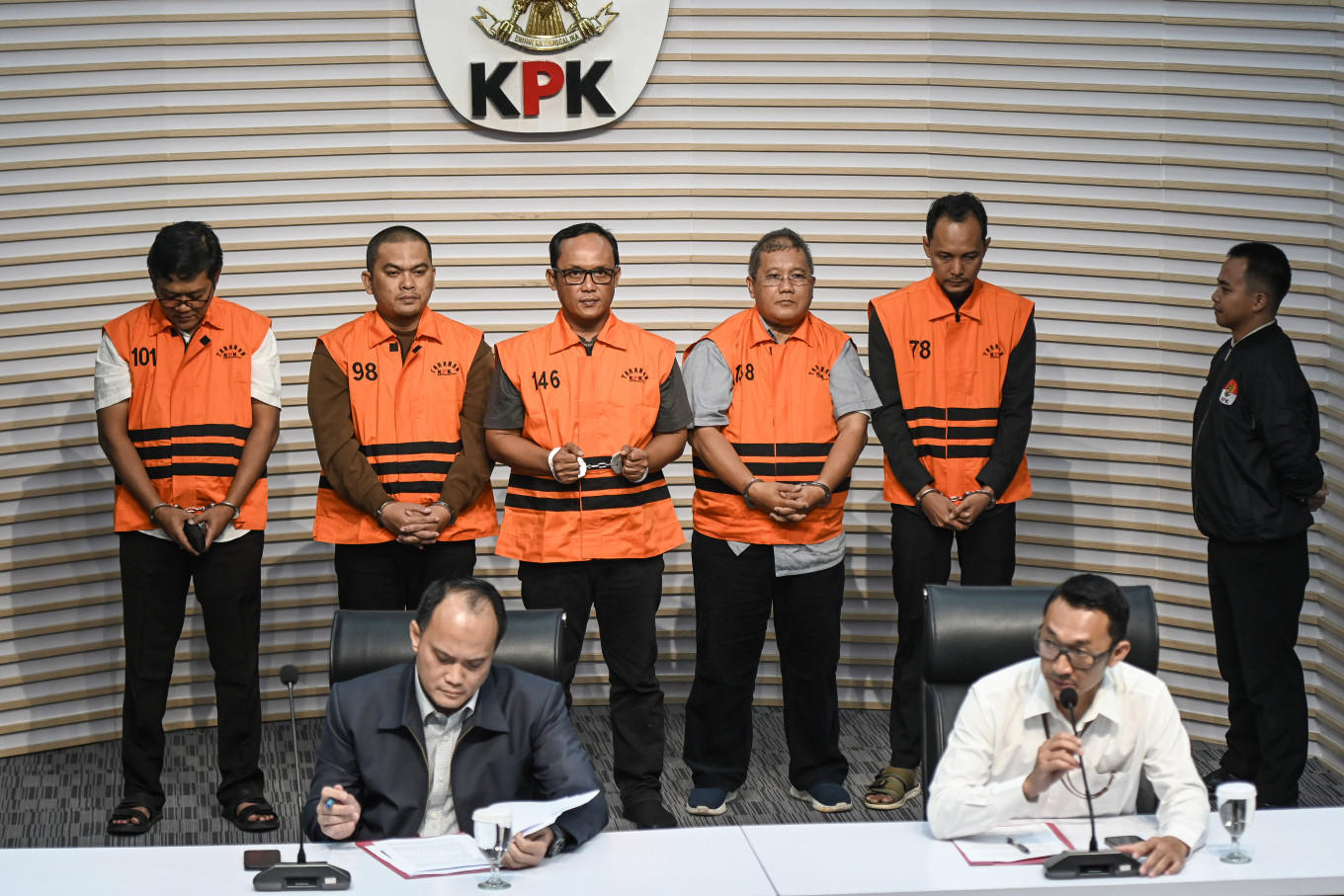 Collective fraud: Five suspects (from left) Central Lampung Revenue Agency acting head Anton Wibowo, Central Lampung Legislative Council member Riki Hendra Saputra, Central Lampung Regent Ardito Wijaya, PT Elkaka Mandiri director Lukman Sjamsuri and the regent’s brother Ranu Hari Prasetyo are seen on Dec. 11, 2025, during a press conference at the Corruption Eradication Commission (KPK) building in Jakarta. The KPK has detained the five suspects in connection with a bribery case related to the procurement of goods and services in several Central Lampung regency projects. (Antara/Sulthony Hasanuddin)
A
t a recent public discussion on corruption, the atmosphere shifted perceptibly when attention turned to corporate practices. In the audience, some frowned. Others leaned back, arms folded. The conversation moved away from the corruption that "harms the state" and toward the murky practices emerging inside private companies.
The shift itself raised questions. If the corruption that drains the state of enormous resources has long been associated with public institutions and civil servants, why has the focus moved now? Why target corporations, entities often operating under formal ethics codes, audits and compliance systems?
And if corruption requires at least two parties to function, which dynamics were being emphasized, and which were quietly receding from view? When corruption becomes routine and barely visible, who allows it to continue, and how?
Over time, the same mistake repeats itself. Similar panels convene. Similar reports circulate. Similar institutional responses follow. Rules are added, compliance mechanisms adjusted, and enforcement units reorganized.
Each cycle introduces cosmetic changes, yet rests on the same naïve assumption: that tightening rules, adding regulations and increasing enforcement will eventually produce a different outcome. When it does not, the assumption is rarely questioned. Instead, it is repeated.
Decades ago, the sociologist Syed Hussein Alatas offered a more uncomfortable explanation. Corruption does not survive because people fail to distinguish right from wrong. It survives because societies provide justifications that allow wrongdoing to feel acceptable. People rarely see themselves as corrupt. They see themselves as practical, constrained, loyal or simply adapting to reality.

This insight shifts attention away from rules and toward how moral boundaries actually operate. In many societies, including Indonesia, wrongdoing does not automatically produce inner resistance. What produces discomfort is exposure. A mistake becomes serious only when it is seen, when it threatens one's position, reputation or access.