The Jakarta Post
Please Update your browser
Your browser is out of date, and may not be compatible with our website. A list of the most popular web browsers can be found below.
Just click on the icons to get to the download page.


Popular Reads
Top Results
No results found. Please check your search term and try again
Can't find what you're looking for?
View all search results
Popular Reads
Top Results
No results found. Please check your search term and try again
Can't find what you're looking for?
View all search resultsAnalysis: When law enforcers place themselves above the Constitution
Change text size
Gift Premium Articles
to Anyone
Share the best of The Jakarta Post with friends, family, or colleagues. As a subscriber, you can gift 3 to 5 articles each month that anyone can read—no subscription needed!
 Set as preferred source
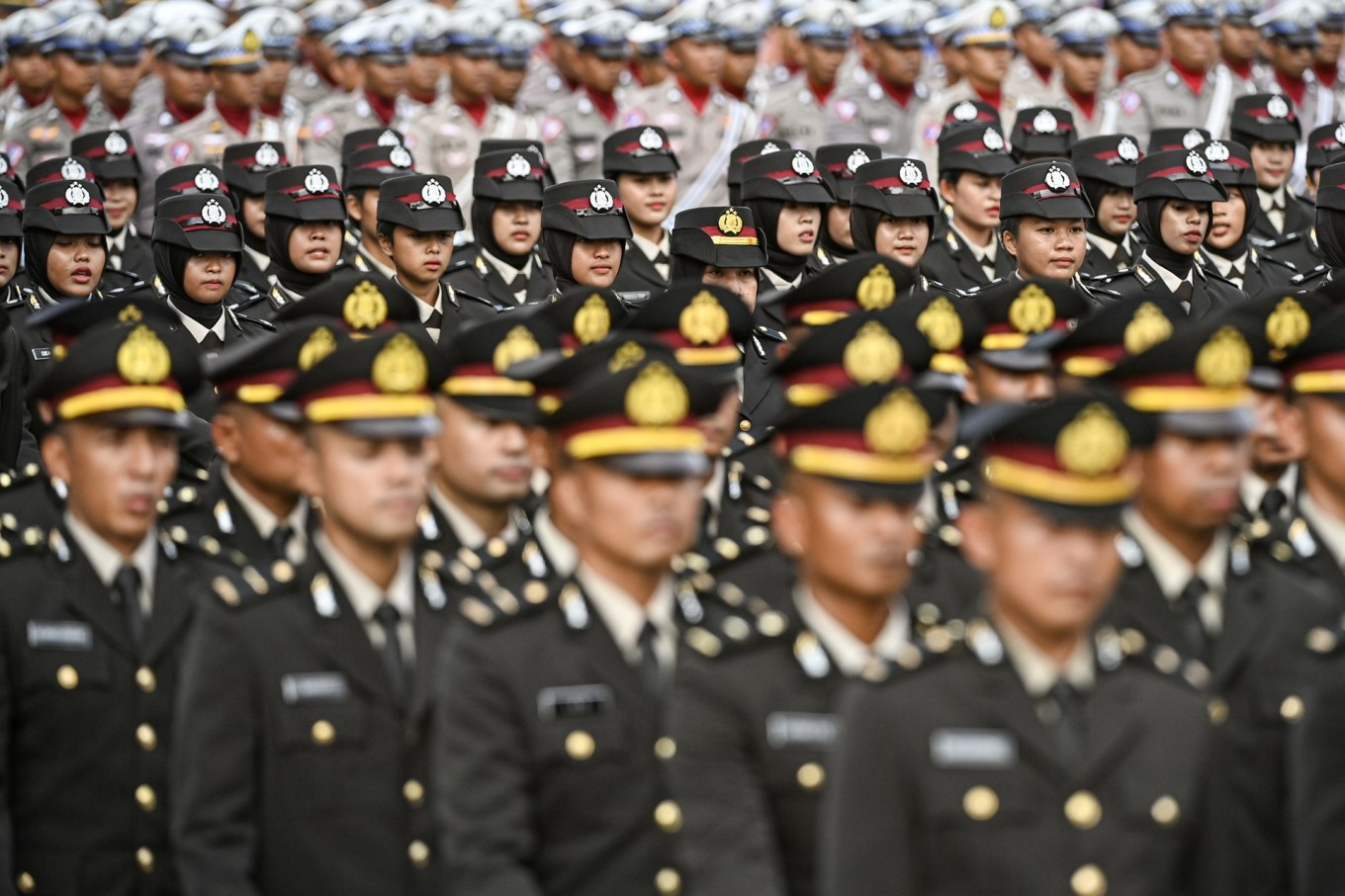 Police officers march during a ceremony on July 1, 2024, to commemorate the 78th anniversary of the National Police at the National Monument (Monas) Square in Central Jakarta. (Antara/Muhammad Adimaja)
R
ather than safeguarding justice, Indonesia's legal instruments are increasingly being bent to serve institutional interests. The standoff between the Constitutional Court (MK) and the National Police over the assignment of active officers to civilian posts exposes not merely regulatory inconsistency, but a deeper disregard for constitutional authority.
On Nov. 13, the MK issued Decision No. 114/PUU-XXIII/2025, explicitly prohibiting active police officers from holding positions outside the police force. The ruling was unequivocal that police personnel may occupy posts in ministries and state agencies only after resigning from active service or formally retiring.
The decision addressed long-standing public unease over the steady expansion of police influence in civilian governance. Far from abating, the practice has accelerated over the past three years, raising concerns about blurred boundaries between law enforcement and civilian administration.
In 2025 alone, 4,351 police personnel were assigned outside the National Police's organizational structure, a 13.8 percent increase from 2024 and a 27 percent rise compared to 2023. Roughly one-third of those seconded to ministries and government institutions were senior officers, underscoring a systematic pattern of embedding police personnel in strategically significant civilian posts.
Yet less than a month after the Court issued its ruling, National Police Chief Gen. Listyo Sigit Prabowo moved in the opposite direction. On Dec. 9, he issued National Police Regulation (Perpol) No. 10/2025, formalizing the placement of active police officers in 17 ministries and government institutions.
The regulation immediately drew sharp criticism. Legal experts and civil society groups argue that the Perpol is not merely problematic, but openly unconstitutional, amounting to an act of institutional defiance against the MK. By creating a regulatory workaround, critics say, the police leadership has effectively hollowed out the Court's authority.

The Police Reform Acceleration Commission, established by President Prabowo Subianto on Nov. 7, has so far failed to provide clarity or resolution. Nevertheless, chairman Jimly Asshiddiqie and commissioner Mahfud MD, both constitutional law experts and former chief justices of the MK, have bluntly described the Perpol as legally defective and inconsistent with higher-ranking laws. Jimly has gone further, urging the public to petition the Supreme Court to have the Perpol annulled.