The Jakarta Post
Please Update your browser
Your browser is out of date, and may not be compatible with our website. A list of the most popular web browsers can be found below.
Just click on the icons to get to the download page.


Popular Reads
Top Results
No results found. Please check your search term and try again
Can't find what you're looking for?
View all search results
Popular Reads
Top Results
No results found. Please check your search term and try again
Can't find what you're looking for?
View all search resultsAre our labs equipped to achieve cervical cancer screening targets?
Out of the 386 regencies and mayoralties targeted by the Health Ministry, fewer than half are estimated to have public health laboratories currently capable of processing PCR-based HPV DNA tests to detect cervical cancer.
Change text size
Gift Premium Articles
to Anyone
Share the best of The Jakarta Post with friends, family, or colleagues. As a subscriber, you can gift 3 to 5 articles each month that anyone can read—no subscription needed!
 Set as preferred source
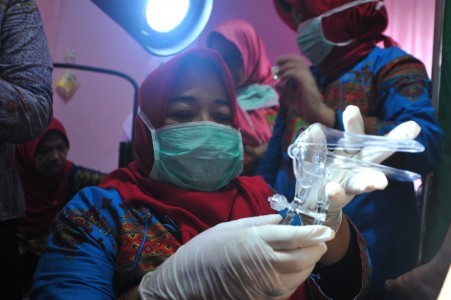 A healthcare worker prepares a device to help a patient with an early cervical cancer screening on July 17, 2017,.at a community health center (Puskesmas) in Palembang, South Sumatra (Antara/ Feny Selly )
W
hen it comes to cervical cancer, we are still not doing enough. This is deeply concerning considering that cervical cancer is one of the most preventable types of cancer. Yet in Indonesia, most cases are detected only at an advanced stage when the risk of death is significantly higher.
The Health Ministry’s Director General for Disease Prevention and Control Yudhi Pramono underscored this urgency during the National Action Plan campaign last year: Indonesia ranks third highest in Southeast Asia for new cervical cancer cases. Without intervention, it is estimated that more than 1.7 million women could die from the disease by 2070.
This is a disease we already know how to detect and treat. The solution lies in improving how we design and deliver health services.
The World Health Organization (WHO) recommends Human Papillomavirus (HPV) DNA testing as the primary screening method, replacing the cytology-based (Pap smear) approach. Because HPV DNA testing can detect abnormalities long before they progress toward malignancy, Indonesia is working to adopt this recommendation, aiming to screen approximately 90 percent of women aged 35 and older.
But a critical question remains: Are we truly ready to implement this nationwide?
The success of this program hinges on laboratory capacity. A screening effort, no matter how extensive, will fail without strong laboratory support, as weak capacity leads to delays and a higher risk of false-negative results.

Out of the 386 regencies and mayoralties targeted by the Health Ministry, fewer than half are estimated to have public health laboratories (Labkesmas) currently capable of processing Polymerase Chain Reaction (PCR)-based HPV DNA tests. This limitation raises a critical question: Can our existing resources - laboratories, logistics and human capital - support such an ambitious target?