TheJakartaPost
Please Update your browser
Your browser is out of date, and may not be compatible with our website. A list of the most popular web browsers can be found below.
Just click on the icons to get to the download page.


Popular Reads
Top Results
No results found. Please check your search term and try again
Can't find what you're looking for?
View all search results
Popular Reads
Top Results
No results found. Please check your search term and try again
Can't find what you're looking for?
View all search resultsThe strategic necessity of ‘mandiri’ in the extreme climate age
The Indonesian term "mandiri" embodies the type of strategic governance necessary to unify a state's resources under a single command during a natural catastrophe.
Change text size
Gift Premium Articles
to Anyone
Share the best of The Jakarta Post with friends, family, or colleagues. As a subscriber, you can gift 3 to 5 articles each month that anyone can read—no subscription needed!
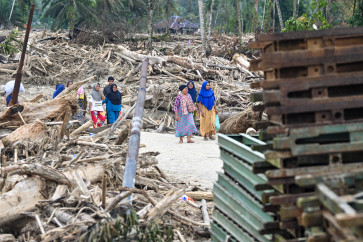
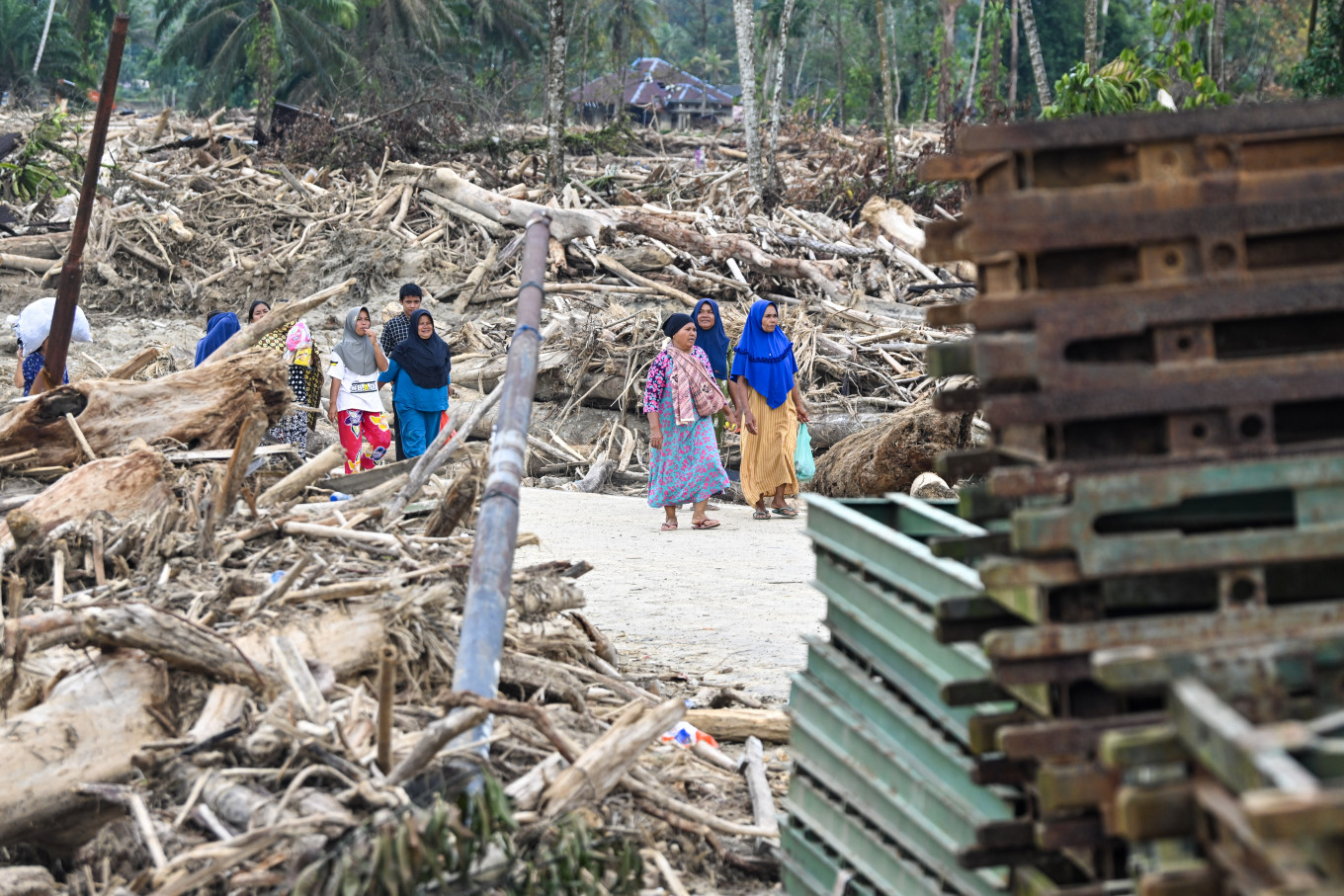 People walk along a path on Dec. 11, 2025, through logs and wood debris left behind by flash floods and landslides in Central Tapanuli regency, North Sumatra. (Antara/Muhammad Adimaja)
T
he international system is, and has always been, anarchical. There is no world authority capable of rescuing nation-states when they confront existential danger. Classical realism has never deviated from this starting point: Self-help is the organizing principle of international relations.
If a state does not strengthen itself, no external actor will shoulder that burden.
This instinct has been visible for centuries. In China, it is known as “fu guo qiang bing” (rich country, strong army). In Japan, the Meiji era entrenched the slogan “fukoku kyohei” (enrich the nation, strengthen the military). In the United States, “Make America Great Again” is essentially a modern slogan wrapped around this ancient reflex. These phrases, spread across time and geography, point to the same civilizational anchor: Without self-help, sovereignty decays.
Indonesia has its own strategic vocabulary for this foundation: mandiri.
On the surface, mandiri means self-reliance. In strategic practice, however, it means something deeper. Mandiri is the state’s ability to govern itself, marshal resources, deploy the military, activate police and auxiliary services and coordinate civilian disaster agencies, all without waiting for foreign rescue missions to determine the nation's fate.
It is the clearest articulation of a nation’s maturity. It means unifying brigade-level mobility, emergency logistics, food stockpiles, evacuation doctrine, humanitarian medical teams, weather surveillance and civilian volunteers under a single command. This is what separates independence from dependency.

Mandiri has been embedded in Indonesia’s political memory for nearly 80 years. The 1955 Bandung Conference, the first great summit of Asian and African leaders, rejected colonialism and imperialism not merely as slogans but as strategic obligations. Bandung demanded self-governance, economic autonomy and political resilience. It was nationalism without xenophobia, positive sovereignty without submission.