The Jakarta Post
Please Update your browser
Your browser is out of date, and may not be compatible with our website. A list of the most popular web browsers can be found below.
Just click on the icons to get to the download page.


Popular Reads
Top Results
No results found. Please check your search term and try again
Can't find what you're looking for?
View all search results
Popular Reads
Top Results
No results found. Please check your search term and try again
Can't find what you're looking for?
View all search resultsTurning Indonesia’s mounting waste into watts
Through the waste to energy initiative, Danantara will provide the investment, while the state utility company, PLN, will handle the electricity generated.
Change text size
Gift Premium Articles
to Anyone
Share the best of The Jakarta Post with friends, family, or colleagues. As a subscriber, you can gift 3 to 5 articles each month that anyone can read—no subscription needed!
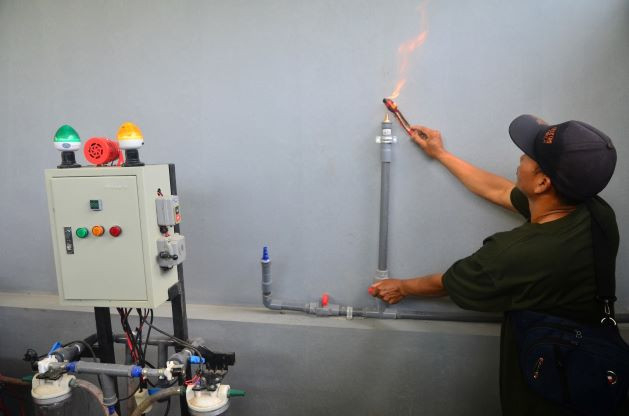 Green energy: A technician checks methane gas produced by a biomass reactor on March 4, 2022, in Gondosari village, Kudus regency, Central Java. The bioreactor installation converts agriculture and animal husbandry waste into energy, fertilizer and pesticide.
(Antara/Yusuf Nugroho)
Green energy: A technician checks methane gas produced by a biomass reactor on March 4, 2022, in Gondosari village, Kudus regency, Central Java. The bioreactor installation converts agriculture and animal husbandry waste into energy, fertilizer and pesticide.
(Antara/Yusuf Nugroho)
T
he world has shifted toward a new paradigm. Everything is being digitized, reshaping political economies, social structures and cultural life. Crucially, this shift includes how we protect our environment. Consequently, the concept of a green economy has become the dominant narrative of our time.
Indonesia has already begun this journey with restrictions on plastic use. Plastic is known for its long decomposing time, harming marine life and the oceans that are integral to our archipelago. This global campaign has become a new tradition in Indonesia: We now shop without single-use packaging, carrying our own bags or purchasing reusable ones. This is our cultural and social evolution, a collective contribution to preserving the environment.
The next evolution is a shift in our habits regarding waste sorting. The goal is to enable both decomposition and recycling processes. The critical step today is converting waste into energy (WtE). With Indonesia's waste accumulation reaching 35 million to 60 million tonnes annually, dominated by up to 60 percent organic waste, it is an obligation, not an option, to practice environmentally friendly waste management.
This is not only about preservation; it is about unlocking economic value. We can generate energy not from fossil fuels, but by diverting waste from landfills. The costs of waste management should no longer vanish into thin air; they must be transformed into production inputs for our economic engine.
To this end, the government has created a roadmap through the end of 2025. The Waste-to-Energy program will be led by the Environment Ministry, but Danantara, the country’s strategic investment management agency, will undoubtedly be the engine for its realization.
Our target is investment in Indonesia's environmental and economic future. This program will involve multiple stakeholders with a primary goal: preserving Indonesia's nature while cultivating a circular economy for the people.

Converting waste to energy is not a pipe dream; it is being implemented globally. Our neighbor, Singapore, has proven this with its TuasOne facility. The Malaysian government is heavily committed to activating 18 waste-to-energy sites by 2050, aiming to convert 90 percent of waste into energy, primarily electricity, for domestic needs. This ensures environmental preservation while boosting their circular economy.