The Jakarta Post
Please Update your browser
Your browser is out of date, and may not be compatible with our website. A list of the most popular web browsers can be found below.
Just click on the icons to get to the download page.


Popular Reads
Top Results
No results found. Please check your search term and try again
Can't find what you're looking for?
View all search results
Popular Reads
Top Results
No results found. Please check your search term and try again
Can't find what you're looking for?
View all search resultsAnalysis: Weak import governance undermines steel industry
Change text size
Gift Premium Articles
to Anyone
Share the best of The Jakarta Post with friends, family, or colleagues. As a subscriber, you can gift 3 to 5 articles each month that anyone can read—no subscription needed!
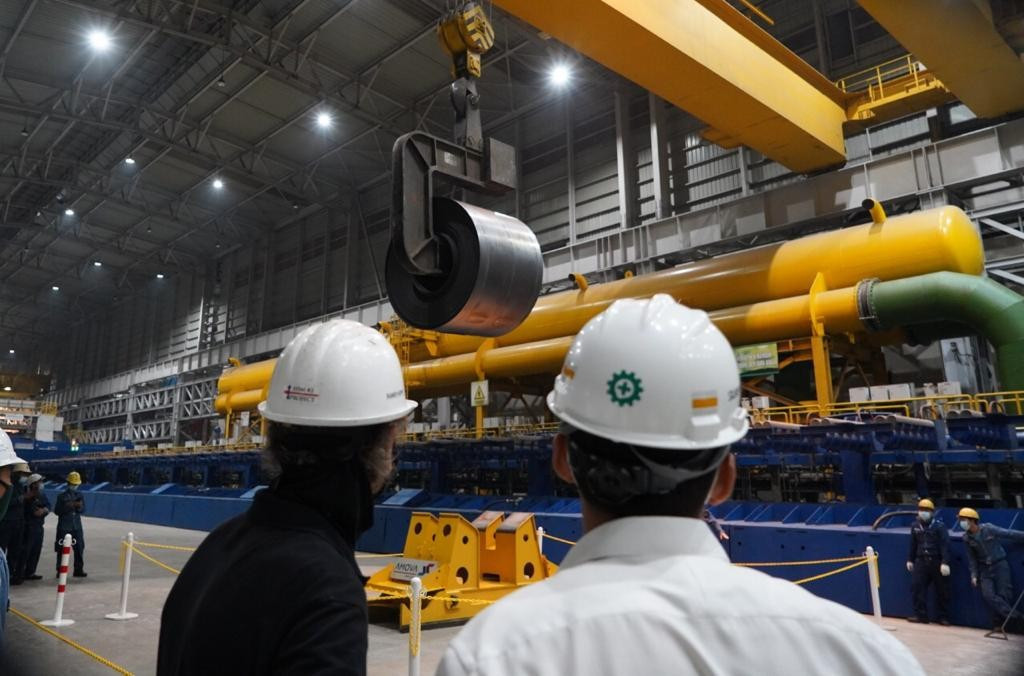 Krakatau Steel employees watch the production of the first hot rolled coil (HRC) steel on May 17, 2021, in the company's second hot steel mill in Banten. (Courtesy of Krakatau Steel)
I
ndonesia's ambition to strengthen its domestic steel industry is being quietly undermined from within. While policymakers continue to champion downstream industry development, industrial resilience and import substitution, recent findings by the Supreme Audit Agency (BPK) reveal troubling weaknesses in steel import governance. The problem extends beyond illegal imports, pointing instead to regulatory gaps, weak inter-ministerial coordination and administrative failures that continue to erode the credibility of Indonesia's industrial policy.
The consequences are increasingly visible across the domestic steel market. A sustained influx of imported steel, particularly from China, has intensified competitive pressures on national producers. In 2024, Indonesia's steel consumption reached 18.5 million tonnes, with imports accounting for more than 55 percent of total demand. This trend persisted in 2025, as imports of basic iron and steel exceeded 9 million tonnes between January and August alone, with China contributing 3.81 million tonnes.
Such volumes cannot be explained by market demand alone. BPK findings point to deeper governance failures in the management of steel imports, particularly in the issuance of import permits. Auditors identified inconsistencies between import approvals issued by the Trade Ministry and the technical considerations provided by the Industry Ministry.
In many cases, imports under certain Harmonized System (HS) codes were approved by the Trade Ministry without technical clearance from the Industry Ministry, raising questions about how HS codes are applied and monitored. Total value of imports without technical clearance reached Rp 895 billion (US$54 million) in 2023 until the first semester of 2024. Several lawmakers from the House of Representatives' Commission VI overseeing trade have urged the BPK to conduct an investigative audit into steel import licensing practices.
These weaknesses in the licensing process have allowed steel products to enter the domestic market without adequate technical justification, creating conditions in which HS code manipulation becomes possible. Compounding the problem is the absence of a steel commodity balance to guide import licensing. Although the government has pledged to establish such a mechanism, it has yet to materialize.
The pressure from imports has been amplified by persistent global oversupply and aggressive export strategies by major steel-producing countries. Circumvention of HS codes has become one of the most contentious trade practices globally, particularly following tighter trade remedies imposed on Chinese steel in multiple markets. Chinese exports are increasingly routed through intermediary countries such as Vietnam, Malaysia and Taiwan before entering Indonesia.

According to the Indonesian Iron and Steel Industry Association, a common method of HS circumvention involves reclassifying carbon steel as alloy steel by adding trace amounts of alloying elements, as little as 0.0008 percent boron or 0.3 percent chromium. Such minimal additions do not materially alter the steel's performance or end use but allow products to qualify as alloy steel with zero tariff. The result has been a surge in alloy steel imports, lower factory utilization in Indonesia's energy-intensive steel sector and declining state revenue.