TheJakartaPost
Please Update your browser
Your browser is out of date, and may not be compatible with our website. A list of the most popular web browsers can be found below.
Just click on the icons to get to the download page.


Popular Reads
Top Results
No results found. Please check your search term and try again
Can't find what you're looking for?
View all search results
Popular Reads
Top Results
No results found. Please check your search term and try again
Can't find what you're looking for?
View all search resultsRogue hegemons are sabotaging the global economy
The US under the Trump administration has emerged as a global hegemon alongside China, albeit with different drivers, afflicting the rest of the world with limited opportunities, especially developing countries.
Change text size
Gift Premium Articles
to Anyone
Share the best of The Jakarta Post with friends, family, or colleagues. As a subscriber, you can gift 3 to 5 articles each month that anyone can read—no subscription needed!
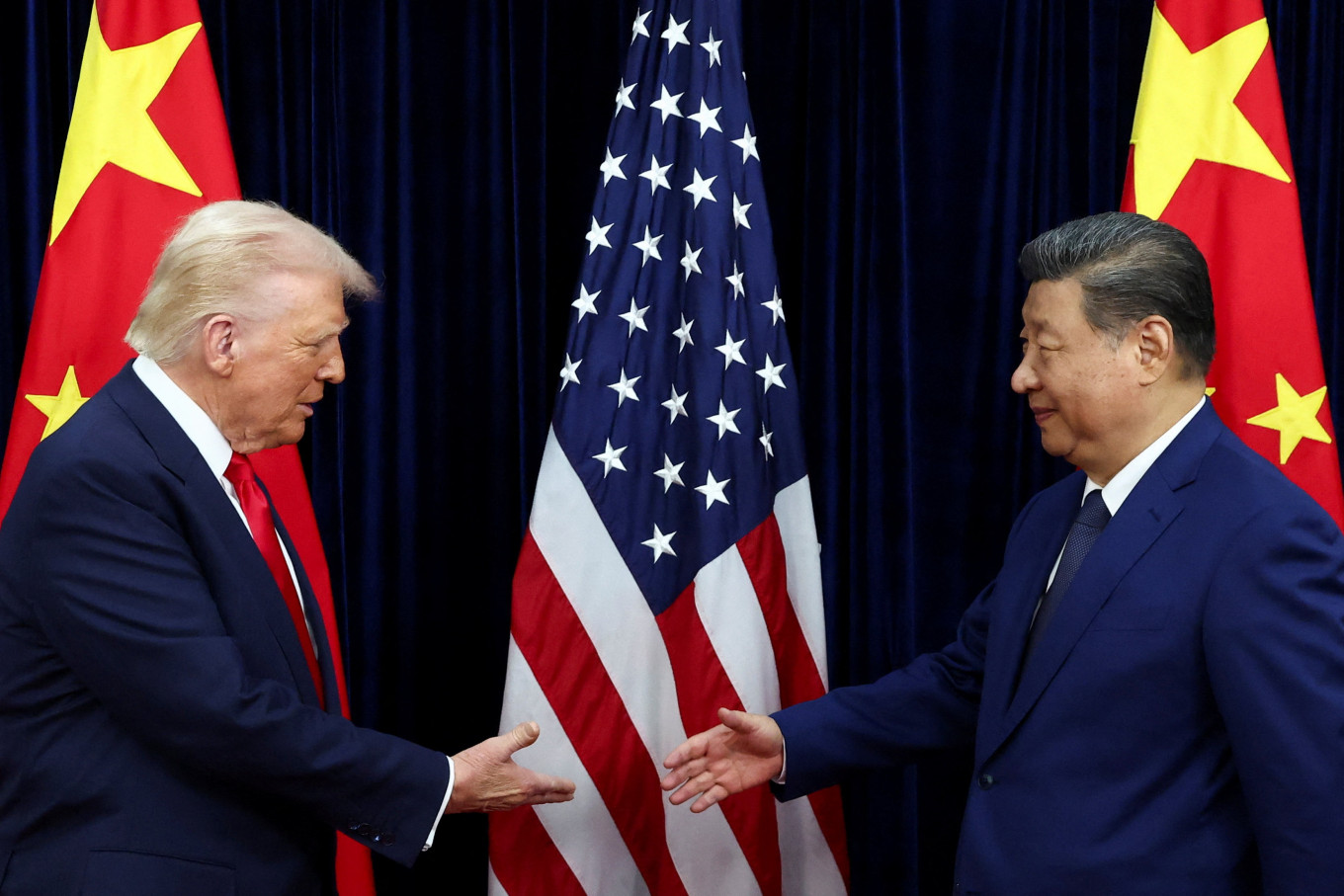 United States President Donald Trump (left) and Chinese President Xi Jinping reach out to shake hands during a bilateral meeting at Gimhae Air Base in Busan on Oct. 30, on the sidelines of the 2005 APEC Summit in South Korea. (Reuters/Evelyn Hockstein)
A
lthough 2025 will probably be remembered as the year that United States President Donald Trump upended the global trading system, the truth is that both of the world’s hegemons, the US and China, have gone rogue. Surging American protectionism and resurgent Chinese mercantilism are now twin scourges afflicting the rest of the world, especially developing countries.
While some apply the label G-Zero to today’s leaderless world, it is more accurate to say that we are dealing with a “G-negative-two” world. Instead of providing global public goods, China and the US are inflicting global economic costs, and they are doing so in mutually reinforcing ways.
In some sense, Chinese mercantilism begot US protectionism.
Trump’s long-standing tariff obsession derives from his fury-fueled conviction that trade surpluses abroad have damaged the US economy, especially its manufacturing sector. In that worldview, China, with its consistently large trade surpluses, is the provocateur in chief, even though in practice more countries have been targeted.
Trump’s “Liberation Day” tariffs in April and the tumultuous iterations that followed have made the US one of the world’s most protectionist economies. On average, tariffs on exports of goods to the world’s largest market have jumped from just over 2 percent to 17 percent, an eightfold increase. Not only has access to US markets been constrained, it is also radically more uncertain because tariffs have become an instrument for indulging the president’s erratic whims and furthering private interests.
In lawsuits challenging Trump’s justification for such sweeping tariffs, the US Supreme Court has signaled that it will not second-guess the executive’s authority to determine what qualifies as a threat to national security. Never mind that the same authority has been (implicitly) invoked to target Brazil for baldly political reasons and to punish India for contradicting Trump’s claim of brokering the peace in its border skirmish with Pakistan in May.

Restraining such an arbitrary and absurd exercise of presidential authority is surely the court’s core responsibility. But even if it does rule against Trump, he will have other ways to pursue the same protectionist agenda and US trading partners will still be operating in a fog of uncertainty.