TheJakartaPost
Please Update your browser
Your browser is out of date, and may not be compatible with our website. A list of the most popular web browsers can be found below.
Just click on the icons to get to the download page.


Popular Reads
Top Results
No results found. Please check your search term and try again
Can't find what you're looking for?
View all search results
Popular Reads
Top Results
No results found. Please check your search term and try again
Can't find what you're looking for?
View all search resultsWhy perspective matters in humanitarian crises
The way we understand humanitarian crises determines whether we truly attempt to resolve them, or merely manage them so they remain tolerable.
Change text size
Gift Premium Articles
to Anyone
Share the best of The Jakarta Post with friends, family, or colleagues. As a subscriber, you can gift 3 to 5 articles each month that anyone can read—no subscription needed!
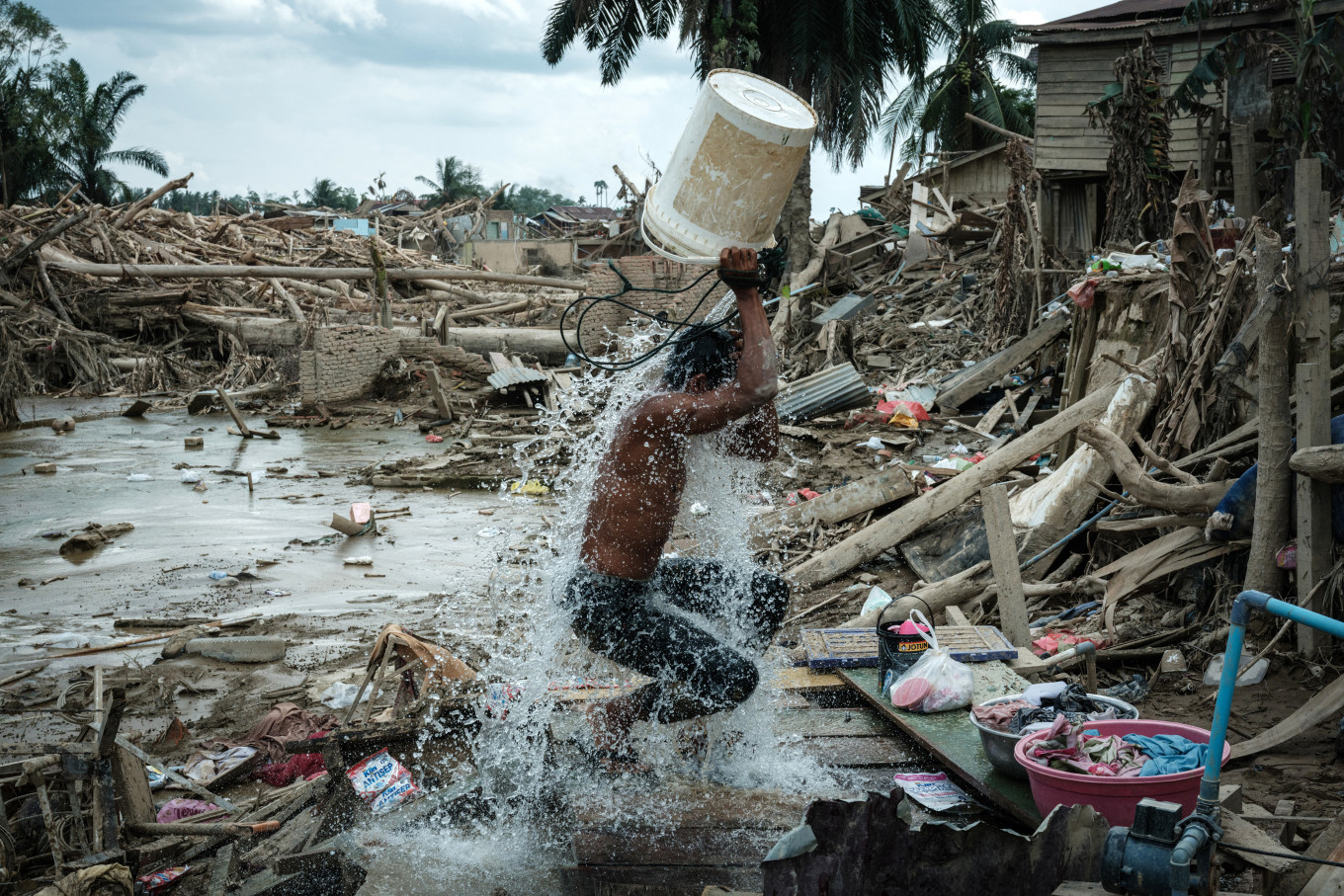 A man uses a bucket to wash off mud on Dec. 13, in Aceh Tamiang, Aceh, surrounded by the devastation wrought by flash flooding and landslides that swept through three provinces in northern Sumatra. (AFP/Yasuyoshi Chiba)
E
ach year, the world, and Indonesia, faces humanitarian crises that seem endless. Disasters, poverty, inequality, food insecurity, stunting, climate shocks and social vulnerabilities appear in different forms but with familiar consequences. Yet amid this repetition, one essential question is rarely asked seriously: Not what is happening, but how we choose to see it.
The way we understand humanitarian crises determines whether we truly attempt to resolve them, or merely manage them so they remain tolerable.
For decades, humanitarianism has largely been understood as a response to events. A disaster occurs, assistance is mobilized. Vulnerable groups are identified, programs are designed. This approach feels reasonable and even ethical. However, it carries a fundamental limitation: it focuses our attention on incidents, while diverting it away from the systems that repeatedly produce those incidents.
Humanitarian crises are not random disruptions. They are logical outcomes of how economies are structured, policies are designed and power is distributed.
This is where a shift in perspective becomes necessary.
The conventional view treats crises as things that happen to certain groups, usually those labeled as vulnerable. Without realizing it, this perspective divides society into helpers and those being helped. One group is seen as capable and rational; the other as passive and in need. Humanitarian action is then reduced to efficiency, technical solutions and the number of beneficiaries reached.

This perspective is not entirely wrong, but it is no longer sufficient.