TheJakartaPost
Please Update your browser
Your browser is out of date, and may not be compatible with our website. A list of the most popular web browsers can be found below.
Just click on the icons to get to the download page.


Popular Reads
Top Results
No results found. Please check your search term and try again
Can't find what you're looking for?
View all search results
Popular Reads
Top Results
No results found. Please check your search term and try again
Can't find what you're looking for?
View all search resultsRule by the law?
The police chief's signing a regulation that counters a court ruling prohibiting active-duty officers from holding a civilian post is a blatant act of disrespect toward the rule of law.
Change text size
Gift Premium Articles
to Anyone
Share the best of The Jakarta Post with friends, family, or colleagues. As a subscriber, you can gift 3 to 5 articles each month that anyone can read—no subscription needed!
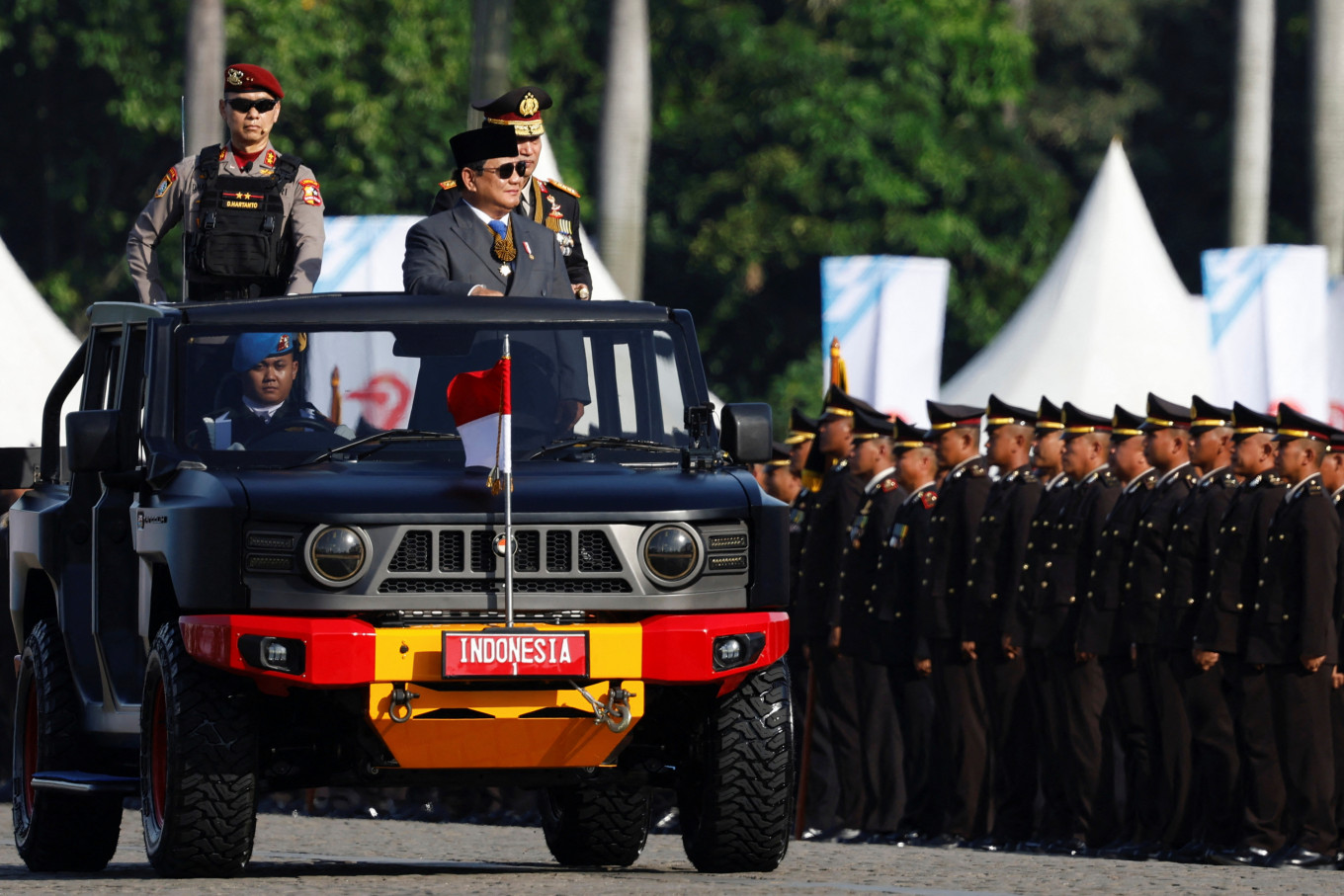 President Prabowo Subianto (right, front seat), accompanied by National Police chief Gen. Listyo Sigit Prabowo (right, rear seat), inspect officers on July 1, 2025, during a ceremony to mark the National Police’s 79th anniversary at Merdeka Square in Gambir, Central Jakarta. (Reuters/Ajeng Dinar Ulfiana)
W
hen the Constitutional Court ruled to ban active police officers from holding concurrent civilian positions and the police chief responded with a regulation allowing the practice to stand, rational observers called this act disrespectful of the rule of law.
The controversy did not stop there. A lawmaker from the ruling Gerindra Party defended the police chief’s defiance of the court’s ruling, which is final and binding. Another politician from the National Awakening Party (PKB) concurred, arguing that the regulation did not violate the ruling.
To complicate things, President Prabowo Subianto has remained silent, though Coordinating Law, Human Rights, Immigration and Correctional Services Minister Yusril Ihza Mahendra confirmed that the President agreed to issue a government regulation to settle the matter beyond doubt.
The debate only shows that legal certainty remains a chronic problem, despite the fact that the Constitutional Court was founded in part to solve it.
Many of our laws are laden with exceptions. One such legislation is the 2002 Police Law, which prohibits active police officers from holding civilian posts in the bureaucracy but simultaneously grants the National Police chief the authority to assign active officers to serve roles at external institutions without resigning.
This inconsistency led to a motion for a judicial review of the Police Law that the Constitutional Court granted last month, on the grounds that the relevant article created legal uncertainty, a violation of Article 28D, paragraph (1) of the 1945 Constitution.

Legal uncertainty often stems not only from conflicting interpretations, usually as a result of vague statutory language, but also from shifting policies. Investors have long pointed to this lack of certainty as a major hurdle to the ease of doing business in the country.