The Jakarta Post
Please Update your browser
Your browser is out of date, and may not be compatible with our website. A list of the most popular web browsers can be found below.
Just click on the icons to get to the download page.


Popular Reads
Top Results
No results found. Please check your search term and try again
Can't find what you're looking for?
View all search results
Popular Reads
Top Results
No results found. Please check your search term and try again
Can't find what you're looking for?
View all search resultsStrengthening the free meals program through women and communities
Nearly a year on since the launch of the free meals program, several studies point to an opportunity for policy learning: scaling the program toward its envisioned targets by placing women at its heart.
Change text size
Gift Premium Articles
to Anyone
Share the best of The Jakarta Post with friends, family, or colleagues. As a subscriber, you can gift 3 to 5 articles each month that anyone can read—no subscription needed!
 Set as preferred source
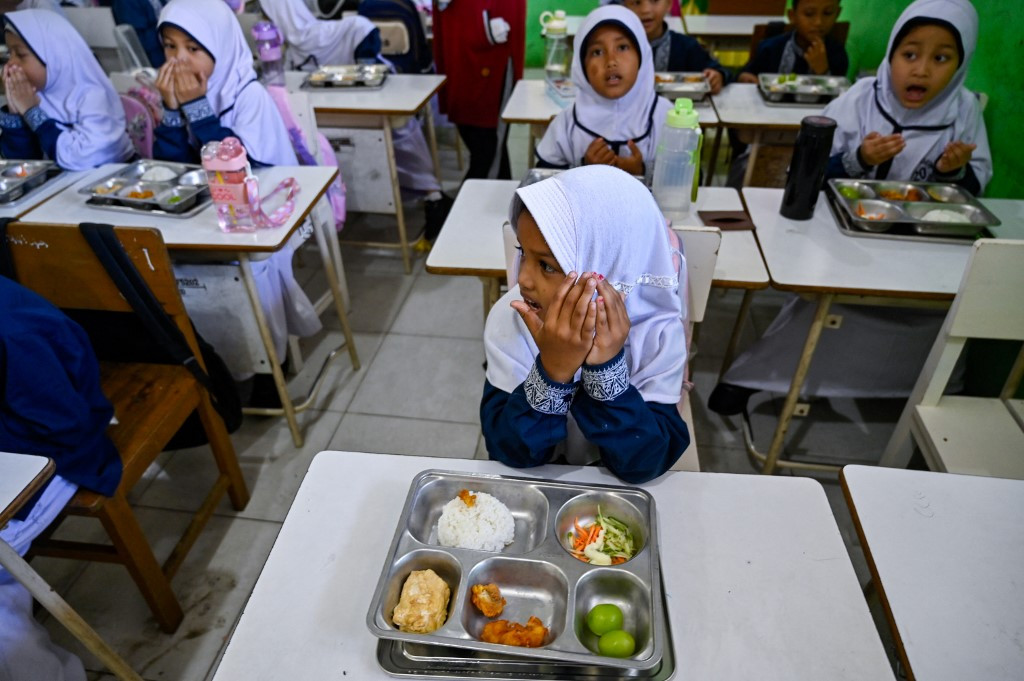 Students pray on Oct. 30, 2025, before eating food provided via the government's free nutritious meal program at an elementary school in Banda Aceh, Aceh. (AFP/Chaideer Mahyuddin)
T
he free nutritious meal (MBG) program marks a significant step in aligning national development priorities with the everyday realities faced by millions of families in Indonesia. Introduced as a flagship commitment during the 2024 presidential election and now designated as a national strategic program, the free meals program responds to persistent challenges in child nutrition.
According to the Indonesia Health Survey (SKI), which integrates the Basic Health Research (Riskesdas) and the Indonesia Nutrition Status Survey (SSGI) for children under 5 to evaluate health development outcomes over the past five years, the prevalence of childhood stunting declined to 21.5 percent in 2023, reflecting steady progress but remaining above national development targets.
The SKI data reveal emerging nutritional vulnerabilities: While the proportion of underweight children has decreased, wasting increased from 7.7 to 8.5 percent and overweight prevalence rose to 4.2 percent, signaling a growing double burden of malnutrition.
Furthermore, recent national nutrition research using Riskesdas data highlights persistent gaps in children’s daily intake: only around 10.6 percent of children consumed breakfasts that met more than 30 percent of daily energy needs, approximately two-thirds consumed breakfasts of low nutritional quality and nearly 60 percent left for school without eating. This underscores the structural nature of nutrition insecurity among school-age children.
Officially launched on Jan. 6, 2025, the MBG program reflects a growing global consensus that school feeding programs are among the most effective public investments a country can make.
Framed against a broader international shift toward school feeding as a best practice for child development and equity, from Brazil’s Programa Nacional de Alimentação Escolar (National School Feeding Program) to Japan’s kyūshoku school lunch system, the MBG program is more than a food provision initiative. It embodies a collective effort to increase school attendance, improve child health and nutrition, enhance learning outcomes, reduce inequality and build inclusive pathways toward Indonesia’s future prosperity.

As the program continues to expand, it is essential to remain open for learning, reflection and improvement. This openness is not a sign of weakness but of responsible governance and collective ownership.