TheJakartaPost
Please Update your browser
Your browser is out of date, and may not be compatible with our website. A list of the most popular web browsers can be found below.
Just click on the icons to get to the download page.


Popular Reads
Top Results
No results found. Please check your search term and try again
Can't find what you're looking for?
View all search results
Popular Reads
Top Results
No results found. Please check your search term and try again
Can't find what you're looking for?
View all search resultsRegional autonomy does not have to redistribute corruption
As Vedi Hadiz has noted, decentralization has produced local oligarchies, new centers of power growing from old patronage networks.
Change text size
Gift Premium Articles
to Anyone
Share the best of The Jakarta Post with friends, family, or colleagues. As a subscriber, you can gift 3 to 5 articles each month that anyone can read—no subscription needed!
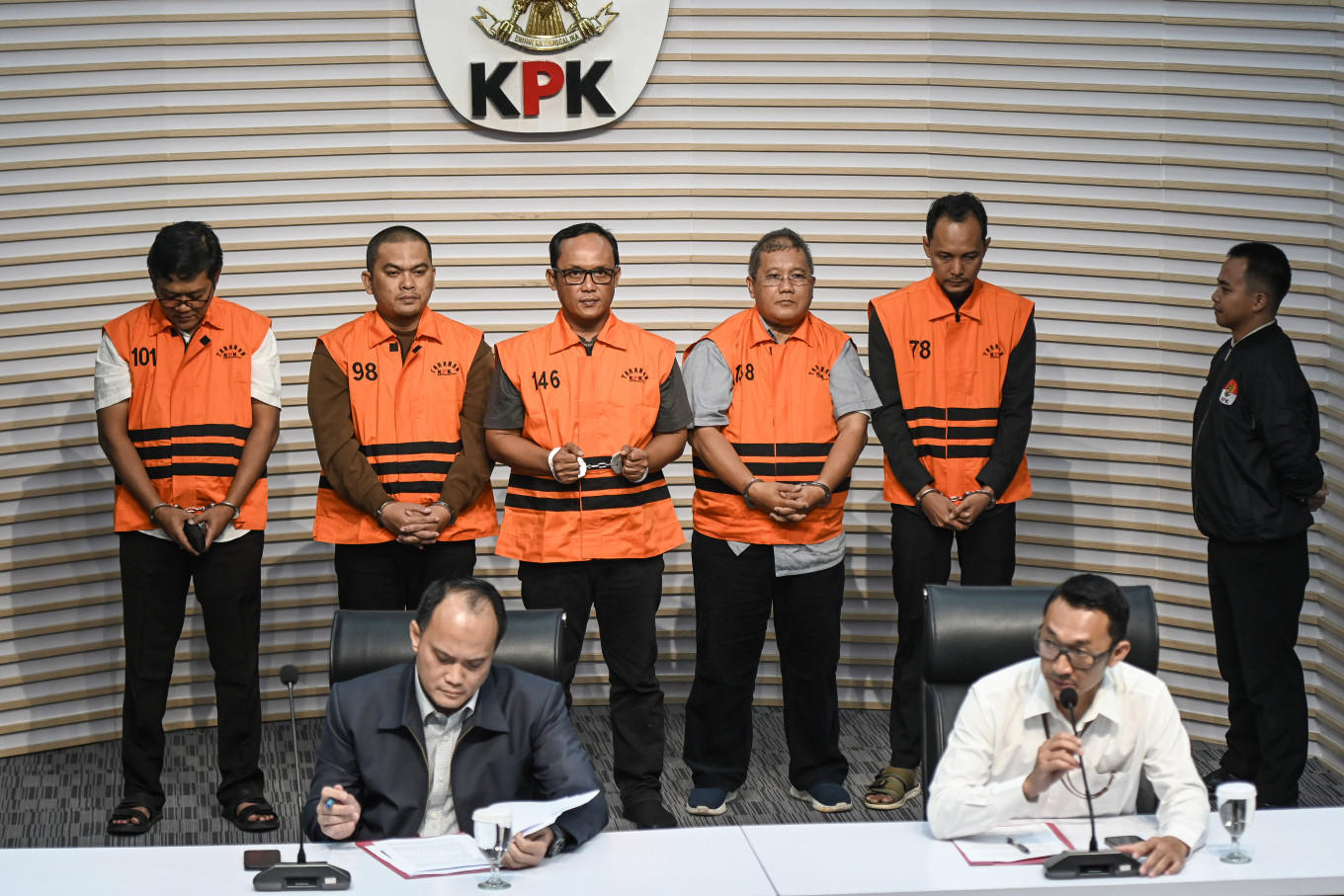 Collective fraud: Five suspects (from left) Central Lampung Revenue Agency acting head Anton Wibowo, Central Lampung Legislative Council member Riki Hendra Saputra, Central Lampung Regent Ardito Wijaya, PT Elkaka Mandiri director Lukman Sjamsuri and the regent’s brother Ranu Hari Prasetyo are seen on Dec. 11, during a press conference at the Corruption Eradication Commission (KPK) building in Jakarta. The KPK has detained the five suspects in connection with a bribery case related to the procurement of goods and services in several projects across Central Lampung regency, Lampung. (Antara/Sulthony Hasanuddin)
A
s we bid farewell to 2025, we note that the year concluded with a series of sting operations by the Corruption Eradication Commission (KPK), targeting at least six regional heads. Yet, the news no longer shocks the public.
There is no moral outrage as in the past, no eruption of anger. Citizens have grown accustomed to seeing mayors, regents and governors paraded before cameras, escorted into detention vehicles in orange vests. Regional power comes and goes, yet one pattern remains: local authority continues to be fertile ground for rent-seeking.
Twenty-five years after decentralization was introduced in the form of direct regional head elections, the expectation was that local autonomy would enhance efficiency, bring public services closer to citizens and strengthen democratic governance.
Ironically, Home Minister Tito Karnavian responded to the wave of anticorruption raids by emphasizing the need to improve the training system for regional heads. This statement appears normative and overly simplistic. It frames corruption as an individual failure, as if the problem could be solved through ethics training and administrative oversight.
In reality, the issue is structural, not merely personal. While training may serve as moral guidance, it fails to address the root causes: an oligarchic political recruitment mechanism, high campaign costs and party patronage.
Meanwhile, the central government has gradually reclaimed some local powers. Scholars like Fitrani, Hofmanand Kaiser refer to this phenomenon as “recentralization within decentralization”, in which the central state retakes fiscal control due to a loss of trust in local authorities. Tito’s response is ironic in this context: while oversight is strengthened, the upstream recruitment process remains untouched.

The root problem lies not in the scope of authority, but in how power is produced and distributed. Training alone becomes mere institutional cosmetics.