The Jakarta Post
Please Update your browser
Your browser is out of date, and may not be compatible with our website. A list of the most popular web browsers can be found below.
Just click on the icons to get to the download page.


Popular Reads
Top Results
No results found. Please check your search term and try again
Can't find what you're looking for?
View all search results
Popular Reads
Top Results
No results found. Please check your search term and try again
Can't find what you're looking for?
View all search resultsIndonesia’s youth and educated unemployment: A ticking time bomb
In Indonesia, education policy continues to expand labor supply rapidly, but industrial policy, investment incentives and labor market institutions have not evolved in tandem.
Change text size
Gift Premium Articles
to Anyone
Share the best of The Jakarta Post with friends, family, or colleagues. As a subscriber, you can gift 3 to 5 articles each month that anyone can read—no subscription needed!
 Set as preferred source
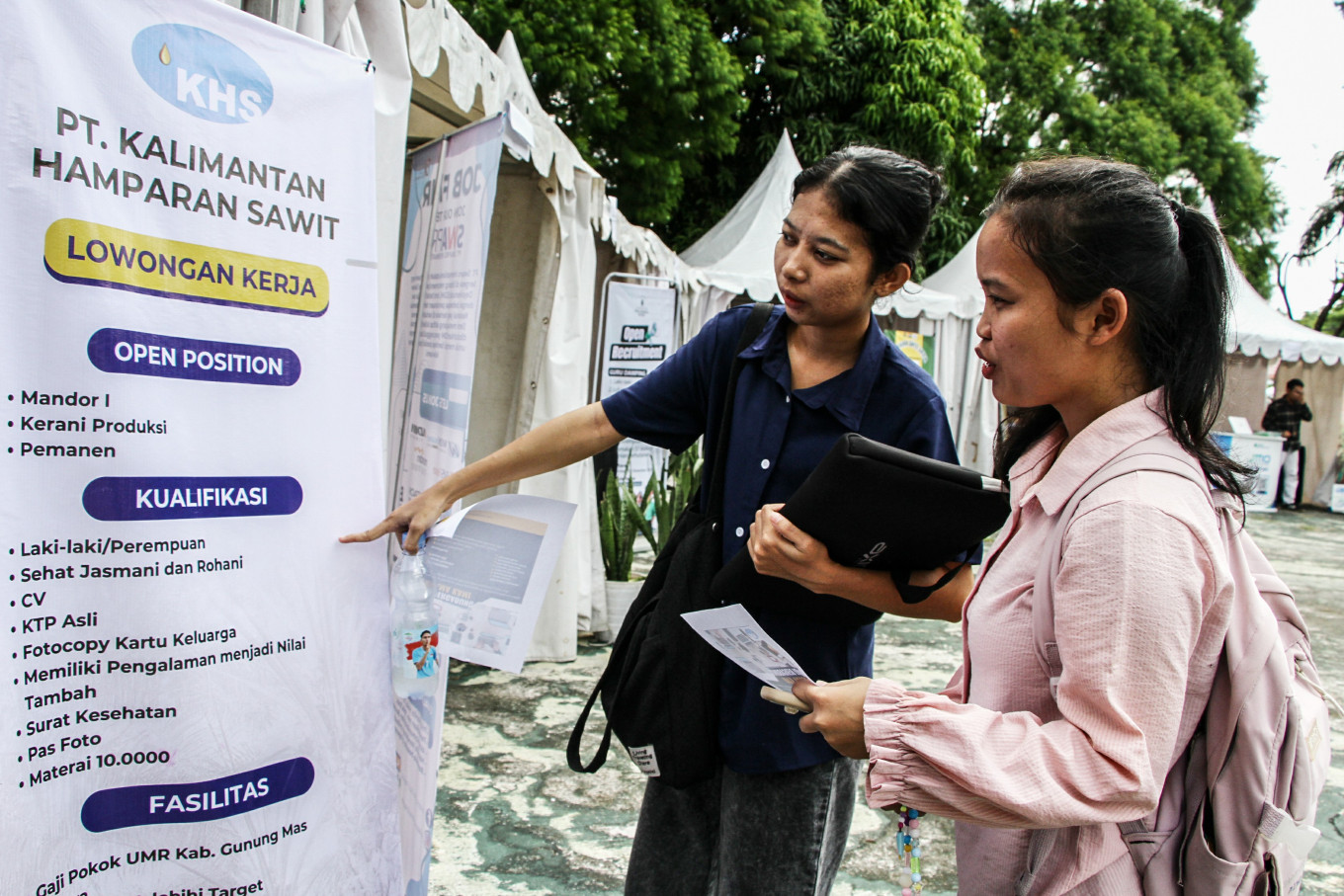 Paycheck pursuers: Visitors look for job vacancy information on Nov. 28, 2025, at a job fair at the University of Palangka Raya in Central Kalimantan. (Antara/Auliya Rahman)
E
very new year arrives with a familiar ritual. Young Indonesians update their résumés, refresh their LinkedIn profiles and send out job applications with renewed optimism. Families repeat the same reassuring phrase: tahun baru, semangat baru (new year, new spirit). Education and hard work, they are told, will eventually pay off.
For a growing number of young and educated Indonesians, however, the new year does not mark a fresh beginning. It marks another year of wasted potential. Each January, millions of new graduates enter the labor market full of expectation, only to discover that demand for their skills remains stubbornly limited.
This is neither an individual failure nor a temporary cyclical downturn. It is a structural problem that has been quietly accumulating for decades. In Indonesia today, youth unemployment and educated unemployment are no longer transient setbacks. They are becoming defining - and potentially dangerous - features of the labor market.
Youth unemployment (ages 15–24) has consistently remained two to three times higher than the national unemployment rate, reaching approximately 16.9 percent compared with 4.9 percent overall last year. Even during periods of respectable economic growth, roughly one in six young Indonesians struggles to find work. Growth, it turns out, has not been a reliable absorber of youth labor.
More troubling still is the pattern of educated unemployment. Graduates of vocational schools, senior high schools and universities face higher unemployment rates than those with lower levels of education. In Indonesia, schooling no longer guarantees a smoother transition into work. In some cases, it even delays it, deepening the sense that the system itself is failing those who followed its rules.
This phenomenon exposes a fundamental flaw in Indonesia’s development path. Youth and educated unemployment are not driven solely by mismatches between education and labor market needs ("skill mismatch"), but by the way Indonesia’s growth model generates and distributes economic opportunities.

For decades, growth has been dominated by large-scale infrastructure, extractive industries and capital-intensive manufacturing. These sectors lift gross domestic product and look impressive in national statistics, but they absorb relatively little of the expanding pool of young and educated labor.