TheJakartaPost
Please Update your browser
Your browser is out of date, and may not be compatible with our website. A list of the most popular web browsers can be found below.
Just click on the icons to get to the download page.


Popular Reads
Top Results
No results found. Please check your search term and try again
Can't find what you're looking for?
View all search results
Popular Reads
Top Results
No results found. Please check your search term and try again
Can't find what you're looking for?
View all search resultsPresident Xi can define a new era of greatness through restraint
China should demonstrate strength through endurance and patience, playing the long game, otherwise, aggressive dynamics can backfire.
Change text size
Gift Premium Articles
to Anyone
Share the best of The Jakarta Post with friends, family, or colleagues. As a subscriber, you can gift 3 to 5 articles each month that anyone can read—no subscription needed!
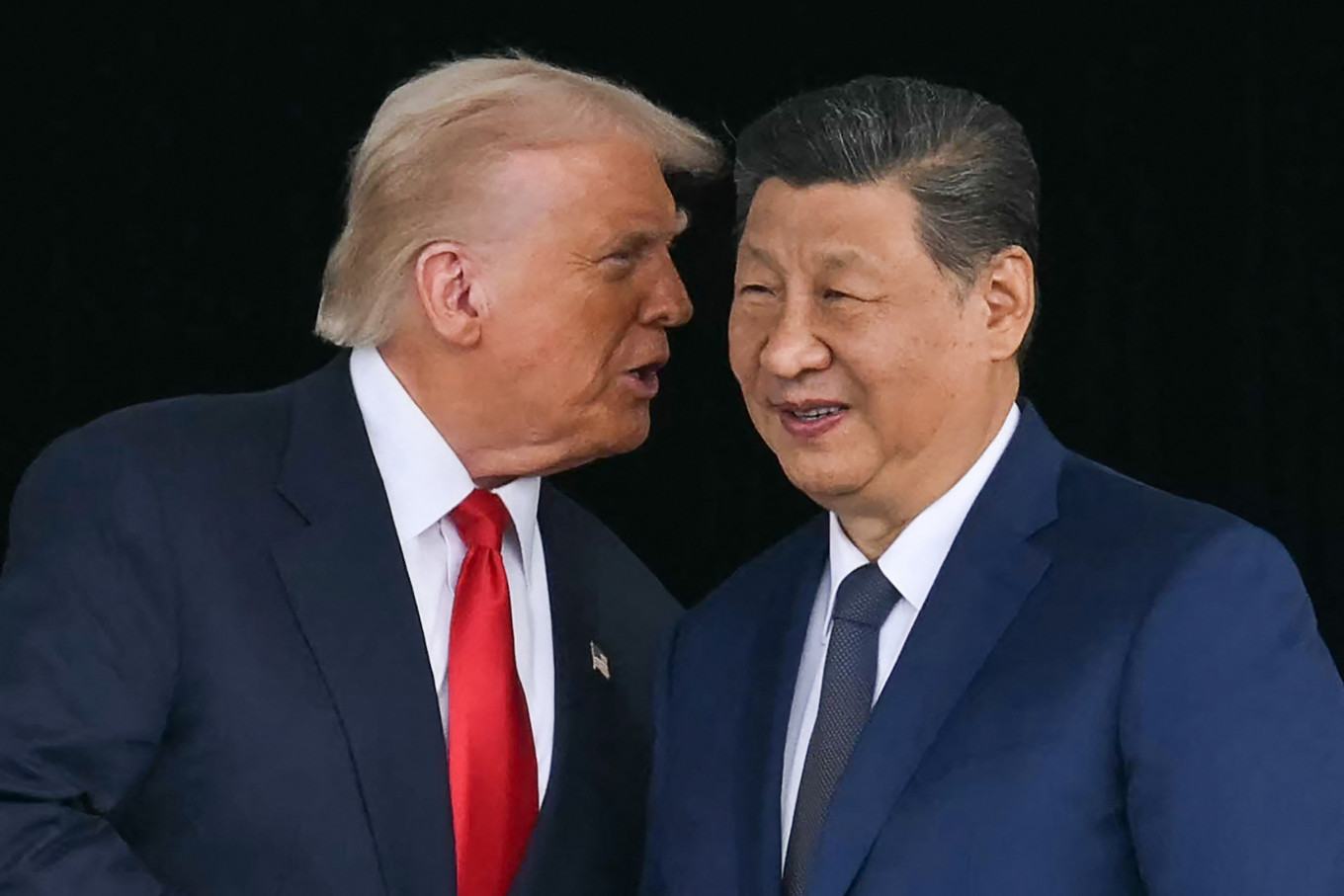 United States President Donald Trump (left) shares a close moment with Chinese President Xi Jinping on Oct. 30, after their talks at Gimhae Air Base in Busan, South Korea. The leaders met face-to-face for the first time in six years to seek a truce in a trade war that has unsettled the global economy. (AFP/Andrew Caballero-Reynolds)
A
s 2025 has come to an end, I would like to take advantage of this moment to offer my best wishes to the most critical player in our region: President Xi Jinping of China.
We are living through highly consequential years. The decisions taken between 2026 and 2030 will shape the future of humanity. Consider the twin crises of global heating and biodiversity loss, or how the breakneck development of artificial intelligence is transforming our societies.
On all these fronts, China is a leading player. President Xi bears an immense responsibility to ensure humanity is ready for a changing world, a world where climate adaptation measures must be accelerated to prevent the loss of millions of lives, not only in the Asia-Pacific but globally.
Climate adaptation has long been overshadowed by mitigation, yet both are indispensable. China must lead the way here, acting far more boldly than it recently announced in its Nationally Determined Contributions (NDCs). With the regrettable retreat of the United States from the Paris Agreement, it falls to China to work harder with partners like the European Union, Brazil, India and Southeast Asian nations to demonstrate a credible path toward a net-zero transition by 2050.
This may compel Xi to double or triple his country’s commitments and raise the stakes with a new net-zero 2050 target, replacing the existing goal centered on 2060. The same applies to biodiversity; China can play a decisive role in implementing the Kunming-Montreal Global Biodiversity Framework (GBF), which it was instrumental in negotiating.
Let us not forget that the Sustainable Development Goals are set to “expire” by 2030, and we are utterly lagging in their implementation. China could inject new impetus into these goals, elevating their standing at the political level.

Then there is AI. China and the US are running neck and neck in the rush to develop artificial intelligence. With full deregulation underway in the US, China must prove itself a responsible player, working with like-minded partners to ensure ethical guardrails are established. The EU, simultaneously a partner and a rival, could share common ground with Beijing in the quest for AI that serves humanity.