TheJakartaPost
Please Update your browser
Your browser is out of date, and may not be compatible with our website. A list of the most popular web browsers can be found below.
Just click on the icons to get to the download page.


Popular Reads
Top Results
No results found. Please check your search term and try again
Can't find what you're looking for?
View all search results
Popular Reads
Top Results
No results found. Please check your search term and try again
Can't find what you're looking for?
View all search resultsChina’s rise: Power, technology and the strategic logic of display
China's power displays in September and November last year were essentially a signal of its arrival on the global stage, a show intended to make the world sit up and recognize it as a major power.
Change text size
Gift Premium Articles
to Anyone
Share the best of The Jakarta Post with friends, family, or colleagues. As a subscriber, you can gift 3 to 5 articles each month that anyone can read—no subscription needed!
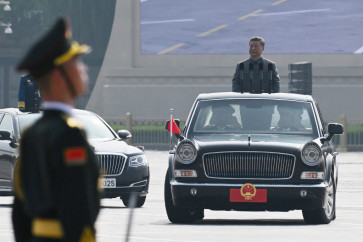
 Chinese President Xi Jinping inspects troops during the annual Victory Day parade in Beijing’s Tiananmen Square on Sept. 3, 2025, which marked the 80th anniversary of China’s war of resistance against Japan and the end of World War II. (AFP/Greg Baker)
I
n September 2025, the People’s Liberation Army (PLA) staged one of the most consequential military parades in its modern history in Beijing to mark the 80th anniversary of the defeat of Imperial Japan in World War II. While the occasion was officially described as commemorative, the parade's content served a strategic purpose: to honor history, to reinforce China’s current stance and to project its intended future direction.
For the first time, China publicly revealed the full structure of its nuclear triad. A new air-launched ballistic missile (ALBM) appeared alongside two newly unveiled intercontinental ballistic missiles (ICBMs), joining a previously disclosed submarine-launched ballistic missile (SLBM).
Together, these systems complete the triadic architecture of credible nuclear deterrence: survivability, redundancy and second-strike capability. This was not an accidental disclosure. Nuclear weapons are rarely displayed casually, and never without purpose.
The message was not that China seeks nuclear war. Instead, it demands recognition as a peer-level strategic actor, one whose deterrent is no longer secondary, symbolic or minimal.
But the parade went well beyond nuclear signaling. Also displayed for the first time were systems that point directly to how China understands the future character of warfare. Among them was the HQ-29, a system widely seen as an anti-satellite interceptor with the added capability of midcourse missile defense.
Its appearance matters. Space is no longer a neutral domain; it is a contested arena for communications, navigation, surveillance and targeting. A state that denies access to space shifts the power balance without firing a shot.

Alongside the HQ-29 were counter-drone systems and other air defense assets, reflecting China’s recognition that low-cost, asymmetric technologies can impose high costs on advanced militaries.