TheJakartaPost
Please Update your browser
Your browser is out of date, and may not be compatible with our website. A list of the most popular web browsers can be found below.
Just click on the icons to get to the download page.


Popular Reads
Top Results
No results found. Please check your search term and try again
Can't find what you're looking for?
View all search results
Popular Reads
Top Results
No results found. Please check your search term and try again
Can't find what you're looking for?
View all search resultsReenergizing higher education in ASEAN
A longstanding debate on higher education is to what extent it should be academic rather than vocational.
Change text size
Gift Premium Articles
to Anyone
Share the best of The Jakarta Post with friends, family, or colleagues. As a subscriber, you can gift 3 to 5 articles each month that anyone can read—no subscription needed!
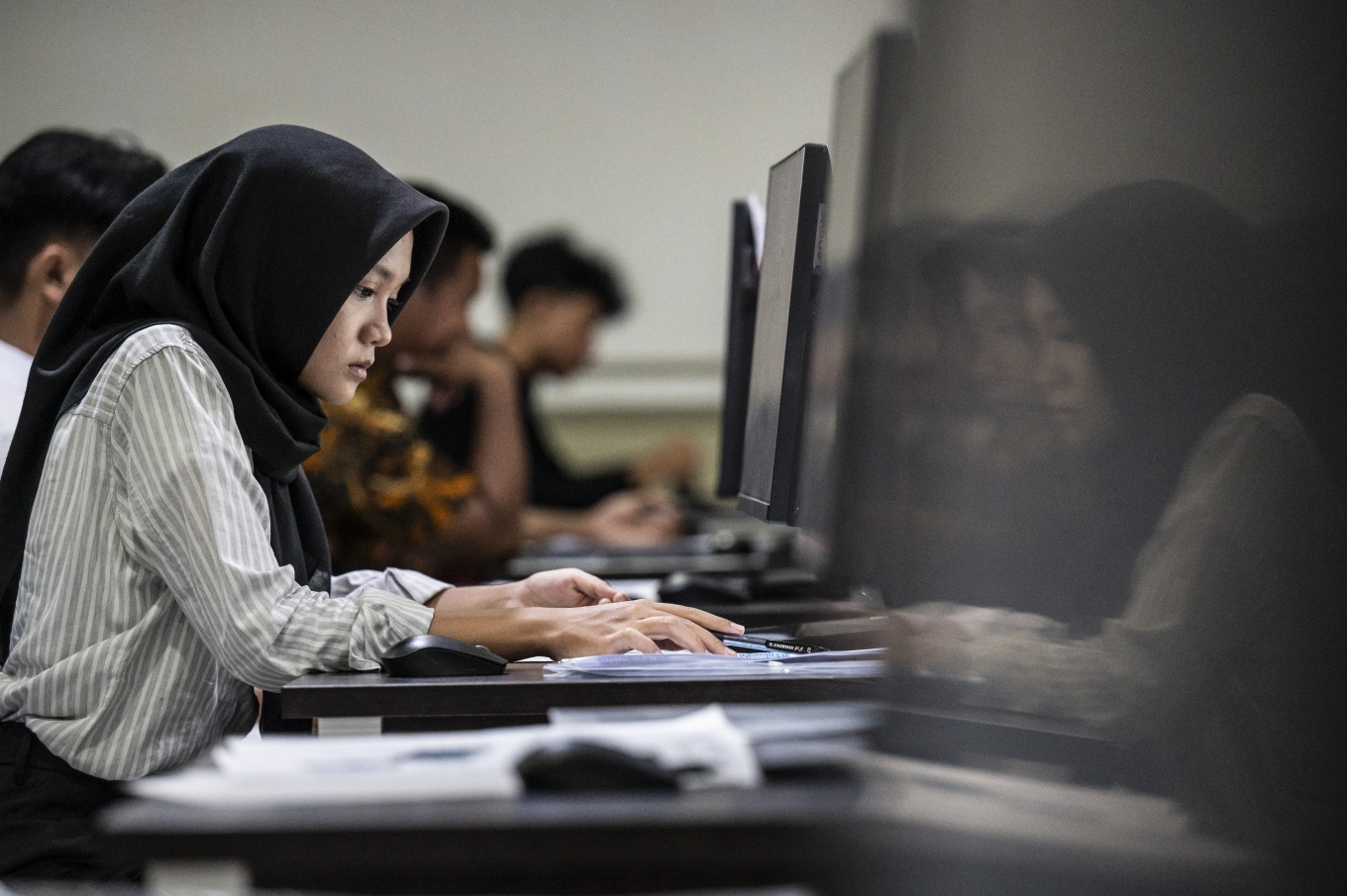 A participant takes the 2025 Computer-Based Written Exam for the National Selection Based on Test (UTBK-SNBT) on April 30, 2025, at Diponegoro University (UNDIP), Tembalang, Semarang, Central Java. (Antara/Aprillio Akbar)
H
igher education, implying the tertiary level associated with universities and parallel institutions, is at an inflection point in the region where the trajectory of socio-political, economic and cultural development is changing rapidly.
Paradoxically, there is a tightrope to be walked between progressive advancement and dispiriting conflict, exemplified by stellar progress in some countries contrasting with disruptive armed conflict in other countries. There is also a marked divergence between the aging and dwindling population in some countries and the burgeoning of the young population of other countries in the ASEAN region.
In this ambiguous state of affairs, much can be done to reenergize the system by means of leadership, commitment, adaptive approach and agile alignments to prepare learners and teachers to explore their fullest potential. Impetus from the business sector, in collaboration with other stakeholders, can be an essential part of that change.
To address these issues in a “quantum” manner, a mini-summit supported by the United Nations Global Compact took place in Malaysia recently. Interestingly, instead of beginning with speeches and discussions usually associated with conferences, it began with a session on mindfulness, inviting the participants to appreciate the process of inhalation and exhalation, and gentle meditation as the basics of self-reflection and self-awareness. This was not an exercise based on any religion, but it had a spiritual element linked with the inner self as the starting point for transformative change.
The rationale behind education, coupled with both the substance and methodology, was then broached through participatory discussions and group work ready to disrupt the business-as-usual curriculum, with sparks of iconoclasm challenging the established system astutely. There is already a global response to the issue embedded in the current UN-backed Sustainable Development Goals which are now approaching their termination point in 2030. While it is common knowledge that the world will not attain those goals by the designated year, the essence of those goals, especially on education, is as pertinent as ever.
There is a universal call to ensure that education is inclusive, equitable, quality-based and open to life-long learning. Education is a means to an end, in the sense that humanity aspires to well-being of a holistic kind, both material and non-material. The aspirations are grounded on the need for human rights, democracy and good governance, peace, sustainable development with an inter-generational connection, environmental protection especially on climate change, and most recently, responsible technologies, especially artificial intelligence, “AI for Good”.

A longstanding debate on higher education is to what extent it should be academic rather than vocational. There is a possible contrast between education for life, on the one hand, and education for living, on the other hand. The former advocates learning space with a critical mind and capacity for self-fulfillment, not necessarily geared to a particular profession. The latter claims that more attention should be paid to the jobs (or lack of jobs) awaiting graduates and the realities of economic upturn or downturn linked with the labor market.