TheJakartaPost
Please Update your browser
Your browser is out of date, and may not be compatible with our website. A list of the most popular web browsers can be found below.
Just click on the icons to get to the download page.


Popular Reads
Top Results
No results found. Please check your search term and try again
Can't find what you're looking for?
View all search results
Popular Reads
Top Results
No results found. Please check your search term and try again
Can't find what you're looking for?
View all search resultsWhy the Thai–Cambodian border remains volatile
Temporary peace between Thailand and Cambodia requires something Southeast Asian politics too often lacks: restraint.
Change text size
Gift Premium Articles
to Anyone
Share the best of The Jakarta Post with friends, family, or colleagues. As a subscriber, you can gift 3 to 5 articles each month that anyone can read—no subscription needed!
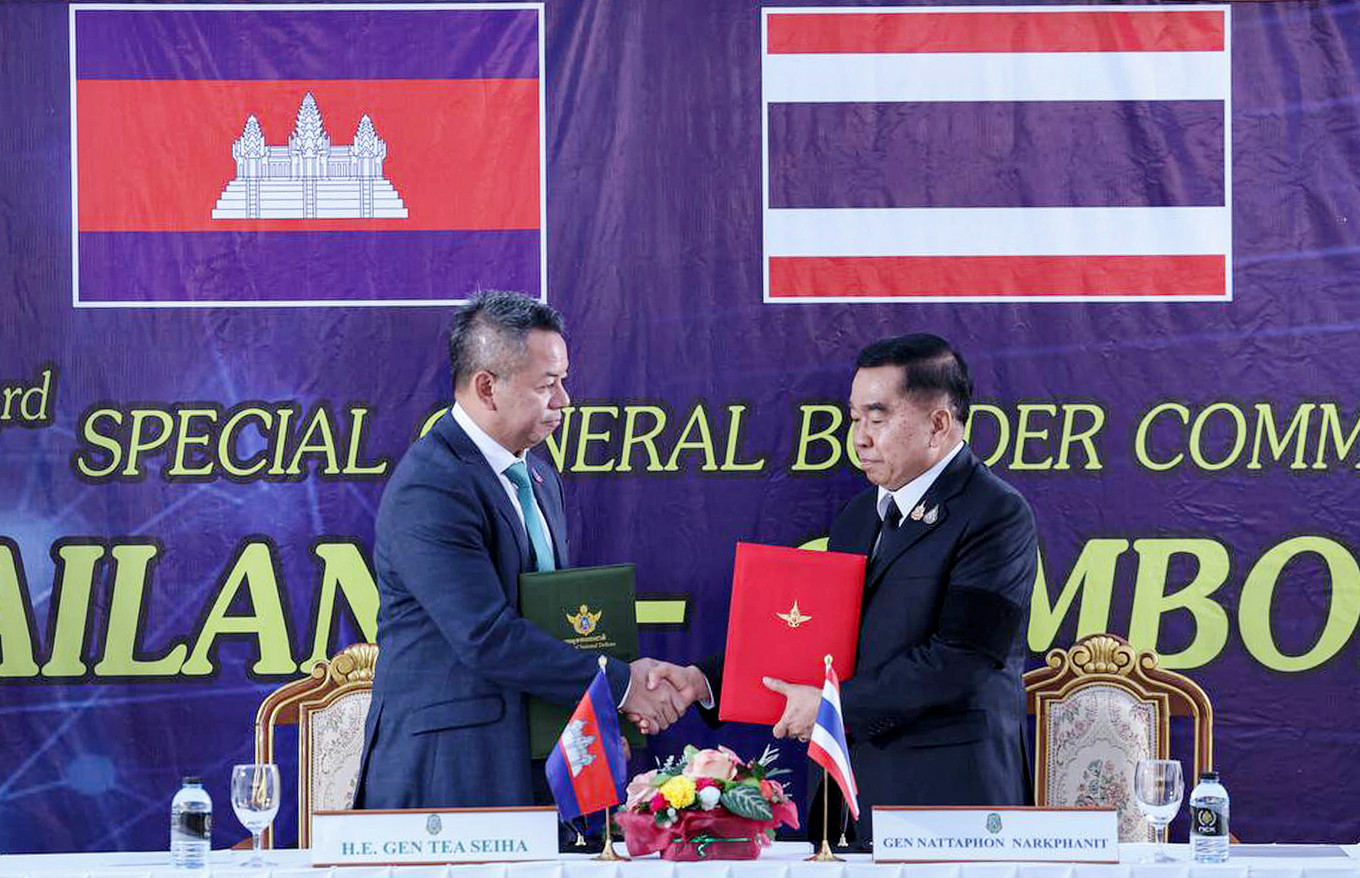 Cambodia’s Defense Minister Tea Seiha (left) and his counterpart Thailand Defense Minister Nattaphon Narkphanit shake hands and exchange documents during a meeting in Chanthaburi province, Thailand, in this handout photo released by Agence Kampuchea Press (AKP) on Dec 27, 2025. Cambodia and Thailand agreed to an “immediate” ceasefire on Saturday, the two countries said in a joint statement, pledging to end weeks of deadly border clashes. (AFP/Agence Kampuchea Press (AKP)/Handout/AFP/Agence Kampuchea Press (AKP)/Handout)
T
he ceasefire agreed between Thailand and Cambodia on Dec. 29, 2025, has been greeted, understandably, with relief. After weeks of bloody border clashes that killed more than 100 people and displaced nearly half a million civilians, silence along the frontier feels like progress.
But ceasefires are not peace; they are pauses. And in the case of the Thai–Cambodian border, history suggests that pauses are often mistaken for solutions.
The ink on the truce was barely dry before Bangkok accused Phnom Penh of violating it through unauthorized drone flights. Cambodia dismissed the allegation as a minor technical lapse; Thailand was unconvinced. This early dispute may appear trivial, but it is emblematic of a deeper problem: the absence of trust between two neighbors whose shared border has been contested for more than a century.
The roots of the conflict stretch back to colonial cartography. When France mapped the Thai–Cambodian border in 1907 during its occupation of Cambodia, it left behind ambiguities that have since metastasized into nationalist grievances. The 817-kilometer frontier has never been just a line on a map; it has been a political instrument, activated whenever domestic pressures demanded an external enemy.
This is not the first time the two countries have clashed over inherited disputes. The most famous flashpoint remains the Preah Vihear temple, an ancient Khmer structure perched near the border, which has repeatedly ignited nationalist fervor in both societies.
The International Court of Justice ruled in Cambodia’s favor in 1962 and clarified its judgment again in 2013. Yet, legal resolutions rarely settle emotional claims. History shows that when sovereignty is fused with pride, court rulings become footnotes.

What distinguishes the current crisis is not the geography but the politics behind it. In Cambodia, Hun Sen’s four-decade rule has recently given way to his son, Hun Manet, in what can only be described as dynastic succession masquerading as reform. For a regime with little economic dynamism, limited political freedoms, and growing youth disillusionment, nationalism offers a convenient adhesive. Border tensions serve as proof of strength and continuity, even when they mask stagnation.