TheJakartaPost
Please Update your browser
Your browser is out of date, and may not be compatible with our website. A list of the most popular web browsers can be found below.
Just click on the icons to get to the download page.


Popular Reads
Top Results
No results found. Please check your search term and try again
Can't find what you're looking for?
View all search results
Popular Reads
Top Results
No results found. Please check your search term and try again
Can't find what you're looking for?
View all search resultsASEAN needs an ASEAN+5 food security framework
Demand for food across Asia will continue to rise, driven by population growth, expanding middle classes and changing diets, but this is unlikely to be met by Asian producers and exporters alone.
Change text size
Gift Premium Articles
to Anyone
Share the best of The Jakarta Post with friends, family, or colleagues. As a subscriber, you can gift 3 to 5 articles each month that anyone can read—no subscription needed!
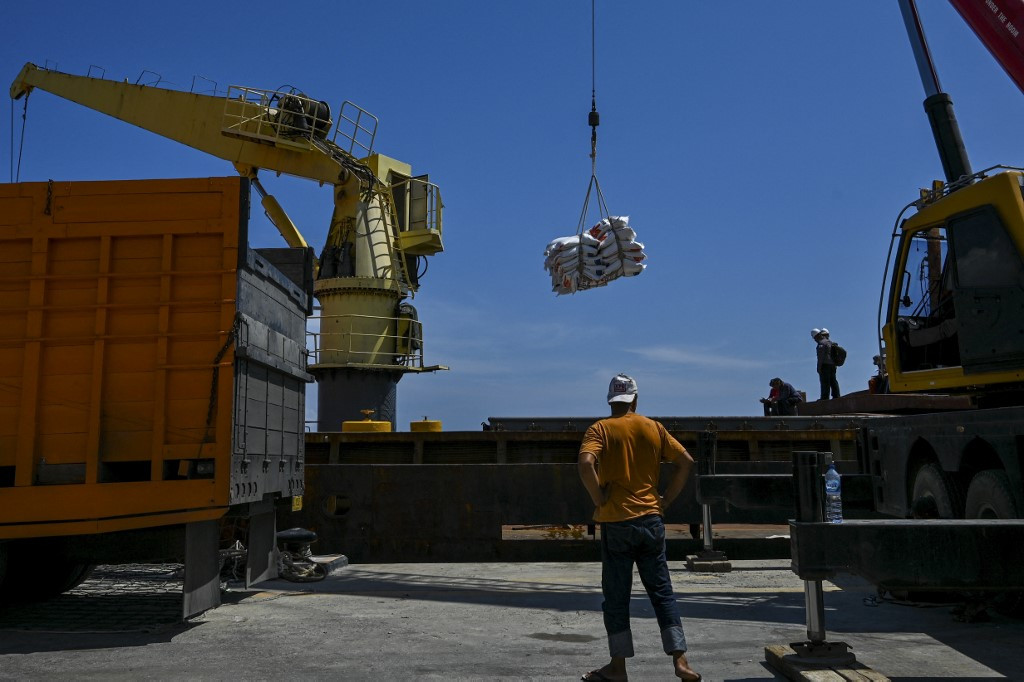 Workers unload sacks of rice imported from Thailand on June 22, 2023, from a cargo ship at Malahayati Port in Krueng Raya, Aceh. (AFP/Chaideer Mahyuddin)
A
sia’s food systems are under mounting structural strain. In recent years, pandemics, global supply chain disruptions, intensifying great-power competition, regional tensions and armed conflicts have placed sustained pressure on food supplies, trade flows and prices. What were once treated as temporary shocks are now exposing deeper vulnerabilities embedded within the region’s food system.
Supply chains long assumed to be resilient have become markedly more fragile. These risks are compounded by Southeast Asia’s heavy exposure to maritime chokepoints: much of the region’s food imports transit congested and contested sea lanes, including the South China Sea. Disruptions at sea, whether from conflict, coercion or accidents, can rapidly ripple through food supply chains, amplifying economic and political pressure on import-dependent states.
At the same time, shocks in shipping, energy prices, fertilizer availability and key export corridors now translate quickly into domestic shortages or sharp price increases. For countries that rely heavily on imports for staple foods or animal feed, external disruptions are no longer distant risks; they are felt almost immediately at home.
Food import-dependent economies in Southeast and East Asia are among the most exposed. Price spikes disproportionately affect lower-income households and quickly become focal points of public concern, raising the political stakes for governments. While countries such as the Philippines, the chair of ASEAN, import more than 25 percent of their food, others, including Singapore, rely on imports for more than 90 percent of their supply.
These vulnerabilities extend beyond Southeast Asia. Food security in the region is closely linked to that of Northeast Asia, where dependence on imported agricultural products is similarly high. Japan, for example, imports roughly 62 percent of its food, including about 80 percent of its wheat and 93 percent of its soybeans. Disruptions affecting one subregion therefore have immediate spillover effects on the other, reinforcing shared risks across East Asia.
Boosting domestic agricultural production may appear to be the most direct response. However, in practice, structural constraints, including limited arable land, water scarcity, rapid urbanization and aging farming populations, make this an insufficient solution on its own.

These realities point to the need for a stronger regional approach to food security. As Manila assumes the ASEAN chairmanship, this moment offers a timely opportunity to elevate food security from a technical issue to a core regional priority, aligned with Manila’s emphasis on resilience, stability and ASEAN centrality.