TheJakartaPost
Please Update your browser
Your browser is out of date, and may not be compatible with our website. A list of the most popular web browsers can be found below.
Just click on the icons to get to the download page.


Popular Reads
Top Results
No results found. Please check your search term and try again
Can't find what you're looking for?
View all search results
Popular Reads
Top Results
No results found. Please check your search term and try again
Can't find what you're looking for?
View all search resultsTime to turn commitments into real protection for migrant workers
Many Indonesian migrant workers continue to live and work without effective protection.
Change text size
Gift Premium Articles
to Anyone
Share the best of The Jakarta Post with friends, family, or colleagues. As a subscriber, you can gift 3 to 5 articles each month that anyone can read—no subscription needed!
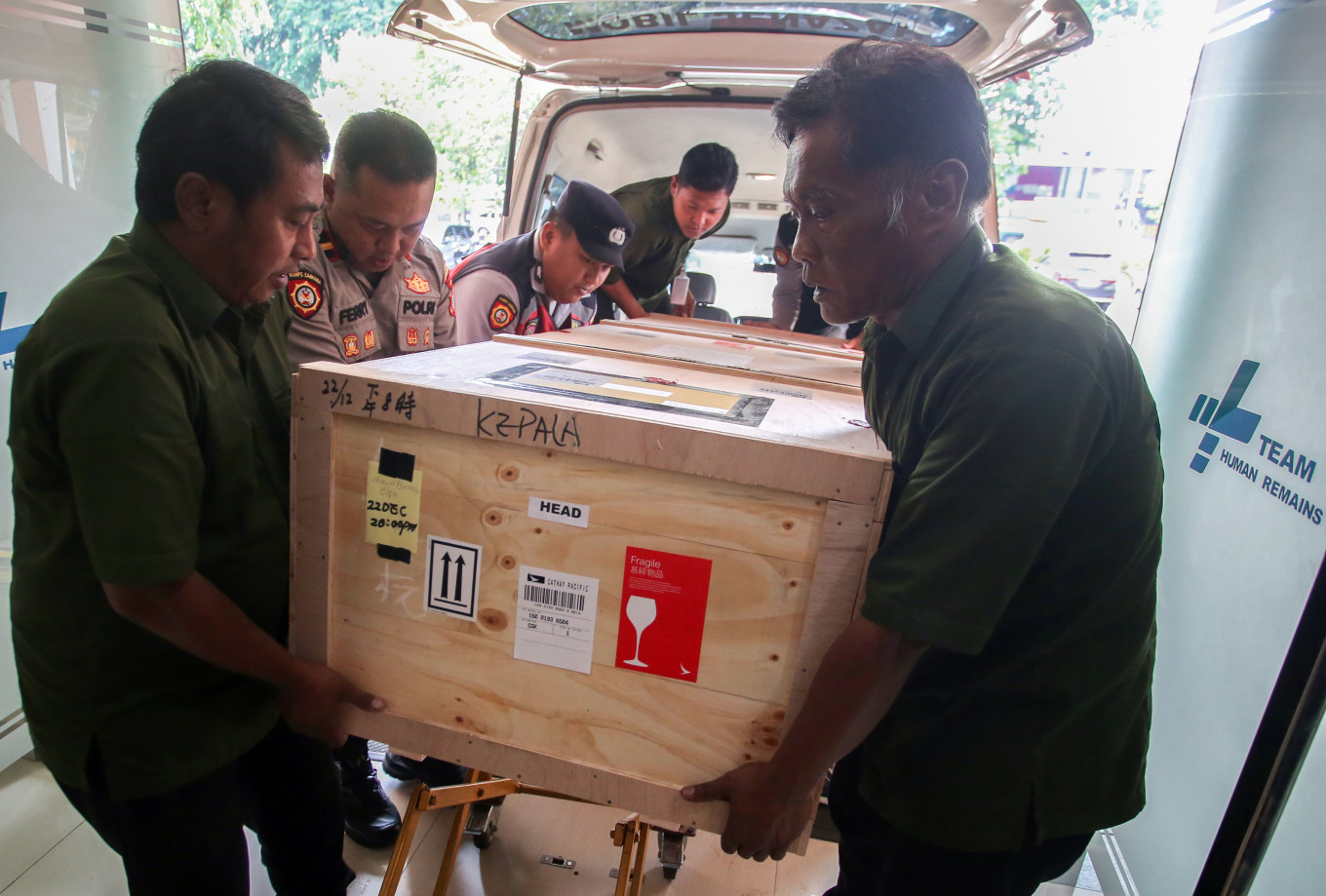 Cargo staff and police officers at Soekarno-Hatta Airport unload the coffin of Indonesian migrant worker Yasmiati from Grobogan, Central Java, upon arrival from Hong Kong on Dec. 23, 2025, at the airport’s cargo terminal in Tangerang, Banten. The Foreign Ministry, the Indonesian Consulate in Hong Kong and the Migrant Workers’ Protection Ministry repatriated nine victims of the Wang Fuk Court apartment fire, on Nov. 26, 2025, in Tai Po District, Hong Kong (Antara/Muhammad Iqbal)
O
ut of 304 million international migrants, 167.7 million are migrant workers, according to United Nations data. These migrant workers are responsible for US$843 billion of remittances sent to low- and middle-income regions in 2022, an amount expected to reach $913 billion as of the end of 2025, according to World Bank. This reflects the indispensable role of migrant workers in the global economy. Yet, the protection of their rights remains limited.
There are approximately 9 million Indonesian migrant workers around the world, and about half are not recorded in official government systems. Cases of forced labor, trafficking and deaths of Indonesian migrant workers continue to surface across sectors and destinations while grievance mechanisms are dysfunctional. These are clearly not isolated incidents but a strong indication of structural weakness in the protection of migrant workers.
The International Migrant Workers Day that we commemorate every Dec. 18 shall be a reminder that many Indonesian migrant workers continue to live and work without effective protection.
One fundamental flaw lies in fragmented governance. Responsibilities are spread across institutions at the central and local level without effective coordination. Disharmony between das sollen (what is stated in the law) and das sein (implementation of the law) at the pre-departure stage of migration exacerbate the situation. To add to the complexity is the poor access to reliable information for prospective migrant workers. All of these factors heighten the risk of irregular migration and leave workers exposed to exploitation, including by unscrupulous intermediaries.
These structural weaknesses also shape how workers interact with the system. Official complaint mechanisms remain underutilized due to poor outreach and workers’ fear of retaliation. Many returnees prefer to seek help through informal networks or NGOs rather than through state-provided channels, suggesting that official systems are often perceived as inaccessible or ineffective.
Indonesia’s second periodic report to the UN Committee on the Protection of the Rights of All Migrant Workers and Members of Their Families (CMW) noted that over the past five years only around 9,000 complaints were recorded out of approximately 9 million Indonesian nationals working abroad. This disparity highlights persistent governance gaps and ongoing shortcomings in policy implementation, rather than an absence of violations.

It was on that basis that Indonesia’s second periodic report was reviewed by the CMW, followed by a dialogue held in Geneva on Dec. 2-3, 2025, as a part of the mandatory review process.