TheJakartaPost
Please Update your browser
Your browser is out of date, and may not be compatible with our website. A list of the most popular web browsers can be found below.
Just click on the icons to get to the download page.


Popular Reads
Top Results
No results found. Please check your search term and try again
Can't find what you're looking for?
View all search results
Popular Reads
Top Results
No results found. Please check your search term and try again
Can't find what you're looking for?
View all search resultsTrump and the raid on Caracas
International law is not simply a moral preference. It is a guardrail built from hard lessons.
Change text size
Gift Premium Articles
to Anyone
Share the best of The Jakarta Post with friends, family, or colleagues. As a subscriber, you can gift 3 to 5 articles each month that anyone can read—no subscription needed!
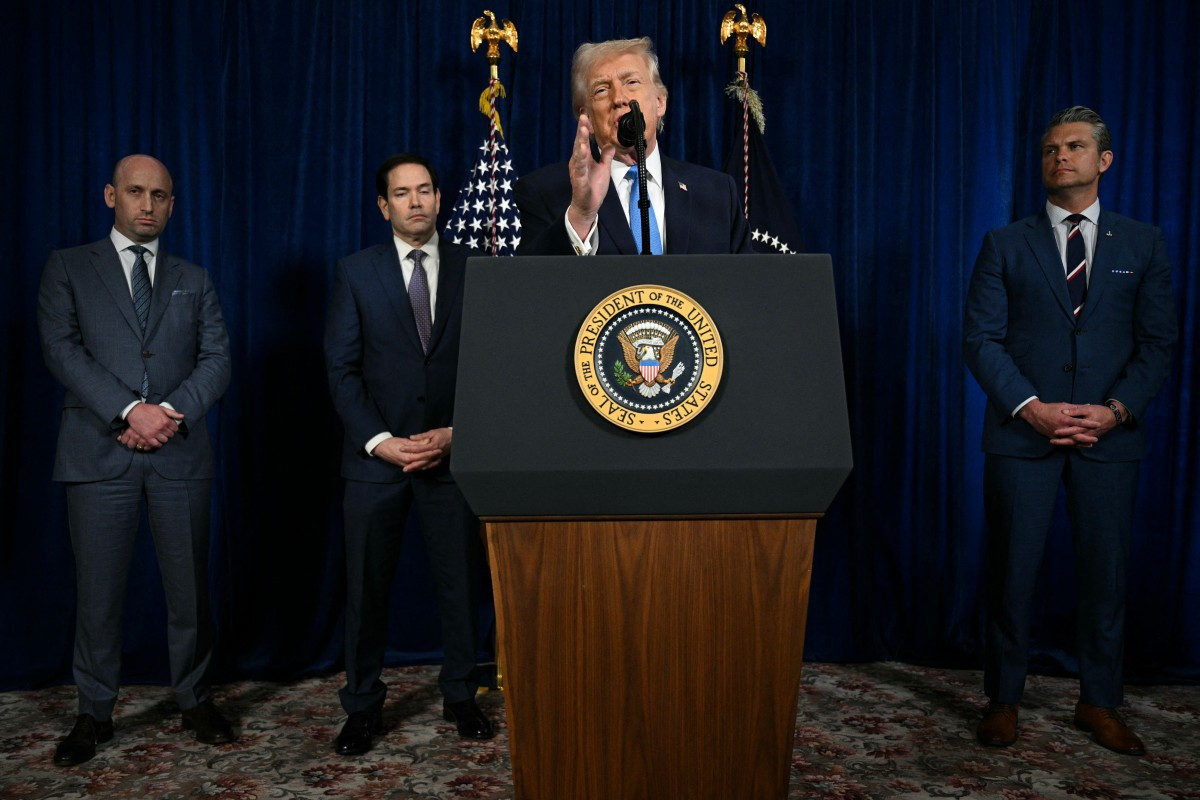 United States President Donald Trump (center), alongside (from left to right) Deputy Chief of Staff Stephen Miller, Secretary of State Marco Rubio and Secretary of Defense Pete Hegseth speaks to the press following US military actions in Venezuela on Jan. 3 at his Mar-a-Lago residence in Palm Beach, Florida, the US. (AFP/Jim Watson)
D
onald Trump is the kind of leader whose decisions are inseparable from his manner of making them. The United States President does not merely pursue policy, he performs it. He speaks in the cadence of business, impatient with slow diplomacy, convinced that global affairs should yield concrete returns for the US, sooner or later. Under the banner of America First, he tends to treat the world less like a seminar on virtue and more like a negotiating table where leverage matters more than etiquette.
That is why Venezuela, in Trump’s vocabulary, rarely stays confined to the language of democracy. It is pulled into a larger bundle of anxieties and opportunities, security, migration, narcotics and finally energy. On Saturday, Washington turned years of pressure into a shock operation that, according to multiple reports, resulted in the capture of Venezuelan President Nicolás Maduro and his wife and their transfer to the US. In the same breath, Trump said the US would run Venezuela for a period and openly referred to putting its oil to use.
If those words sounded brazen, that was the point. This is Trump’s instinctive craft. He aims to seize the camera before he seeks the consensus. He prefers a loud signal to a quiet memo. He speaks to a domestic audience even as the world listens. It is political communication designed to feel decisive, even if its legal footing is contested and its strategic costs remain uncertain.
The timing sharpened the geopolitical edge. Reports indicate Maduro had met a Chinese special envoy only hours before the operation, a detail that makes the episode read not only as a strike on a regime but as a cut through rival influence in what Washington has long considered its strategic neighborhood. Beijing condemned the action as a serious violation of international law.
The US has framed the operation in the language of law enforcement. Maduro has long faced serious accusations in US courts, including allegations tied to narcotics and terrorism. Yet the controversy begins precisely there. Arrest warrants and indictments do not automatically translate into a lawful basis for using military force across borders. Legal experts quoted in reports have argued that presenting a large-scale military action as an arrest mission strains both international law and constitutional logic, especially in the absence of clear authorization from Congress or an international mandate.
International law is not simply a moral preference. It is a guardrail built from hard lessons. The United Nations Charter limits the use of force primarily to self defense or Security Council authorization. When a great power stretches these limits, it does not only rearrange one country’s politics. It also edits the global script of what can be done, and what others may later attempt to copy. Even if consequences for the strong are often limited, the precedent can be contagious, and smaller states usually pay the price when rules erode.

Then there is oil, not as a slogan but as a structure of interest. Venezuela sits on the world’s largest proven crude reserves, yet years of mismanagement, underinvestment and sanctions have hollowed out production capacity. Trump’s public suggestion that the US would run Venezuela while tapping its oil reserves pushed many observers to interpret the operation as something more than a policing action. It begins to look like a geopolitical takeover where legality becomes secondary to utility.