TheJakartaPost
Please Update your browser
Your browser is out of date, and may not be compatible with our website. A list of the most popular web browsers can be found below.
Just click on the icons to get to the download page.


Popular Reads
Top Results
No results found. Please check your search term and try again
Can't find what you're looking for?
View all search results
Popular Reads
Top Results
No results found. Please check your search term and try again
Can't find what you're looking for?
View all search resultsVenezuela, Taiwan and the return of power politics
The US invasion of Venezuela is a worrying sign of the world to come, one that will be defined by multilayered, regional systemic conflict against which internal national strength is the only defense.
Change text size
Gift Premium Articles
to Anyone
Share the best of The Jakarta Post with friends, family, or colleagues. As a subscriber, you can gift 3 to 5 articles each month that anyone can read—no subscription needed!
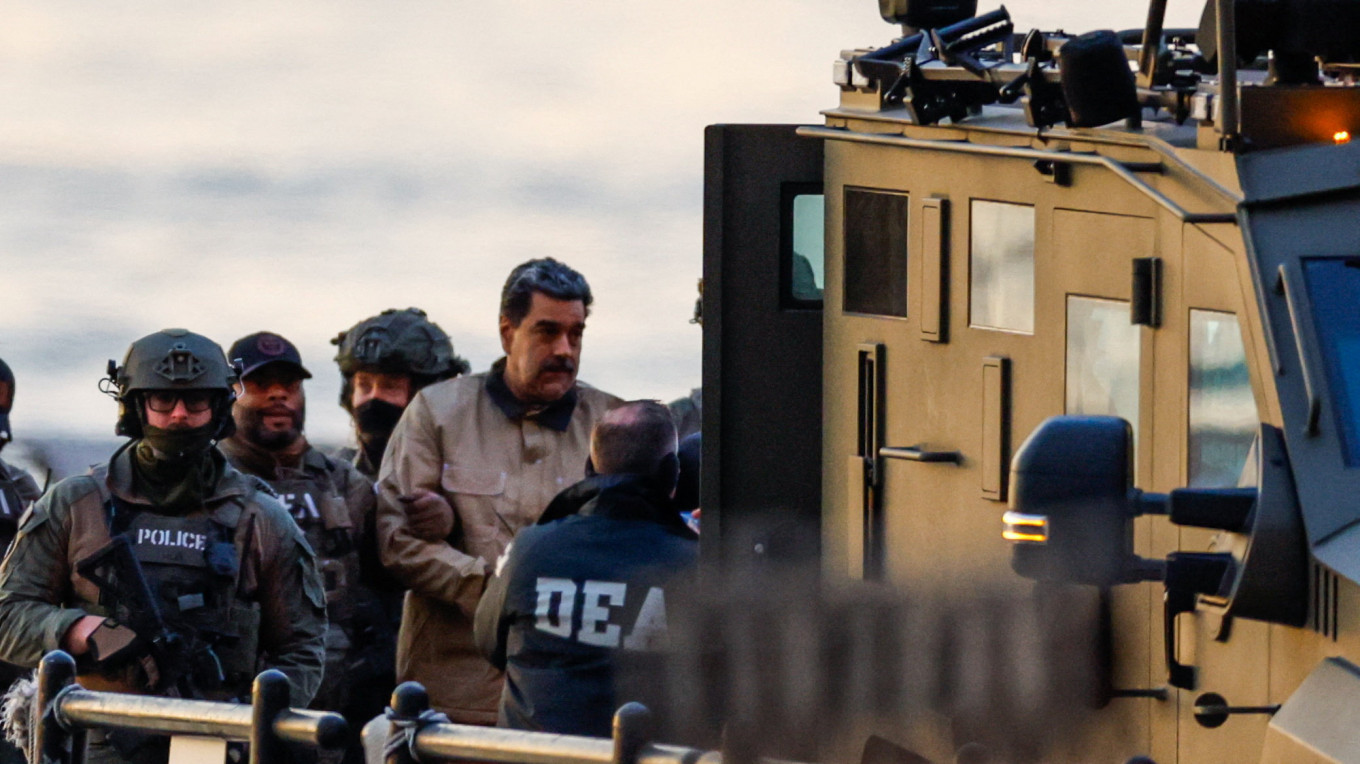 Personnel from the United States Drug Enforcement Administration (DEA) escort Venezuelan President Nicolas Maduro to an armored van at the Downtown Manhattan Heliport in New York City on Jan. 5, 2026, for transporting to the Daniel Patrick Moynihan US Courthouse to face federal charges including narco-terrorism and money laundering. (Reuters/Eduardo Munoz)
T
he United States’ military invasion of Venezuela on Jan. 3 should not be read as a sudden anomaly or an isolated intervention in Latin America. Rather, it marks a decisive inflection point in contemporary international politics, a moment when geopolitics, geostrategy and geo-economics converge into a single, hard-edged expression of power.
This operation signals not only Washington’s willingness to reassert dominance in its traditional sphere of influence but also the broader transformation of global conflict, from ideological confrontation to a raw competition over access, control and strategic resources.
At its core, the attack on Venezuela reflects a structural reality of the emerging international system: the return of power politics under a condition of great power rivalry. The liberal assumptions of restraint, multilateralism and rule-based conflict management that once underpinned the post-Cold War order are giving way to a more coercive and transactional logic. Venezuela, in this sense, is not the cause of the crisis but its stage.
From a geopolitical perspective, the invasion represents a maximalist revival of the Monroe Doctrine in 21st-century form. For much of the post-Cold War era, US hegemony in the Western Hemisphere was taken for granted, enforced less through direct force than through economic leverage and institutional dominance. That assumption has now collapsed.
Venezuela’s worsening economic collapse and deepening strategic alignment with China and Russia transformed it, in Washington’s calculus, from a troublesome regime into a systemic threat. It was no longer merely a case of democratic backsliding but a geopolitical outpost of rival powers in America’s traditional “backyard”.
The invasion thus functions as a blunt message: the Western Hemisphere remains a nonnegotiable sphere of US primacy, and any attempt by external powers to entrench themselves there will be met with force.

In this context, the operation is best understood as an act of geopolitical containment. Just as Cold War containment sought to limit Soviet expansion, contemporary US strategy aims to deny China and Russia strategic depth in regions vital to American security.