TheJakartaPost
Please Update your browser
Your browser is out of date, and may not be compatible with our website. A list of the most popular web browsers can be found below.
Just click on the icons to get to the download page.


Popular Reads
Top Results
No results found. Please check your search term and try again
Can't find what you're looking for?
View all search results
Popular Reads
Top Results
No results found. Please check your search term and try again
Can't find what you're looking for?
View all search resultsAmid disasters, worsening geopolitics, Indonesia’s ‘theater state’ could reach its limit
There are democratic there are practices that are deployed to bind a nation together, whereas in an authoritarian society, rituals and theater are imposed upon the masses, to instill fear and submission.
Change text size
Gift Premium Articles
to Anyone
Share the best of The Jakarta Post with friends, family, or colleagues. As a subscriber, you can gift 3 to 5 articles each month that anyone can read—no subscription needed!
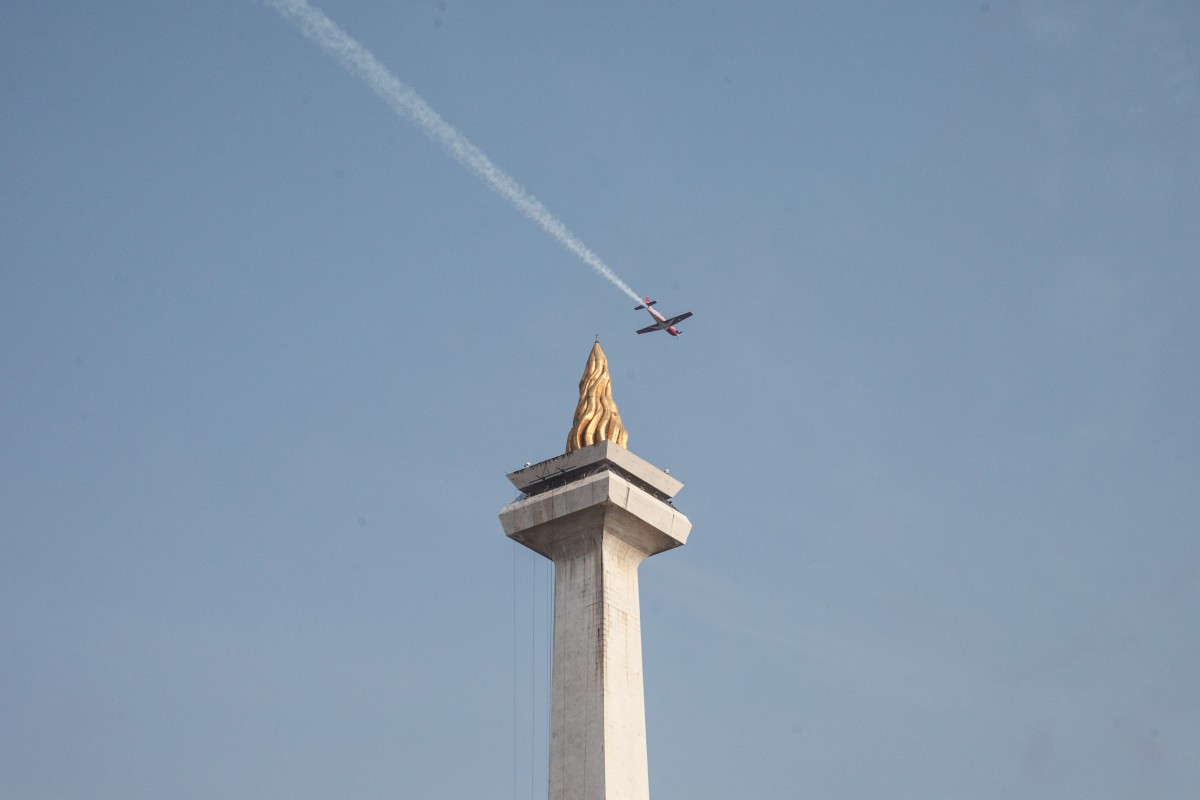 An Indonesian Air Force plane from the Jupiter aerobatic team flies past the National Monument (Monas) during a parade on Oct. 5, 2025, held as part of celebrations marking the Indonesian Military's (TNI) 80th anniversary at Merdeka Square in Central Jakarta. (AFP/Aditya Irawan)
Symbolism, ritual and theater play an important part in politics.
Under a democracy, the military parades, televised state of the nation address and construction of statues and monuments are the glue that binds the nation together, if not devices deployed to shore up the state.
In an authoritarian society, rituals and theater are imposed upon the masses, mostly with the threat of violence in the background, to instill fear and submission.
In both of these cases, rituals are means to political ends.
But in some places or regions a unique case emerges, an anomaly identified by the United States anthropologist Clifford Geertz as a “theater state”, a seminal concept he introduced in his now-classic 1980 book Negara, the Theatre State in Nineteenth-Century Bali.
In the early chapters of the book, Geertz argued that “the nature of Balinese state was always pointed not toward tyranny, whose systematic concentration of power it was incompetent to effect and not even very methodically toward government, which it pursued indifferently and hesitantly, but rather toward spectacle, toward ceremony”.

Geertz proposes that for the Balinese, and other societies in Southeast Asia, rituals were the ends themselves and that the state at the end of the day, in his own words: “even in its final gasp, was the device for the enactment of mass ritual. Power served pomp, not pomp power.”