The Jakarta Post
Please Update your browser
Your browser is out of date, and may not be compatible with our website. A list of the most popular web browsers can be found below.
Just click on the icons to get to the download page.


Popular Reads
Top Results
No results found. Please check your search term and try again
Can't find what you're looking for?
View all search results
Popular Reads
Top Results
No results found. Please check your search term and try again
Can't find what you're looking for?
View all search resultsHow should ASEAN address the 2025 mess?
What 2025 ultimately revealed is how far the Indo-Pacific has drifted from the visions ASEAN and its partners once championed.
Change text size
Gift Premium Articles
to Anyone
Share the best of The Jakarta Post with friends, family, or colleagues. As a subscriber, you can gift 3 to 5 articles each month that anyone can read—no subscription needed!
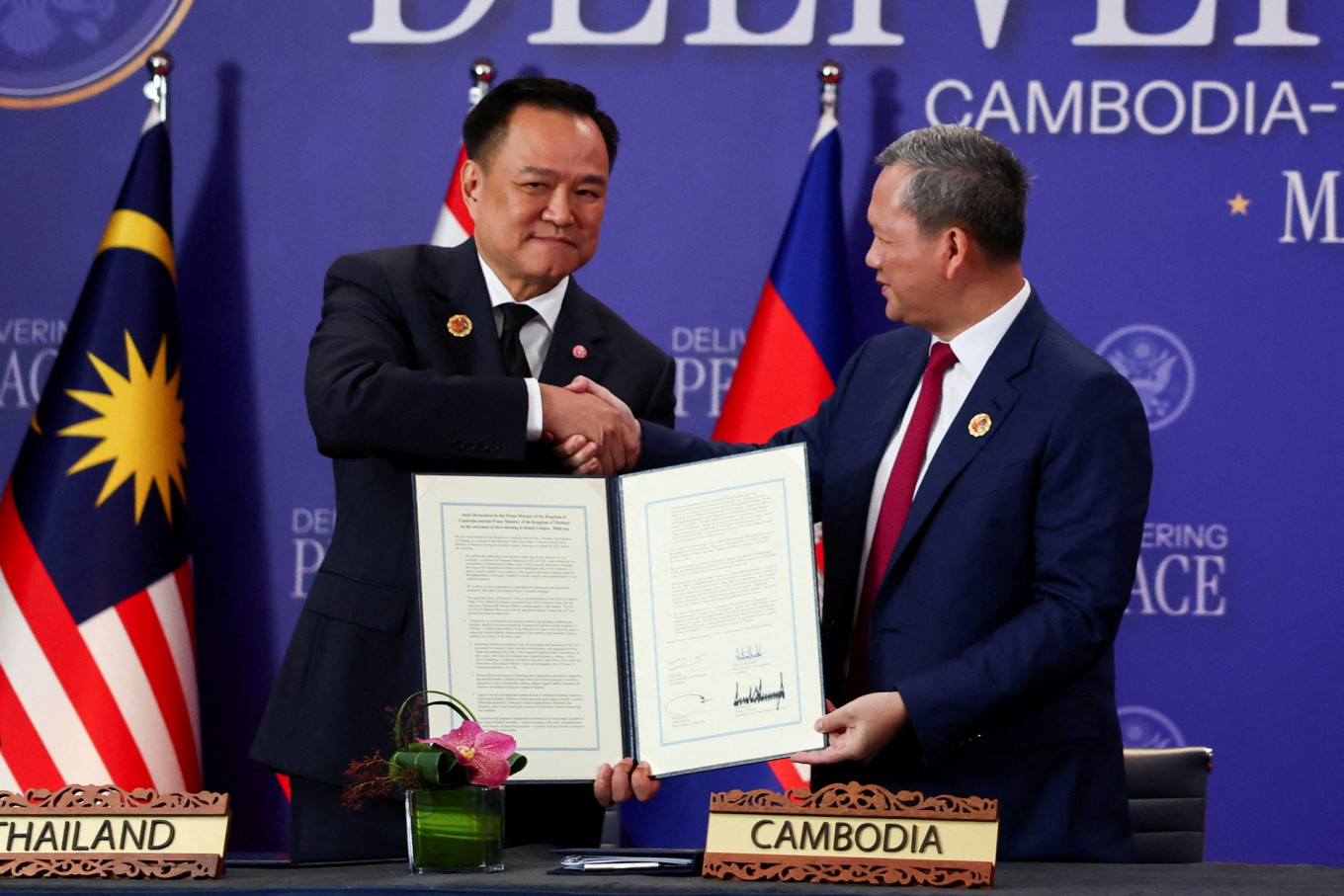 Thailand's Prime Minister Anutin Charnvirakul (left) and Cambodia's Prime Minister Hun Manet shake hands and hold up a document during the Oct. 26, 2025, signing of a ceasefire deal between Cambodia and Thailand on the sidelines of the 47th ASEAN summit in Kuala Lumpur. (Reuters/Evelyn Hockstein)
A
s the new year begins, people often set hopes, targets and expectations for a better year ahead. A new year is not only a fresh page, it is also a continuation of what came before: What went wrong? How were problems handled? And how should we address them better this year? The same questions apply to Southeast Asia’s regional bloc ASEAN.
Last year, Dino Patti Djalal captured the global mood in his keynote speech at the Conference on Indonesian Foreign Policy (CIFP) 2025: “The next world order is upon us […] we are really seeing a world that is going in the wrong direction.” Michael Beckley echoed this in Foreign Affairs, describing today’s world as “a closed club of aging incumbents, circled by middle powers, developing countries and failing states.” The world is clearly in transition, and the sharpest contours of that transition lie in the Indo-Pacific.
The Indo-Pacific strategic landscape in 2025 was the most fragile in decades. In Southeast Asia, once described by Amitav Acharya as having “met its security community,” a region bound by high levels of trust was shaken by the new border conflict between Thailand and Cambodia. Meanwhile, Myanmar’s civil war and humanitarian crisis show no sign of ending.
What 2025 ultimately revealed is how far the Indo-Pacific has drifted from the visions ASEAN and its partners once championed through the ASEAN Outlook on the Indo-Pacific (AOIP) and the Free and Open Indo-Pacific (FOIP).
The region may have delivered ports, railways and connectivity agreements, but these achievements have not stopped the broader vision of a free, open, inclusive and rules-based Indo-Pacific from slipping further away. Instead, the region spent much of last year trapped in a state of “hot peace,” where rising tensions, mistrust and militarization overshadowed cooperation.
The gap between aspiration and reality widened, and any miscalculation risked pushing the region even further from the order it claims to pursue.

This gap stems from four underlying realities. First, trust deficits are widening, and conflicts are emerging across the region. Second, the appetite to connect the Pacific and Indian Oceans through multilateral frameworks such as the AOIP remains limited. Third, China continues to prioritize its own initiatives, the Belt and Road Initiative (BRI) and the Shanghai Cooperation Organization (SCO), over ASEAN-led Indo-Pacific mechanisms. Fourth, connectivity projects meant to link the Indian and Pacific Oceans have not produced meaningful integration.