TheJakartaPost
Please Update your browser
Your browser is out of date, and may not be compatible with our website. A list of the most popular web browsers can be found below.
Just click on the icons to get to the download page.


Popular Reads
Top Results
No results found. Please check your search term and try again
Can't find what you're looking for?
View all search results
Popular Reads
Top Results
No results found. Please check your search term and try again
Can't find what you're looking for?
View all search resultsLeveraging rare earths: A pathway to national resilience
Despite its abundance of strategic minerals, the country still relies on imports to meet domestic demand for processed rare earth products.
Change text size
Gift Premium Articles
to Anyone
Share the best of The Jakarta Post with friends, family, or colleagues. As a subscriber, you can gift 3 to 5 articles each month that anyone can read—no subscription needed!
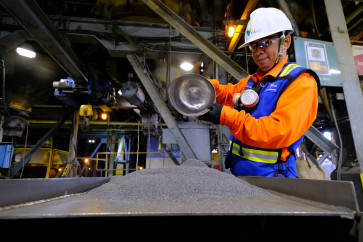
 A worker monitors production on Aug. 2, 2024, at the nickel smelter of PT Vale Indonesia in Sorowako, South Sulawesi. Nickel is a key component in the batteries of electric vehicles, and Indonesia is both the world’s largest producer and home to the biggest known reserves globally. (AFP/Muchtamir Zaide)
I
ndonesia sits on a geological goldmine of Rare Earth Elements (REE), with significant potential contained within tin, bauxite and nickel by-products across Bangka Belitung, Kalimantan and Sulawesi. Yet, the nation remains constrained by limited processing capacity, low technological readiness and regulatory inconsistencies.
While recent downstreaming policies represent critical initial steps toward supply chain integration, their effectiveness hinges on policy coherence, investment certainty and cross-sector collaboration. To strengthen national resilience, Indonesia must transition from a passive resource holder to an active, geostrategically informed player in the global supply chain.
Institutional momentum accelerated in August last year with President Prabowo Subianto’ establishing the Mineral Industry Agency. Tasked with managing strategic defense resources, specifically rare earths and radioactive minerals, the agency operates on a tripartite mandate: optimizing extraction, safeguarding these resources as vital national assets and driving the downstream production of high-value goods.
The growing global demand for REEs presents a specific window of opportunity for Indonesia. However, a paradox remains: despite its abundance of strategic minerals, the country still relies on imports to meet domestic demand for processed rare earth products, including lanthanum, cerium and neodymium. Indonesia is currently at an early exploration stage, lacking sufficient refining capacity or advanced metallurgical technologies.
This condition stands in sharp contrast to China, which controls the entire value chain from upstream to downstream, allowing it to produce high-value components with significant economic returns.
To transcend this vulnerability, Indonesia has adopted a downstreaming policy aimed at building domestic smelters and processing facilities. The goal is to enable domestic industries to transform raw ore into semi-processed materials ready for industrial application, rather than exporting raw value abroad.

The government reinforced this approach by enacting the fourth amendment to the Mineral and Coal Mining Law in February 2025. This regulatory shift reflects a stronger orientation toward value-added production and the integration of mineral resources into the national strategic agenda.