TheJakartaPost
Please Update your browser
Your browser is out of date, and may not be compatible with our website. A list of the most popular web browsers can be found below.
Just click on the icons to get to the download page.


Popular Reads
Top Results
No results found. Please check your search term and try again
Can't find what you're looking for?
View all search results
Popular Reads
Top Results
No results found. Please check your search term and try again
Can't find what you're looking for?
View all search resultsThe desacralization of nature and disaster
The transition from traditional belief systems toward formal religiosity has brought an unintended side effect: a reckless desacralization of nature
Change text size
Gift Premium Articles
to Anyone
Share the best of The Jakarta Post with friends, family, or colleagues. As a subscriber, you can gift 3 to 5 articles each month that anyone can read—no subscription needed!
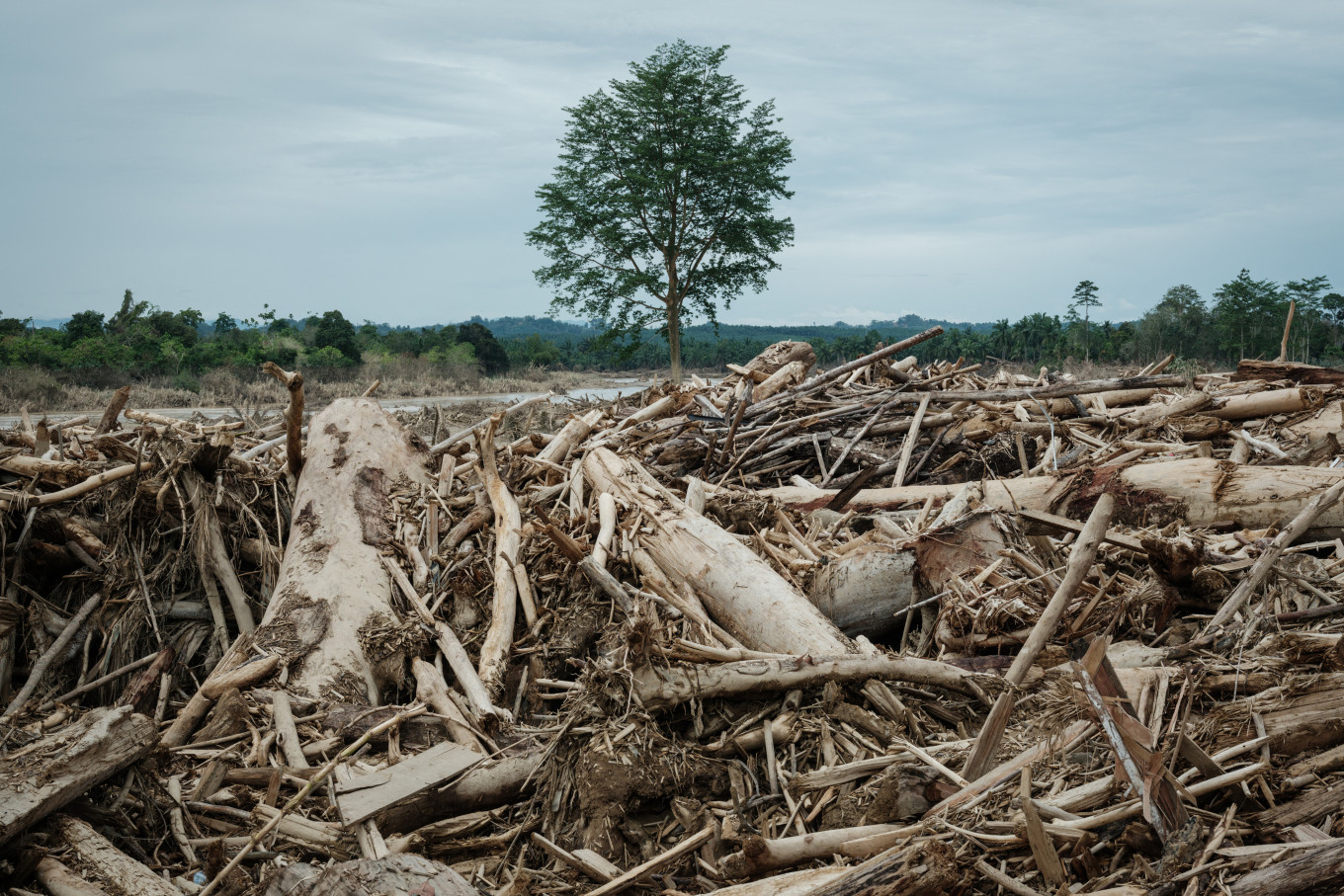 Tree carnage: Logs swept in by flash floods weeks earlier lie piled on Dec. 14, 2025, where homes once stood along a river in Aceh Tamiang, North Sumatra. (AFP/Yasuyoshi Chiba)
I
n the past few weeks, Indonesia has been cloaked in a repetitive veil of grief. Flash floods tear through residential areas, and landslides bury dreams on the slopes of hills. If disasters were once perceived as the "wrath of forest guardians" or "messages from mystical powers," that narrative is now fading. In the contemporary era, the discourse on disaster has shifted into mere technical data: rainfall in millimeters, slope gradients in degrees or material losses valued in billions of rupiah.
Anthropologically, this phenomenon indicates a fundamental shift in how Indonesians view their living space. The transition from traditional belief systems, steeped in mystical-ecological nuances, toward formal religiosity, specifically Islam, has brought an unintended side effect: a reckless desacralization of nature. Nature is no longer viewed as a living, authoritative entity, but as a dead object ready for commodification.
In anthropological discourse, traditional societies often implement what is known as "sacred fear-based environmental ethics". Terms like wingit (sacred/forbidden), angker (haunted), or keramat (shrine-like) are not mere superstitious nonsense. These terms are instruments of social control used to maintain ecosystem balance. When a protected forest is labeled angker, a psychological barrier automatically prevents residents from disturbing it. No one dares to fell ancient trees or clear land for palm oil, fearing kualat (divine retribution) or interference from supernatural forces.
This is preventive local wisdom. Forests remained green not because of patrolling forest rangers, but because of a cosmological awareness that nature has "inhabitants" who must be respected. However, as religious purification movements have strengthened, such beliefs have been purged. Anything carrying a mystical scent is labeled as superstition, khurafat (myth), or most extremely, shirk (polytheism).
Unfortunately, this purification process is often hijacked by political and economic interests. Authorities frequently manipulate religious terminology to smooth the path for destructive development agendas. In the name of "eradicating shirk," traditional environmental protections are dismantled. Areas once protected as sacred are now easily leveled by bulldozers after a narrow religious narrative convinces residents that respecting an old tree is an act of equating others with God.
At this juncture, nature-blind development finds its momentum. Once nature is emptied of its sacred values, it becomes a pure commodity. Mountains are hollowed out for mines, forests are converted into monoculture plantations, and water catchment slopes are choked with concrete villas. Developers hide behind formal legality and often use religious narratives to silence the critical voices of indigenous communities holding onto local wisdom. Ironically, the same communities that once guarded nature out of "fear" of the mystical now harbor no fear at all, believing nature is merely God’s creation to be used at will without ethical responsibility.

It is crucial to emphasize that this shift is not the fault of religion itself. In Islam, for instance, not a single verse or hadith commands humans to destroy the Earth. On the contrary, the concept of Khalifah fil Ardh (stewardship on Earth) emphasizes the human role as a guardian, not an absolute ruler. Corruption on land and sea is explicitly mentioned in the holy text as a result of human hands (Surah Ar-Rum verse 41).