TheJakartaPost
Please Update your browser
Your browser is out of date, and may not be compatible with our website. A list of the most popular web browsers can be found below.
Just click on the icons to get to the download page.


Popular Reads
Top Results
No results found. Please check your search term and try again
Can't find what you're looking for?
View all search results
Popular Reads
Top Results
No results found. Please check your search term and try again
Can't find what you're looking for?
View all search resultsVenezuela and the dangerous return of might makes right
Learning from the Venezuela invasion, Indonesia should continue to position itself as pro-law, pro-stability, pro-development and firmly opposed to military interventions, or worse, a new form of colonialism.
Change text size
Gift Premium Articles
to Anyone
Share the best of The Jakarta Post with friends, family, or colleagues. As a subscriber, you can gift 3 to 5 articles each month that anyone can read—no subscription needed!
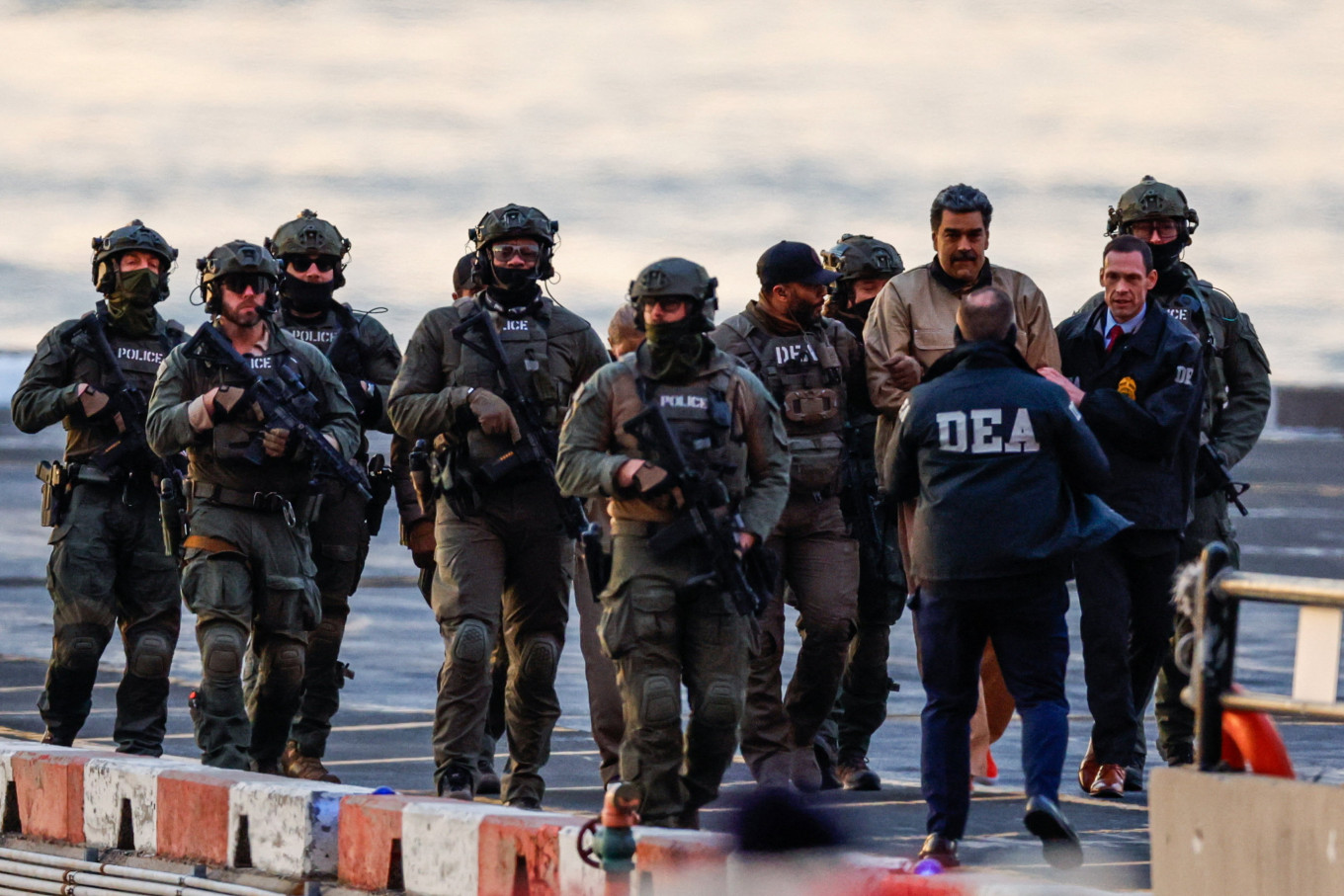 Bold operation: Captured Venezuelan President Nicolas Maduro arrives on Jan. 05, at the Downtown Manhattan Heliport as he heads toward the Daniel Patrick Manhattan United States Courthouse for an initial appearance to face US federal charges including narco-terrorism, conspiracy, drug trafficking, money laundering and others in New York City, the US. (Reuters/Eduardo Munoz)
B
efore dawn broke over Caracas, the operation was already over. In a swift, tightly coordinated raid involving elite United States special forces, intelligence assets and covert operators, Venezuelan President Nicolas Maduro was seized and flown out of his own capital, alive, detained and bound for a courtroom thousands of kilometers away.
The speed and precision of the operation left little room for resistance, let alone consent. There was no declaration of war, no United Nations mandate and no multilateral process. Instead, overwhelming force was applied in a matter of hours to remove a sitting head of state from the territory of a sovereign country.
What unfolded was not a conventional invasion, but something arguably more unsettling: a display of the speed, secrecy and coercive reach of the world’s most powerful military imposing law enforcement on the territory of another sovereign state, without consent, notification, or legal authorization.
From the standpoint of international law, this distinction matters less than Washington may suggest. Article 2(4) of the UN Charter is explicit: members shall refrain from the threat or use of force against the territorial integrity or political independence of any state. The absence of occupation does not sanitize the incursion.
This time might makes right is back in a different package. The language used by senior US officials following the operation was telling. There was little attempt to cloak the action in moral universalism or democratic obligation. Instead, the justification was blunt: the US acted because it could.
Power, not legitimacy, was the operative logic. This is not the liberal rules-based order Washington once claimed to defend. It is a return to great-power prerogative, updated for the age of precision warfare.

The implications extend far beyond Latin America. If even a sitting president can be removed through force, then restraint becomes a liability. The act has shown that respect from great powers may only be granted once deterrence is firmly in place. In such an environment, nuclear capabilities will be guarded even more jealously by hardened regimes, while sustained force accumulation will appear less as provocation and more as necessary insurance.